

The single best way to protect quality and landed cost on a bulk hardware order is to run eight steps in sequence: lock the specification, approve a control sample, plan lot-based inspection, standardise packaging, score your suppliers, negotiate MOQs against a real forecast, stagger delivery to match site capacity, and set measurable reorder triggers before you ever place the order. Skip any one of these and you inherit risk that shows up weeks later as a chargeback, a failed inspection, or a van full of the wrong gaskets.
We've built this checklist from how trade buyers actually operate, not from theory. Here's the sequence:
- Freeze the specification — drawings, material grade, finish and tolerance, signed off before quoting.
- Approve a golden sample — physically retained, referenced at every incoming inspection.
- Write an inspection plan by lot — using a recognised method such as ANSI/ASQ Z1.4 sampling.
- Standardise packaging and labelling — site codes, PO numbers, and moisture protection specified in writing.
- Score suppliers on a simple matrix — lead time stability, certification, and capacity, not price alone.
- Set MOQs against a real forecast, not a guess — most suppliers start negotiating around ten identical units (learn more about construction workforce planning to improve your demand forecasting).
- Stagger delivery to match a 12 to 16 week deployment horizon so you're not warehousing six months of stock.
- Set a reorder trigger tied to utilisation or safety-stock minima, not to who shouts loudest on site.
The order that goes wrong is rarely the one with a bad supplier. It's the one with a vague spec, no retained sample, and no plan for what happens when a lot fails inspection.
Commission the sample, freeze the spec in writing, and set your first reorder trigger before the purchase order goes out. Everything below explains why each step earns its place.
Key Takeaways
Consistent quality on bulk hardware orders depends on frozen specifications, retained control samples, lot-based inspection, and reorder triggers set before the purchase order is placed.
| Point | Details |
|---|---|
| Freeze the spec first | Confirm drawings, material grade, finish and tolerance in writing before requesting quotes. |
| Retain a golden sample | Approve and physically keep a reference sample for every incoming inspection. |
| Inspect by lot, not by order | Set sample sizes and acceptance thresholds at pre-production, in-process, pre-shipment and arrival stages. |
| Negotiate beyond unit price | Forecasts, bundled services and staggered delivery typically save more than chasing a lower per-unit rate. |
| Order through a trade partner | Windowhardwarestore offers trade pricing with no minimum order and real-time stock visibility to support staged, forecast-led bulk buying. |
Table of Contents
- Best practices for bulk hardware orders start with the specification
- Approve, archive and reference control samples
- Standardise finish and tolerance language across every order
- Plan inspection and quality control by lot, not by order
- Get packaging and labelling right before it's too late
- Build a supplier evaluation scorecard that actually works
- Negotiate MOQs, pricing and payment terms with a real forecast
- Plan lead times, staggered delivery and site drop-shipping
- Set reorder triggers, safety stock and asset-tracking rules
- Final checks before shipment and on arrival
- Trade-ready templates worth reusing
- Frequently asked questions
- Sources
Best practices for bulk hardware orders start with the specification
Ambiguous specifications cause more disputes than any other single failure in bulk procurement. A supplier who receives a vague drawing will make reasonable assumptions, and reasonable assumptions rarely match what you actually needed on site. By the time 500 hinges arrive with the wrong finish, you're negotiating a partial credit instead of fitting doors.
A usable specification needs every one of these fields, not just the obvious ones:
- Drawing reference and part number, version-controlled so nobody quotes against an outdated revision.
- Material grade and, where relevant, heat treatment or hardness rating.
- Surface finish and coating specification, stated as a code rather than a description like "silver".
- Critical dimensions with explicit tolerance bands, not "standard tolerance".
- Assembly orientation, especially for handed hardware like gearboxes and multipoint locks.
- Packaging unit and packing method (bagged in pairs, boxed in 25s, palletised).
- Labelling and handling instructions for the outer carton.
- Test criteria and the acceptable defect rate for the batch.
Paste that list into your RFQ template and require suppliers to confirm each field back to you in writing before sampling begins. A five-minute confirmation step now saves a three-week rework cycle later.
Pro Tip: The field buyers forget most often is assembly orientation. It sounds trivial until 2,000 handed door handles turn up built for the wrong side, and you're paying return freight on stock that was technically "in spec" everywhere else.
Approve, archive and reference control samples
A retained golden sample stops mixed-lot quality drift before it starts. Without one, "matches the last order" becomes a subjective argument between you and the supplier, and subjective arguments rarely resolve in the buyer's favour once goods are already fitted.
Run the approval process in four steps:
- Request a pre-production sample and inspect it against the frozen specification, not against memory of a previous batch.
- Sign off approval in writing, naming who approved it and on what date, with photographs attached to the record.
- Retain a physical sample in a labelled, accessible location, not just a photo on a phone.
- Reference that retained sample explicitly during every incoming inspection for the life of the order relationship.
First-article approval should confirm five things before you sign off: dimensional accuracy, surface and finish quality, functional performance under load, a serial or batch marking system, and confirmation the packaging matches what was agreed. Bulk procurement should verify supplier process capability using multi-piece samples, because a single sample can pass while the production run drifts.
Keep the retained sample for the full duration of the supply relationship, or at minimum through two full reorder cycles. That single reference object resolves more disputes than any email thread ever will.
Standardise finish and tolerance language across every order
Vague finish language is one of the most expensive habits in bulk hardware buying. "Silver finish" means something different to every anodiser, plater and powder-coater you'll ever deal with, and that gap only surfaces once 1,000 units are sitting in a warehouse looking slightly wrong.
Write finish and tolerance calls the way a toolroom would, not the way a sales brochure would:
- Finish code: "RAL 9016 matt powder coat, 60 to 80 micron film thickness" beats "white finish" every time.
- Coating description: name the process (electro-galvanised, anodised, PVD) alongside the visual outcome.
- Tolerance statement: "±0.1mm on all bore diameters, ±0.5mm on overall length" rather than "standard tolerance".
- Permitted variance: state explicitly if batch-to-batch colour variance within a defined delta is acceptable, and lock it down in writing if it isn't.
A buyer who once accepted "close match" plating across two production runs discovered the alternate plating vendor used a different base alloy, and the whole batch corroded faster than the approved sample. A single clause, "no substitution of plating vendor without written approval," would have prevented six months of warranty claims. Standard language costs nothing to write and saves real money the first time a subcontractor changes.
Plan inspection and quality control by lot, not by order
Inspecting a whole order only once it's fully built is how a single tooling fault becomes 2,000 defective units instead of twenty. Lot-based inspection catches drift while it's still cheap to fix.
A workable inspection plan defines sample size per lot, the checkpoints that matter, and what happens when something fails:
- Confirm material certificates against the specification before production starts.
- Check critical dimensions with calibrated gauges on a statistically meaningful sample, not "a few off the top".
- Measure plating or coating thickness where corrosion resistance matters.
- Run functional tests on locking mechanisms and gearboxes under realistic load, not just by hand.
- Record pass/fail results against a written acceptance threshold, agreed before the order was placed.
Recommended sampling methods, such as ANSI/ASQ Z1.4, give you a defensible acceptance quality limit rather than a gut-feel pass rate. When a lot fails, the escalation path should already exist on paper: rework at the supplier's cost, sort the lot for conforming units, reject outright, or file a formal claim, depending on the severity and the defect rate against your agreed threshold.
Timing matters as much as method. Aligning inspection to four production milestones, pre-production, in-process, pre-shipment and on-arrival, catches problems while they're still a phone call rather than a container full of returns.

Get packaging and labelling right before it's too late
Packaging is one of the most underestimated cost drivers in bulk hardware procurement. The cheapest packing option often looks fine on the quote and then generates the most damage claims and the slowest goods-in process once the pallet actually arrives.
Build a packaging checklist into every purchase order:
- Specify primary inner packaging: bagged, boxed, or blister-packed, matched to the fragility of the item.
- Confirm carton marking includes PO number, SKU, and quantity, visible without opening the box.
- Require partitioning or foam inserts for anything with a plated or polished finish that scratches easily.
- Ask for moisture protection on anything travelling by sea freight or sitting in unheated storage.
- Set labelling standards for multi-site orders: site code, delivery address, and a serial manifest per carton.
Retail-ready packaging suits small accessory runs going straight to a counter. Bulk cartons suit large fit-out orders going to a single warehouse. Choosing the wrong one either wastes money on unnecessary presentation or creates a goods-in nightmare when nobody can tell which carton belongs on which site. Packaging choices materially affect handling labour and return rates, and a well-designed packaging approach protects hardware from the moment it leaves the factory to the moment it's fitted.
Pro Tip: Ask suppliers for photos of their standard packing method before you order, not after a damaged shipment arrives. A five-minute review catches thin foam and loose partitioning that would otherwise show up as scratched handles three weeks later.
Build a supplier evaluation scorecard that actually works
A short, repeatable scorecard saves more procurement time than any amount of extra reading through supplier brochures. Score every candidate on the same dimensions and the subjective "they seem reliable" judgement disappears.
Weight these dimensions when comparing suppliers for a bulk hardware order:
- Lead time stability across the last three to five orders, not just the quoted figure.
- Documented process capability, including how they control dimensional consistency across a production run.
- Material certification and traceability back to the mill or foundry.
- Their own inspection regime, and whether they'll share reports without being asked twice.
- Packaging capability matched to your product category.
- Warranty terms and how disputes are actually resolved in practice, not just on paper.
- Confirmed capacity to repeat the order at the same quality six months from now.
Request documentary evidence, not verbal assurance: material certificates, ISO or BS certifications, sample inspection reports, packing photographs, named production lines, references from other trade buyers, and a written RMA policy.
For trade buying, weight reliability above price on the scorecard. Consolidating the bulk of your routine purchases with two or three primary vendors unlocks better account support and volume tiers than spreading spend thinly across a dozen suppliers chasing the lowest unit price on every line.
Negotiate MOQs, pricing and payment terms with a real forecast
Unit-price discounts get most of the attention in bulk negotiations, but they're rarely the biggest lever available. Forecasting, bundling and service scope typically move the total cost further than shaving a few pence off a per-unit rate.
Most suppliers start treating an order as genuinely "bulk" at around ten identical units or a basket value above €10,000, with deeper discounts and hold-stock arrangements typically opening up at 50 units or more. Below that threshold, don't expect meaningful movement on price. Above it, you have real leverage, especially if you can commit to a documented forecast.
Levers worth negotiating beyond the headline unit price:
- Bundling accessories or complementary hardware into the same purchase order.
- Pre-configuration or pre-imaging where relevant to the product category.
- Asset tagging applied at the supplier's facility rather than yours.
- A single consolidated warranty across the batch rather than per-unit warranty registration.
- Staggered delivery locked at a single agreed price.
- Extended payment terms, Net 30 or Net 60, in exchange for volume commitment.
- Hold-stock arrangements that let you draw down units against a locked price over several months.
A credible written forecast, even a non-binding one, often unlocks better pricing tiers without forcing you to commit capital up front. Send suppliers a short forecast brief: expected annual volume by quarter, a conservative and an aggressive scenario, your preferred delivery cadence, and a request for tiered pricing against each volume band. That single document does more negotiating work than a phone call ever will.
Plan lead times, staggered delivery and site drop-shipping
Taking an entire bulk order on one delivery date creates two problems at once: nowhere to store it, and a spike in goods-in labour nobody planned for. Staggering delivery against a locked price solves both without costing you the volume discount.
A sensible staggered schedule looks like this:
- Confirm the full purchase order and lock pricing across the whole volume upfront.
- Agree a delivery cadence, commonly four to six week intervals across a 12 to 16 week window.
- Nominate delivery quantities per drop that match your actual fitting schedule, not round numbers for convenience.
- Build in a buffer drop at the end for snagging and replacement stock.
For multi-site jobs, drop-shipping direct to site removes a full handling step. Each site needs its own instructions: full delivery address, site contact name and number, labelling that matches the site code on your purchase order, and any specific acceptance criteria (a signature, a photo of the delivered pallet, or a named receiving contact).
Staggered delivery and direct-to-site drop-ship are arrangements most suppliers will accommodate without an uplift, provided you agree the full schedule before the order is confirmed. Ask for staggering after the fact, mid-production, and you'll usually pay for the privilege.
Set reorder triggers, safety stock and asset-tracking rules
Reordering on gut feel is how procurement teams end up either running out mid-project or sitting on six months of dead stock. A measurable trigger removes the guesswork entirely.
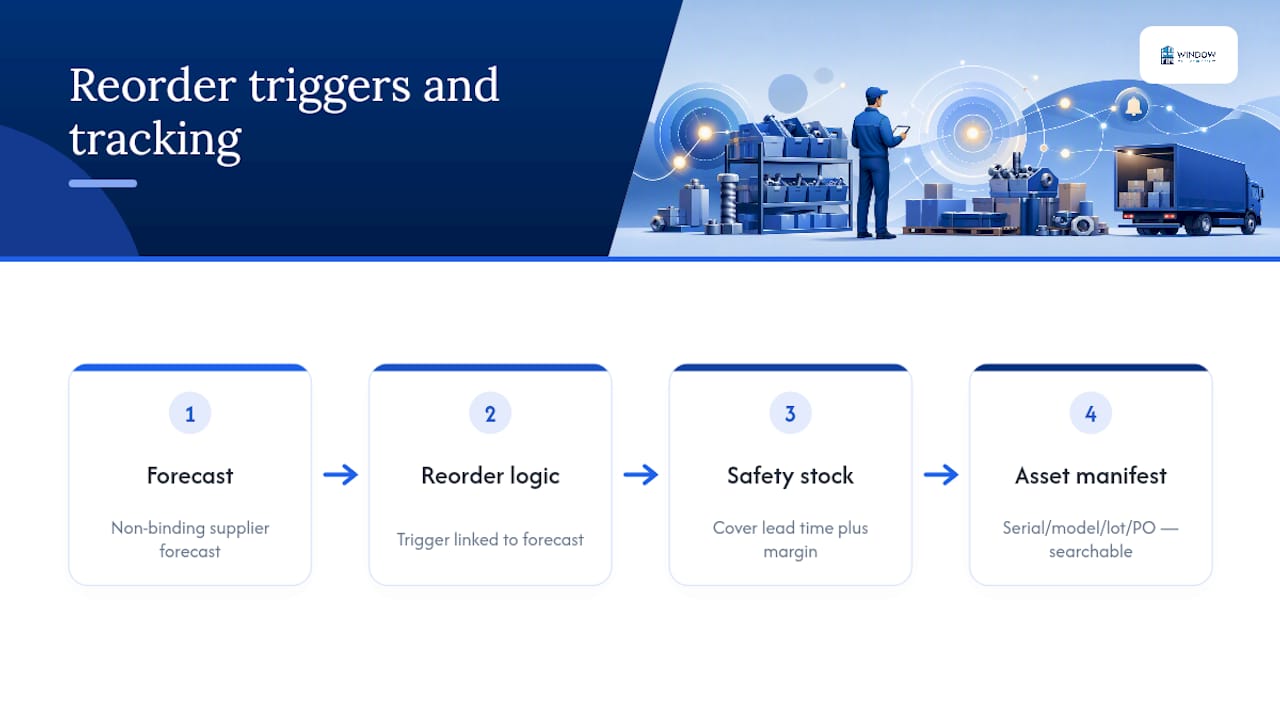
If lead time is eight weeks, your safety stock needs to cover consumption for at least that long, plus a margin for delay.
Request an asset manifest from every supplier alongside the delivery: serial numbers, model, lot number, PO reference, delivery date, destination site, and the installer or van it's assigned to. That manifest turns a pallet of boxes into a searchable record the moment it lands, which matters enormously the first time a warranty claim needs proof of purchase date and batch.
Reorder logic works best when it's linked back to the forecast you gave your supplier at negotiation stage. A non-binding forecast used to secure better pricing also gives you a benchmark to check actual consumption against, so you can spot early if a project is running faster or slower than planned. Standardising on a smaller core catalogue of universal window handles rather than a dozen near-identical SKUs also makes the reorder maths considerably simpler.
Final checks before shipment and on arrival
A short arrival checklist resolves most disputes before they escalate into a formal claim. Skip it, and you discover the shortfall weeks later, long after the supplier's goodwill window has closed.
On receipt, check five things immediately:
- Confirm carton count against the delivery note before signing for anything.
- Visually inspect for transit damage on the outer packaging, not just the contents.
- Pull a random sample and check it against your retained golden sample.
- Reconcile the serial manifest against what was actually delivered.
- Run a functional test on any safety-critical item, such as locking mechanisms, before it goes anywhere near a job.
If something's wrong, notify the supplier within the window stated in your terms, usually 48 to 72 hours, and collect evidence immediately: photographs, the retained sample for comparison, and the delivery note. Quarantine the affected units, decide quickly whether partial acceptance makes sense for the conforming portion, and open a formal return or credit claim with that evidence attached rather than a verbal complaint.
Trade-ready templates worth reusing
Real templates save procurement teams from rebuilding the wheel on every order. A spec template, a sample approval form, a supplier scorecard and a packaging checklist, each one used consistently, turns bulk buying from a one-off negotiation into a repeatable process.
- Spec template: the field list from earlier in this guide, adapted per product category.
- Sample approval form: records who signed off, when, and against what criteria.
- Supplier scorecard: the seven-dimension matrix used at RFQ stage.
- Packaging checklist: inner packing, carton marking and labelling standards.
For sizing the order itself, a quantity calculator built for window contracts turns a rough estimate into a defensible number before you ever send an RFQ.
A template only earns its place if someone actually uses it on the next order. The value isn't in having the document. It's in the habit of reaching for it every time.
Author's perspective: priorities for busy trade buyers
When time is short, protect three things first: the specification, the delivery schedule, and the asset trail. Freeze the spec in writing before quoting. Stagger delivery against your actual site capacity, not round numbers. Track every serial from goods-in onward. Most trade buyers who run into trouble haven't got a supplier problem. They've got a storage or onboarding capacity problem they didn't plan for at the negotiation stage.
How Windowhardwarestore helps with bulk trade orders
Windowhardwarestore removes the guesswork from bulk hardware buying by putting real-time stock visibility in front of every trade order, so you're negotiating quantities against actual availability rather than a supplier's best guess. Trade pricing applies from the first order, with no minimum quantity forcing you to overbuy just to unlock a discount.
Whether you're standardising on a core catalogue of gaskets across multiple sites or bundling patio door handle sets into a single fit-out order, our support team handles the complex logistics that a standard checkout can't: staggered delivery, site-specific labelling, and reorder support tied to your actual project pace. Set up a trade account today and talk to our team about bulk pricing and staged delivery for your next order.
Frequently asked questions
What counts as a "bulk" hardware order? Most suppliers start treating an order as genuinely bulk at around ten identical units or a basket value above €10,000, with deeper discounts typically opening up at 50 units or more.
How many samples should I approve before placing a bulk order? A single pre-production sample confirms design intent, but multi-piece sampling across the production run catches consistency drift that one unit can't reveal.
Do staggered deliveries cost more than a single bulk delivery? Usually not, provided the full order and pricing are locked upfront. Suppliers commonly accommodate staggered delivery without an uplift when it's agreed before production, not requested afterwards.
What documents should I request from a new bulk hardware supplier? Material certificates, relevant ISO or BS certifications, sample inspection reports, packing photographs, and named references from other trade buyers.
How do I stop overbuying on a bulk hardware order? Build a forecast using conservative, base and aggressive scenarios tied to measurable demand drivers, and set a reorder trigger based on utilisation and safety stock rather than a single estimate.
Sources
For further reading on the figures and methods referenced above: the Irish procurement guide on bulk thresholds covers negotiation starting points and staggered delivery; the hardware bulk-buying checklist explains sampling and inspection milestones; the forecasting guide for large orders covers scenario planning; and the enterprise procurement guide explains vendor consolidation. Internally, our quantity calculator and packaging guide support the sizing and packaging checklists above.
- Buying IT Hardware in Bulk in Ireland: A Procurement Guide
- Hardware Tools Bulk Buying Guide for Hardware Suppliers
- Enterprise IT Hardware Procurement Guide — Best Practices for 2026