

If you've just opened a delivery and something is clearly wrong, do three things right now:
- Stop installation immediately. Never attempt to fit a part you suspect is incorrect. Forcing a wrong part risks damaging the frame and may void any warranty.
- Photograph everything. Capture the outer packaging, inner packing, labels, the part itself from multiple angles, and any visible damage. Do this before you move or discard anything.
- Contact your supplier with your order number, the SKU of the incorrect item, and your preferred outcome (refund or replacement). The faster you report, the faster this gets resolved.
Keep the original packaging and every small fixing, cover, and plug until your supplier confirms the return. Under the Consumer Rights Act 2015, goods that are "not as described" or faulty entitle you to repair, replacement, or refund. Whether the part is simply wrong or genuinely defective affects which remedy applies and who covers return postage, so that distinction matters from the outset.
Table of Contents
- How to inspect window parts correctly on delivery
- What evidence to collect and how to contact your supplier
- How the returns process works: RMA, packaging, and shipping
- Refunds vs replacements: timelines, deductions, and your legal rights
- Special cases: custom parts, trade orders, and safety-critical components
- How to avoid ordering the wrong parts in future
- How Windowhardwarestore handles wrong or damaged parts
- Key takeaways
- A fitter's perspective on avoiding returns
- Get the right parts quickly with Windowhardwarestore
- Useful sources and further reading
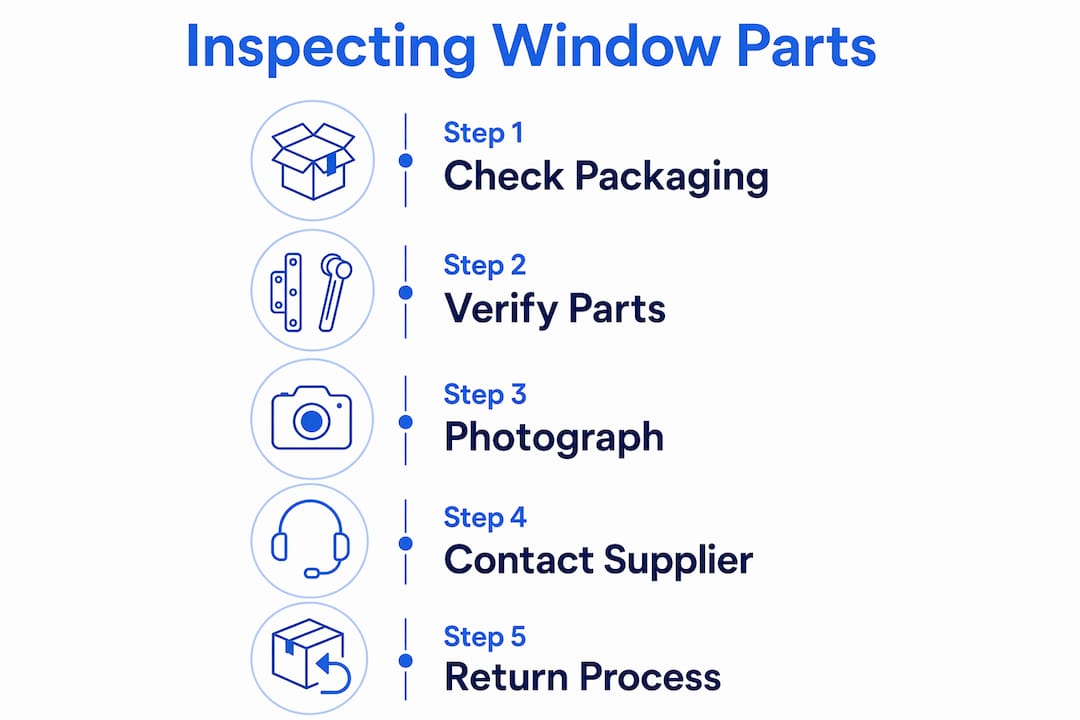
How to inspect window parts correctly on delivery
A consistent inspection routine takes less than ten minutes and can save days of back-and-forth with a supplier. Manufacturer installation manuals recommend checking for cosmetic damage, correct item, handing, colour, and the presence of all parts before you begin any installation work.
Step-by-step delivery inspection:
- Check the outer box first. Note dents, tears, crushed corners, and any discrepancy between the delivery label and your order confirmation. Photograph the box before opening it.
- Open carefully and compare the packing list to your invoice. Count every item, compare SKUs and part descriptions line by line, and confirm quantities match.
- Inspect each part for visible damage. Look for cracks, bent plates, stripped threads, and missing fixings. Check serial numbers and part numbers against your order.
- Test mechanical action where safe. Open and close hinges, operate handles, and check locking mechanisms by hand. Do not force anything.
- Record measurements. For gaskets, extrusions, and profiles, measure length, width, and thickness. Include a ruler or tape measure in at least one photograph for scale.
- Photograph sealed items intact. If a gasket or sealed pack is unopened, photograph the seals before breaking them. If you do test a part, note exactly what you tested and how.
Installation instructions for replacement windows specifically list included small parts and warn that missing fixings are a common cause of delays. Keep every small item in a labelled, sealed bag until the supplier confirms the delivery is correct.
Pro Tip: Set up a simple timestamped photo folder on your phone the moment a delivery arrives. Timestamps are accepted as evidence by most suppliers and carriers, and they take seconds to create.

What evidence to collect and how to contact your supplier
The single most effective way to shorten approval time is a complete evidence pack sent promptly. Supplier returns pages consistently show that clear photos and a concise description sent within 24–48 hours of delivery significantly reduce disputes and speed up approvals.
Mandatory evidence checklist:
- Order number and original invoice
- SKU or part number of the incorrect or damaged item
- Clear photographs of the damage or discrepancy (multiple angles)
- Photographs of the outer packaging, inner packing, and parcel label
- Parcel tracking number from the carrier
- Short video demonstrating any functional fault (stuck lock, misaligned hinge, and so on)
- Serial number or batch label photo if present on the part
Sample initial message (copy and adapt):
Keep the message short. Suppliers process dozens of claims daily; a concise, well-evidenced message with the order number in the subject line gets prioritised.
Pro Tip: Send your evidence within 48 hours of delivery. Include your preferred remedy in the first message so the supplier can action it without a follow-up exchange.
How the returns process works: RMA, packaging, and shipping
Most UK suppliers require a Return Merchandise Authorisation (RMA) number before they will accept a return. An RMA is simply a reference that links your return parcel to your claim on the supplier's system. Sending a parcel without one often means it sits unprocessed in a warehouse.
How to request an RMA:
- Contact the supplier by email or phone with your order number, the faulty or incorrect SKU, and a brief description of the issue.
- Attach your photo evidence at this stage.
- The supplier issues an RMA number and return instructions, including the correct return address.
- Write the RMA number clearly on the outside of the return parcel.
- Include a printed copy of your order confirmation or invoice inside the box.
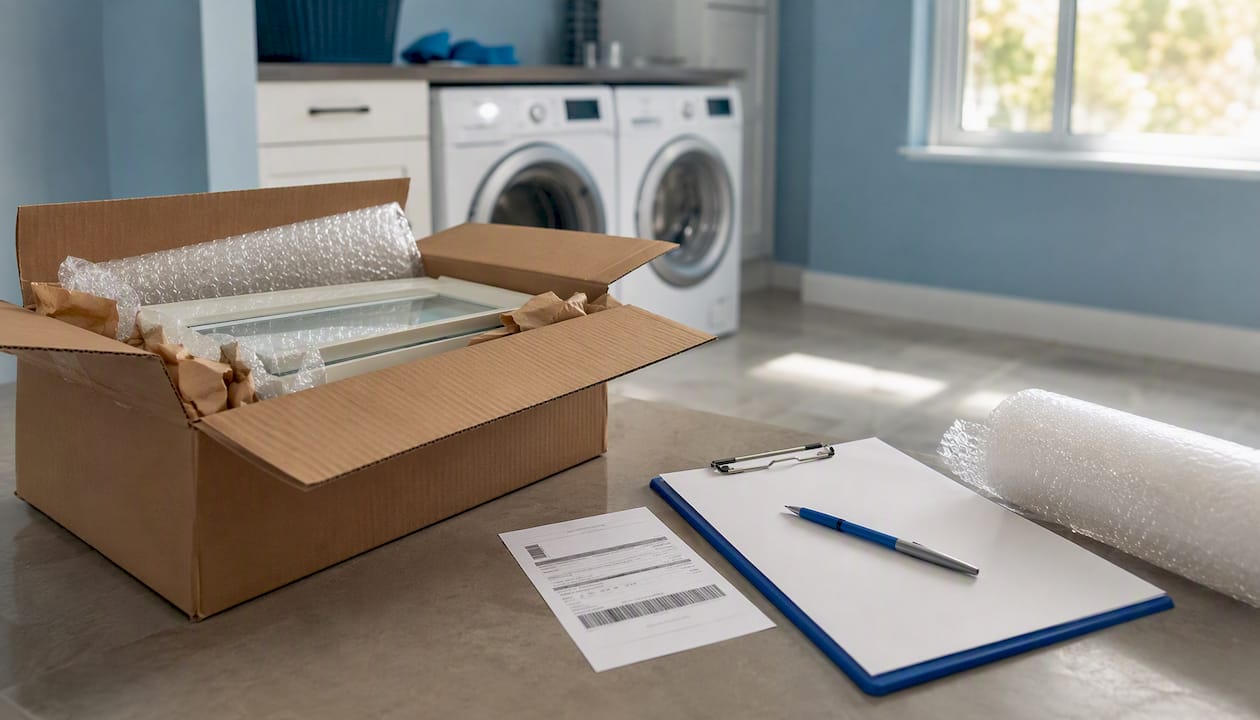
Packaging best practice for returns:
- Use the original inner packaging wherever possible; it is designed for the part.
- Wrap fragile components (hinges, gearboxes, locking mechanisms) in bubble wrap inside a sturdy outer box.
- Do not use a box that is significantly larger than the part; movement during transit causes further damage.
- Attach the RMA reference to the outside of the parcel in a clear plastic wallet.
Shipping: always use a tracked, signed-for, and insured service. Keep the tracking reference and proof of postage until your refund or replacement is confirmed. Royal Mail Tracked 48 or a courier such as DPD or Evri with declared value cover are practical options for most window hardware.
Carrier damage claims: if the carrier marks a parcel as delivered damaged, lodge a claim immediately and retain all packaging for at least 14 days. Carriers and insurers require the full pack-level evidence, including the outer box, inner packing, and timestamped photographs. Notify your supplier at the same time so they can support the claim.
Who pays for return postage? For faulty or wrongly supplied items, the seller is generally responsible for return postage costs under UK consumer law. For change-of-mind returns, the buyer typically covers the cost, and a restocking fee may apply.
Refunds vs replacements: timelines, deductions, and your legal rights
Knowing what to expect keeps you in control of the process. Here are the typical timelines for UK window hardware returns:
- Acknowledgement: 48–72 hours after you report the issue
- Inspection and decision: 7–14 days after the supplier receives the return
- Refund processing: 7–14 days after inspection is complete
- Replacement dispatch: dependent on stock; standard parts are usually dispatched within a few days, while bespoke or custom items can take 14–60 days
Common charges to be aware of:
- Restocking fees for change-of-mind or unwanted returns. Some seller policies apply a fee of up to 20% of the item value, and original shipping charges are usually non-refundable for buyer-initiated returns.
- No restocking fee for proven faulty or wrongly supplied items. Reputable suppliers handle faulty or incorrectly supplied items without a restocking charge and provide a return label once the claim is approved.
Your legal position under the Consumer Rights Act 2015: if goods are not as described or are faulty, you are entitled to a repair, replacement, or refund. For faulty goods, you have a short-term right to reject within 30 days for a full refund. After 30 days, the seller may offer a repair or replacement first. Keep all correspondence and proof of postage as evidence if a dispute arises.
If a refund is delayed: escalate to the supplier's customer support team, reference your RMA number and proof of postage, and set a clear deadline. If the supplier remains unresponsive, raise a dispute with your payment provider (most card providers and PayPal offer buyer protection). For persistent disputes, Citizens Advice and the Consumer Ombudsman are the appropriate escalation routes in the UK.
Special cases: custom parts, trade orders, and safety-critical components
Not every return follows the standard process. A few situations need a different approach.
Custom or made-to-measure parts are frequently non-returnable unless the supplier made an error. Always check the order terms before purchasing bespoke items. If a custom part arrives incorrectly made, document the discrepancy against the agreed specification and contact the supplier immediately. Some suppliers treat special-order items as non-returnable even when returned in original condition, so confirming the policy before ordering is worth the extra minute.
Trade and bulk orders carry their own logistics. Suppliers with trade accounts often offer partial shipment of correct items while the return is processed, or a "send replacement first" arrangement for established accounts. Verify quantities on delivery before signing the courier's paperwork; a signed delivery note that does not note discrepancies can complicate a later claim.
Safety-critical parts and on-site fitters: if a fixing, restrictor, or locking component is discovered to be wrong after partial installation, stop work immediately. Photograph the part in situ, keep the packaging, and contact the supplier for authorisation before removing or replacing anything. Attempting to force a wrong part risks frame damage and may void warranty clauses.
Pro Tip: For trade accounts, ask your supplier explicitly for "trade handling" when you report an issue. Priority RMA turnaround and swap-out replacement options are often available but not always advertised.
How to avoid ordering the wrong parts in future
Most incorrect-part situations start before the order is placed. A few habits at the measurement and ordering stage prevent the majority of returns.
Measurement checklist before ordering:
- Measure length, width, and thickness of the existing part.
- Note hole centres, spindle size, and backset for handles and locks.
- Confirm handing (left or right) for hinges and handles.
- Photograph the existing part next to a tape measure for scale.
- Note the manufacturer name and any visible part number from the existing component.
Our guide on measuring uPVC window parts covers each measurement in detail with diagrams, and it is worth bookmarking for any future replacement job.
SKU and part number verification:
- Always include the manufacturer part number in your order, not just a description.
- Cross-reference against supplier diagrams and compatibility charts. Our uPVC compatibility guide is a practical starting point.
- For gaskets and extrusions, documenting measurements with a scale in the photo removes most ambiguity when cross-referencing profiles.
- If you are unsure, contact the supplier's technical team before ordering. A two-minute call saves a two-week return.
Useful habits for tradespeople:
- Keep a labelled photo library for each window type at a property.
- Use a template measurement sheet for repeat jobs.
- For complex gearboxes or multi-component assemblies, request an exploded-diagram view or technical drawing. Common DIY door and window replacement mistakes often trace back to skipped measurement steps.
Pro Tip: Ask your supplier for a sample photo or technical confirmation for any non-standard part before placing the order. For complex gearboxes, a pre-fit check by phone with technical support is worth requesting.
How Windowhardwarestore handles wrong or damaged parts
When something is wrong with an order, Windowhardwarestore keeps the process straightforward. Here is how it works:
Step-by-step process:
- Report the issue: contact the team by phone or email with your order number, the SKU of the incorrect or damaged part, and your photos.
- RMA issued: if a return is required, an RMA reference is issued promptly so your parcel is processed without delay.
- Return instructions: you receive clear packaging and shipping instructions, including the return address and any label needed.
- Inspection and resolution: once the return is received, inspection is completed and a replacement is dispatched or a refund processed.
Trade account benefits: trade customers can request priority handling, which includes faster RMA turnaround and, where eligible, a replacement dispatched before the return is received. If you are a fitter with a job on site, mention this when you call so the team can assess same-day courier options.
When you contact us, include:
- Your order number and the SKU of the part in question
- Two or three clear photos of the fault or discrepancy
- Your preferred remedy (replacement or refund)
Windowhardwarestore offers real-time stock visibility across its full range of uPVC, composite, aluminium, and patio door hardware, which means replacement parts can usually be confirmed and dispatched quickly. Trade pricing is open to all customers, with no minimum order.
Pro Tip: Put your order number in the subject line of any email to the support team. It routes your message to the right person immediately and cuts response time.
Key takeaways
Resolving a wrong or damaged window part quickly comes down to three things: stopping work immediately, collecting solid photo evidence, and contacting your supplier with a clear, complete first message.
| Point | Details |
|---|---|
| Three immediate actions | Stop installation, photograph everything, contact the supplier with your order number and preferred remedy. |
| Evidence pack essentials | Order number, invoice, SKU, photos of damage and packaging, parcel tracking number, and video of any functional fault. |
| Packaging and postage | Use original inner packaging, tracked and insured return shipping; seller covers postage for faulty or wrongly supplied items. |
| Timelines to expect | Acknowledgement within 48–72 hours; refund or replacement decision typically within 7–14 days of the supplier receiving the return. |
| Windowhardwarestore support | Report by phone or email with order number and photos; trade accounts can request priority RMA and fast replacement dispatch. |
A fitter's perspective on avoiding returns
The returns process is well-documented, but the habits that actually prevent returns rarely make it into guides. Most wrong-part situations I have seen come down to one of two things: a measurement taken in a hurry, or an assumption that a part "looks the same" as the old one.
The fitters who rarely deal with returns keep a few simple habits. They label every bag of small fixings the moment a delivery is opened, photograph the handing of a hinge before removing it, and keep a spare box and sealed bags in the van specifically for evidence capture. None of that takes more than a couple of minutes, but it means that if something is wrong, the evidence is already there.
The more important habit is knowing when to stop. Attempting to fit a part that does not quite match, hoping it will work, is where most warranty problems begin. A wrong restrictor or a mismatched gearbox forced into place can damage a frame that costs far more to repair than the part itself. Stop, photograph, and call the supplier. That is always the right call, even when there is schedule pressure.
For safety-critical components, such as window restrictors and security locks, the threshold for stopping should be even lower. If there is any doubt about whether a part is correct, it should not go in. The replacing window handles safety guidance from Windowhardwarestore is a useful reference for the safety checks that apply before and during installation.
Get the right parts quickly with Windowhardwarestore
Wrong parts slow jobs down. Windowhardwarestore is built to minimise that disruption, with real-time stock visibility across the full range of uPVC, composite, aluminium, patio, and French door hardware, so you can see what is available before you order and avoid the wait.
Trade customers get priority support when something needs resolving fast. Report a wrong or damaged part by phone or email, include your order number and photos, and the team will issue an RMA and confirm your replacement or refund without unnecessary back-and-forth. For fitters with a job on site, same-day courier options for replacements are worth asking about when you call.
Whether you need a window restrictor, a gasket, or a full locking mechanism, browse the full range at Windowhardwarestore and contact the support team directly if you need help confirming the right part before you order.
Useful sources and further reading
The sources below back the key claims in this guide and are worth saving for reference when handling a return or checking installation requirements.
- Consumer Rights Act 2015 — the primary UK legislation governing your right to repair, replacement, or refund for goods that are faulty or not as described. Available at legislation.gov.uk.
- Windor Systems 1750 Series installation and QC manual — covers the delivery inspection checklist, QC steps, and packaging evidence requirements referenced in the inspection and carrier claims sections. Read the manual.
- Window Hardware Company: guide to identifying and ordering the right window parts — supports the measurement checklist and SKU verification guidance. Read the guide.
- Windowhardwarestore measurement guide — step-by-step instructions for measuring uPVC window parts accurately, with diagrams.
- Windowhardwarestore compatibility guide — uPVC parts cross-reference chart for SKU verification and part number matching.
- Citizens Advice — for escalating unresolved disputes with suppliers. Visit citizensadvice.org.uk for guidance on consumer rights and next steps.
This article provides general information about the window parts return process in the UK. It is not legal advice. For your specific situation, check the supplier's current returns policy and, where needed, seek guidance from Citizens Advice or a qualified professional.
Recommended
- Trade Guide: Essential uPVC Window Parts to Keep in Your Van | Window Hardware Store | Window Hardware Store
- Replacing Window Handles: Tools and Safety Tips | Window Hardware Store | Window Hardware Store
- Quick Swap Guide: Replacing Window Handles in 10 Minutes | Window Hardware Store | Window Hardware Store
- uPVC Window Parts Compatibility Guide: Cross-Reference Chart | Window Hardware Store | Window Hardware Store