

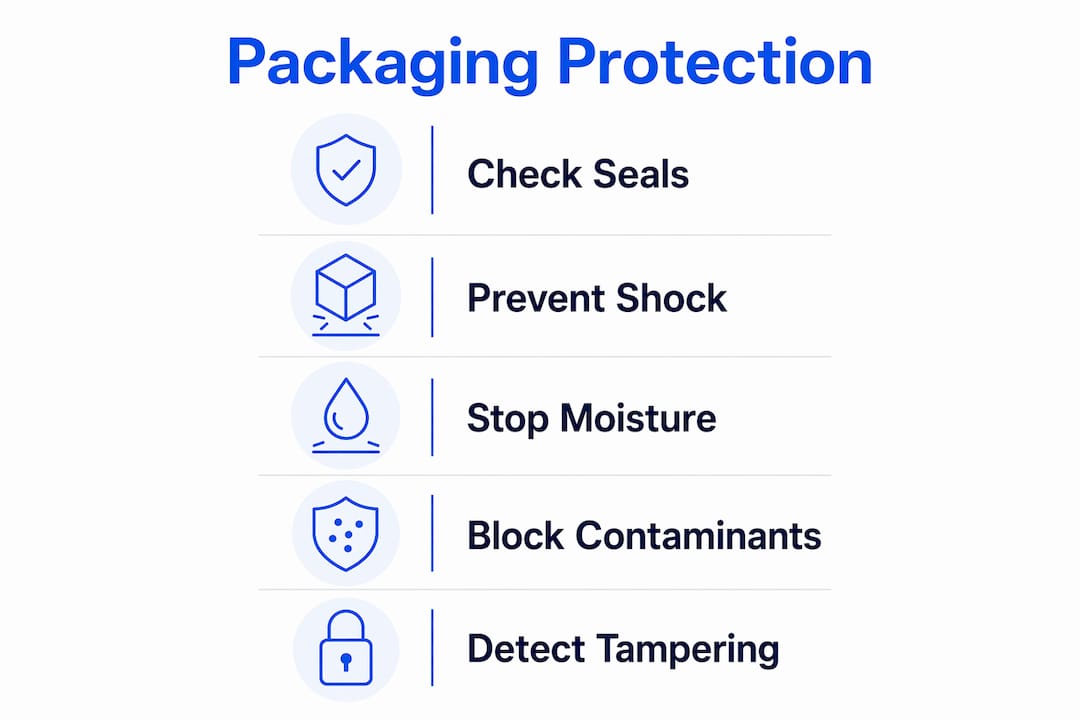
Correct packaging prevents mechanical damage, corrosion, contamination, and tampering so that window and door hardware arrives ready to fit straight away. The protective mechanisms at work are:
- Physical cushioning and immobilisation — foam inserts and corrugated walls absorb impact and stop parts shifting
- Moisture control — desiccants and barrier films suppress humidity that causes swelling and corrosion
- Corrosion inhibitors — VCI (vapour corrosion inhibitor) paper and bags release protective molecules around metal surfaces
- Particulate exclusion — sealed polybags keep dust, swarf, and debris away from precision moving parts
- Tamper-evident sealing — intact seals confirm no parts have been removed or substituted in transit
- ESD protection — anti-static films and shielding bags, specified under ANSI/ESD S541, guard any electronic or switchgear components
On delivery, check that every seal is intact before you open a box. That single habit catches most transit damage before it becomes your problem.
Table of Contents
- What transit and storage threats does packaging need to stop?
- Which packaging materials actually protect hardware in transit?
- What should you check when hardware arrives on site?
- Does better packaging actually save money?
- What should you expect from a trade-focused supplier?
- Key takeaways
- A practical habit worth copying
- Useful standards and sources for packaging performance
What transit and storage threats does packaging need to stop?
Window and door hardware faces a surprising range of hazards between the supplier's despatch bench and your installation site. Understanding each one helps you judge whether a supplier's packaging is actually up to the job.
Mechanical shock and vibration
Mechanical shock is the most obvious threat, but vibration is the one that catches people out. A single fork-lift drop or a van kerbing a speed bump can bend a multipoint lock body or crack a die-cast handle spindle. Repeated small impacts during road transit are subtler: they gradually loosen assembled components, abrade plated finishes, and can strip the thread on fixing screws. Sea freight is worse still — container vibration over a long ocean voyage is continuous and multi-directional, and ordinary pallet packing rarely neutralises it.
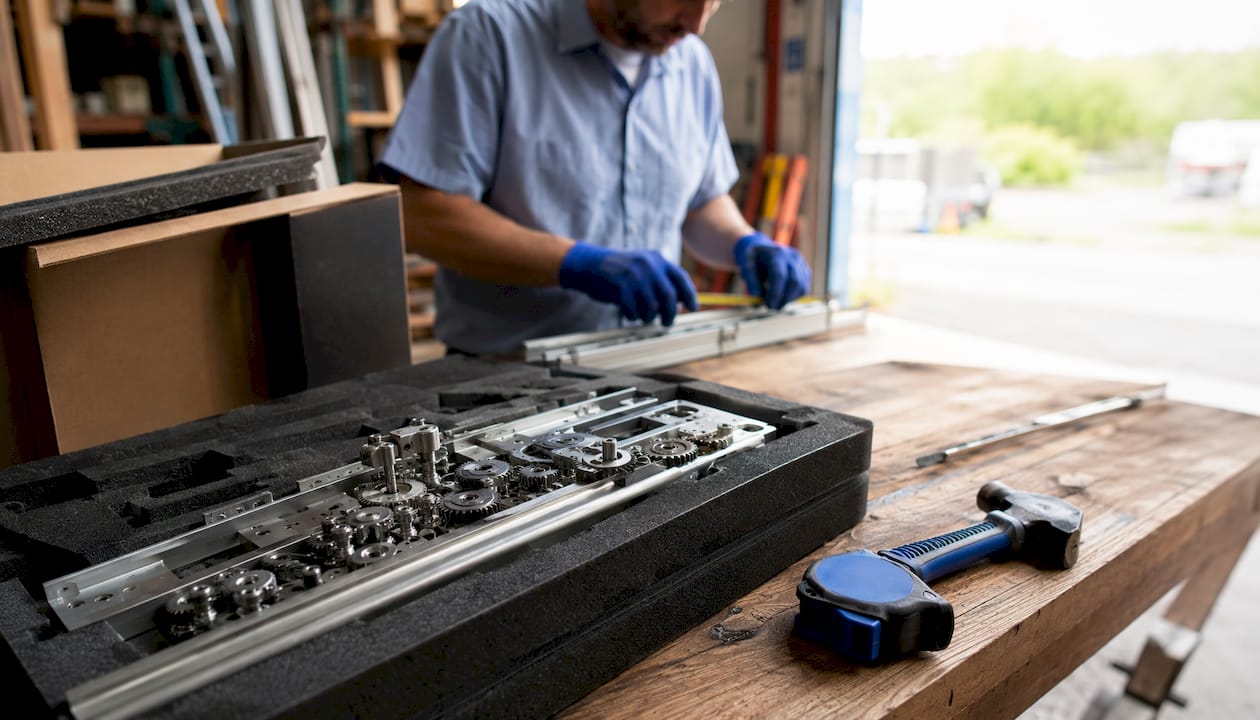
A precision window gearbox has tolerances measured in fractions of a millimetre. Even minor deformation from a single impact can mean it no longer aligns with the keep and striker on site.
Moisture, humidity, and salt spray
Humidity is a slow attacker. Temperature swings during overnight van storage cause condensation to form inside packaging, and that moisture sits against metal surfaces for hours. Coastal shipping routes carry salt-laden air that accelerates corrosion on aluminium profiles, steel fixings, and chrome-plated handles. A barrier film rated to ASTM F121 for water vapour transmission is the standard reference point for moisture-resistant packaging.
Pro Tip: The most overlooked threat for installers is parts left in a builder's van overnight in wet weather. Condensation inside an unsealed bag can corrode a chrome handle or seize a gearbox cam within 48 hours. Keep parts in their sealed inner bags until the moment of fitting.
Particulate contamination
Dust, metal swarf, and even packaging debris can work into the moving parts of a gearbox or locking mechanism during transit. Once contamination is present, precision-cleaned components cannot simply be wiped clean on site without risking further damage. The contamination affects fit, increases wear, and can void any manufacturer warranty.
Tampering and missing parts
On busy sites, opened packaging is an invitation for parts to go missing. Tamper-evident seals give you a clear, visible record that a box arrived as packed. If a seal is broken on delivery, you have grounds to refuse the consignment or raise an immediate claim — rather than discovering a missing fixing mid-installation.
Which packaging materials actually protect hardware in transit?
The right combination of materials addresses each threat discretely. No single layer does everything.
| Material | Threat mitigated | When to use |
|---|---|---|
| Double-wall corrugated box (≥50 psi compression) | Crush, stacking loads, drop impact | All transit shipments |
| Custom foam or die-cut inserts | Immobilisation, vibration, shock | Precision parts, plated handles, gearboxes |
| Vacuum or heat-sealed pouches | Particulate, moisture, recontamination | Precision-cleaned hardware; plated finishes |
| Metallised or poly barrier bags | Moisture, salt spray, humidity | Coastal/sea freight; long storage |
| VCI paper or VCI bags | Corrosion on ferrous and non-ferrous metals | Steel fixings, hinges, multipoint locks |
| Desiccants with humidity indicators | Residual moisture inside sealed packs | Long transit, container shipping |
| Tamper-evident seals | Tampering, missing parts | All trade and site deliveries |
| Anti-static PE foam and shielding bags | Electrostatic discharge (ESD) | Electronic locks, smart handles, switchgear |
| Strapping, custom racks, air dunnage bags | Extreme G-forces, container shift | Heavy joinery, patio door sets, crated pallets |
Packaging choices by use-case:
- Small replacement parts (fixings, restrictor pins, gasket lengths) — sealed polybag inside a corrugated mailer is usually sufficient
- Plated or powder-coated components — add foam insert and VCI bag to prevent abrasion and corrosion
- Precision-cleaned parts — heat-sealed barrier pouch with non-residue tape; ordinary tape can leave films that recontaminate surfaces
- Project pallet or crate shipments — strapping to custom racks with air-filled dunnage bags to neutralise container movement
- Long-distance sea freight — dual-layer wrapping, foam corner protectors, reinforced wooden crates, and desiccants as standard
Drop-test performance and compression strength are commonly cited minimum specifications for corrugated hardware packaging. Wooden crates are warranted when individual items exceed the load limits of corrugated board or when sea freight transit exceeds a few days.
What should you check when hardware arrives on site?
A quick, consistent delivery check preserves your warranty and avoids fit problems that only show up mid-installation. Work through these steps every time:
- Inspect external seals and labels — confirm tamper-evident seals are intact and labels match your order
- Check packaging for visible damage — dents, crushing, or water staining on the outer box signal rough handling
- Open in a clean area — avoid dusty van floors or site rubble that can contaminate parts the moment they are unwrapped
- Inspect each part — look for dents, scratches, corrosion, or thread damage before touching fixings
- Confirm quantities and part numbers against the packing list; project labelling by item number and room speeds this up considerably
- Perform a basic function test where safe — operate a handle once, check a gearbox cam moves freely
- Photograph any damage immediately and report it to the supplier before installation begins
For short-term storage on site or in a van:
- Keep parts in sealed inner bags until fitting
- Store long extrusions and gaskets vertically to prevent bowing
- Avoid stacking heavy items on finished hardware
- Maintain a dry, stable temperature; avoid leaving parts in a vehicle overnight in wet conditions
- Use breathable covers for plated parts stored beyond a few days
Pro Tip: Label every bag with the room or window reference before you put it in the van. On a busy site with multiple window types, an unlabelled handle set is a mix-up waiting to happen. Our trade van guide covers exactly this kind of site organisation.
Does better packaging actually save money?
Good packaging reduces replacement costs, project delays, and reputational risk. The commercial argument is straightforward once you put numbers to a single failure.
Consider a plated multipoint handle set damaged by corrosion in transit. The part cost is one element, but the real cost is the labour to revisit the site, the delay to the customer's project, and the call-back that undermines your reputation. Professional-grade packaging costs a fraction of a single day's lost labour.
Cost drivers that good packaging avoids:
- Replacement part spend on corroded, bent, or contaminated components
- Labour for return visits and rework
- Site delays when a missing or damaged part holds up a window installation
- Waste disposal for damaged goods
- Customer disputes over condition on arrival
There is a perceptual dimension too. Customers notice how hardware arrives. Carefully engineered inner protection signals product quality before a single fixing is turned. For a trade professional, the condition of delivered parts reflects directly on your own standards. An aluminium door set arriving with scratched powder coating because of inadequate transit protection is a dispute waiting to happen, regardless of who is technically at fault.
What should you expect from a trade-focused supplier?
A trade-focused supplier should provide clear packing details, project labelling, and optional upgraded measures for sensitive items — not just a box and a delivery note.
When placing an order for precision or high-value components, request:
- Packing photographs before despatch, confirming inner bag sealing and labelling
- SKU-level labelling on every inner bag so parts can be identified without opening
- Sealed inner bags for all plated or powder-coated components
- VCI or desiccants for any order travelling more than a day in transit
- ESD-safe packing for electronic locking components or smart hardware
- Wooden crates or palletised racks for heavy door sets or multi-window project orders
- Clear handling instructions on outer packaging ("This way up", "Fragile", "Keep dry")
Windowhardwarestore applies these practices as standard for trade orders. Samuel, who writes the practical trade content on the Windowhardwarestore blog, recommends specifying packaging requirements directly on your purchase order — a single line such as "sealed inner bags required for all plated components" is enough to trigger the right process at despatch. For locking hardware in particular, intact packaging on arrival is part of the security chain: a broken seal before installation is a reason to pause, not to proceed.
When budgeting for a large project, include a line for crating or custom inserts if the order contains precision gearboxes, specialist restrictors, or finished door hardware. The cost is small relative to the value of the components and the labour already committed to the project.
Key takeaways
Good packaging is a functional specification, not an afterthought — it is what ensures window and door hardware arrives in the condition it left the factory.
| Point | Details |
|---|---|
| Demand sealed inner bags | Specify sealed inner bags for all plated, precision, or locking components on every purchase order. |
| Check seals before opening | Inspect tamper-evident seals and outer packaging for damage before accepting any delivery. |
| Photograph damage immediately | Record and report any transit damage with photos before installation begins to protect your warranty claim. |
| Use desiccants for long transit | Request desiccants and humidity indicators for sea freight or any order in transit for more than a day. |
| Keep parts sealed until fitting | Store hardware in original sealed bags on site; never leave unsealed parts in a van overnight in wet conditions. |
Windowhardwarestore stocks a full range of window and door hardware — from patio door handle sets to window restrictors — all despatched with trade-appropriate packaging. Contact us to discuss packaging specifications for your next project order.

A practical habit worth copying
When a delivery arrives, my first move is always the two-minute check: seals intact, outer box undamaged, open in a clean spot, and a quick visual on every part before anything goes in the bag for site. If something looks wrong, I photograph it immediately and make the call to the supplier before a single fixing is touched. Installing a part and then raising a damage claim is a losing position — the supplier will always ask whether the damage occurred on site.
The go/no-go rule is simple: if the seal is broken, the part is visually damaged, or a function test feels wrong, it goes back. The cost of returning a part is always less than the cost of a callback after a failed installation. Get into the habit of treating the acceptance check as part of the job, not an optional extra.
Useful standards and sources for packaging performance
- ASTM F121 — the standard test method for water vapour transmission of flexible barrier materials; use it to specify or verify moisture barrier ratings on pouches and bags. Available via ASTM International (astm.org).
- ANSI/ESD S541 — the EOS/ESD Association standard covering packaging materials for ESD-sensitive items, including surface resistance ranges (dissipative: 10⁵–10¹¹ ohms; conductive: below 10⁵ ohms). Available via the ESD Association (esda.org).
- The Precision Companies — packaging guidance — practical reference on heat-sealed barrier pouches, non-residue tapes, and contamination control for precision hardware (precgroup.com).
- Windowhardwarestore trade blog — practical packing and site-handling guidance written for UK installers, covering van storage, part identification, and supplier specification. Available at windowhardwarestore.com.
- Door hardware terminology reference — if you need precise language to specify components or packaging on a purchase order, the door hardware terminology guide is a useful starting point.
To request packing test evidence from a supplier, ask specifically for compression test certificates (quoting ≥50 psi for corrugated boxes), drop-test records (≥1.5 m), and moisture barrier ratings referenced to ASTM F121. A supplier who cannot provide these on request for a significant order is worth questioning.
Recommended
- Replacing Window Handles: Locking vs Non-Locking Options | Window Hardware Store | Window Hardware Store
- Window Handle Security Features: What Makes a Handle Secure | Window Hardware Store | Window Hardware Store
- Window Handle Maintenance: Cleaning Lubrication and Tightening | Window Hardware Store | Window Hardware Store
- Window Hardware Store