

For a standard casement window, order 2 hinges per opening sash leaf, 1 handle per sash, and 1 multi-point lock per active door leaf. For sash windows, allow 4 cords per window (2 per sash). Add a 5–10% spare allowance across the whole contract, or one complete spare set per 10 units for pack-based items. Convert gasket totals to the nearest full coil (10 m, 25 m, or 50 m). Three formulas cover most situations:
- Required parts: units × components per unit = gross count
- With spares: gross count × 1.05 to 1.10 = order quantity
- Pack conversion: order quantity ÷ pack size, rounded up to the next whole pack
For urgent orders, photograph the existing hardware, note the backset and PZ dimension, and call the supplier with those two figures before anything else.
Table of Contents
- What do you need to measure on site?
- How do you calculate quantities for each hardware type?
- How to build a contract takeoff spreadsheet
- What to check with your supplier before raising the purchase order
- How do you estimate costs for a window hardware contract?
- What mistakes cause rework, and how do you avoid them?
- Windowhardwarestore: trade stock, coil sizes and direct ordering support
- Key takeaways
- The measurement detail most contractors underestimate
What do you need to measure on site?
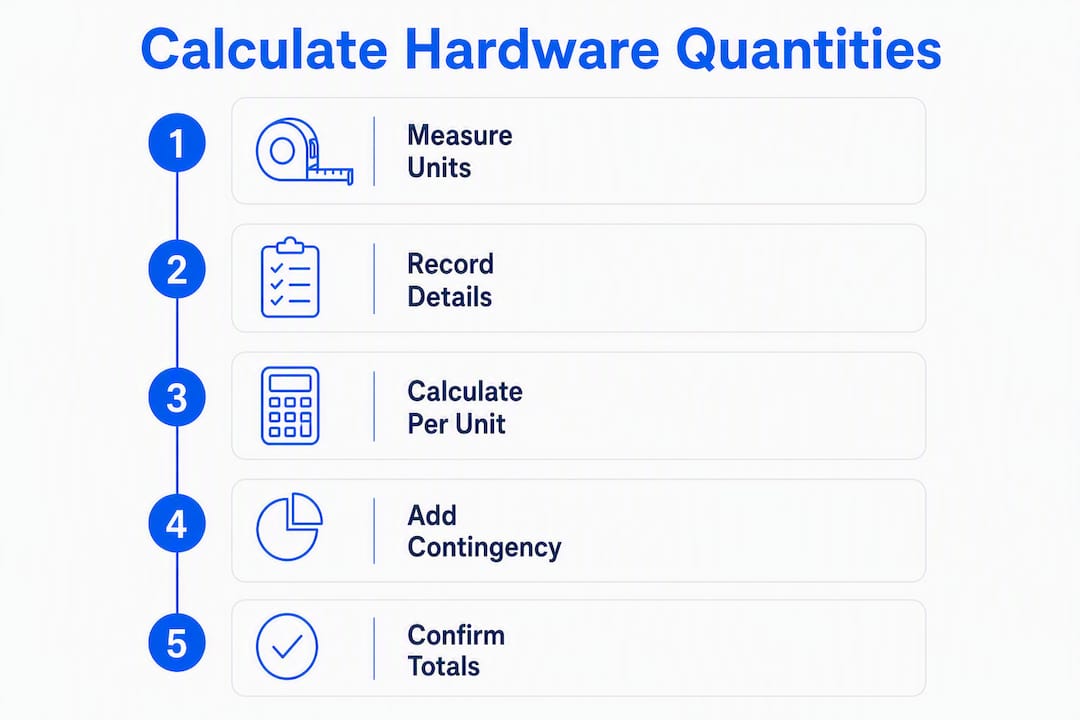
Accurate uPVC window part measurements are the foundation of any correct order. Collect these for every unit before you leave site.
Non-negotiable measurements to record:
- Backset: edge of door or sash to centre of spindle hole, in mm
- PZ dimension: centre of spindle to centre of cylinder (typically 92 mm on uPVC doors, but always verify)
- Spindle length: measured across the full width of the handle spindle
- Fixing centres: screw-to-screw distance, centre-to-centre in mm
- Hinge leaf length and stack height: measure leaf length along the frame; stack height is 13 mm or 17 mm — check with a calliper, not by eye
- Gasket perimeter: measure all four sides of each frame opening in mm, then convert to metres
- Roller positions: note distance from bottom of patio door leaf to roller centre
- Handedness: stand outside facing the door or window; note whether the handle is left or right
Record each unit with a unique ID (e.g. W01, D01), leaf number, and a sketch showing handing. Take three photos per unit: face of frame for backset, edge view for hinge stack height, and a full-frame shot for context. Manufacturer fitting guides publish PZ and backset tolerances — cross-reference them before ordering, particularly for lock replacements.
Pro Tip: Carry a printed measurement sheet with blank fields for each unit. Fill it in on site rather than relying on memory or phone notes — transcription errors between site and desk are where most ordering mistakes begin.

How do you calculate quantities for each hardware type?
Turn your site notes into exact counts using these per-item rules.
Hinges
- Casement sash: 2 hinges per sash leaf (3 for heavy or oversized sashes above 900 mm)
- Composite or timber door: 3 hinges per door leaf as standard
- Formula: (leaves × hinges per leaf) + spare allowance
Handles
- 1 handle per opening sash or door leaf; always measure spindle length and fixing centres before selecting
- Order as matched sets where locking and dummy handles are paired on patio doors
Locks and cylinders
- 1 multi-point lock per active door leaf
- 1 cylinder per lock, unless a master-keyed set is specified — in which case, confirm the key schedule before ordering
- Backset and PZ must match the existing faceplate cutout exactly
Gaskets
- Measure the full perimeter of each frame opening (all four sides)
- Formula: (perimeter per unit in metres × number of units) × 1.10 wastage = total metres
- Convert to coils: divide total metres by coil size (10/25/50 m) and round up
Sash cords
Sash window repairs require 4 cords per window (2 per sash). Always replace all four at the same time — mixing new and worn cords creates uneven counterbalance and accelerates failure.
Rollers
- Typically 2 rollers per patio door leaf; confirm with the door manufacturer's datasheet
- Formula: rollers per leaf × number of leaves + spare allowance
Restrictors
- 1 restrictor per opening sash; the RES Lock concealed restrictor fits most standard uPVC casements
Worked examples:
| Unit type | Quantity | Key hardware | Order quantity |
|---|---|---|---|
| Casement window (1 sash) | 12 | 2 hinges, 1 handle, 1 restrictor | 27 hinges, 13 handles, 13 restrictors (with 10% spare) |
| Patio door (2 leaves) | 2 | 1 handle set, 4 rollers, gasket | 3 handle sets, 6 rollers, gasket per perimeter calc |
| Composite door | 1 | 3 hinges, 1 lock, 1 cylinder | 3 hinges, 1 lock, 1 cylinder (plus contract spare) |
How to build a contract takeoff spreadsheet
A well-structured spreadsheet turns site notes directly into a purchase order. Use these columns:
| Column | What to record |
|---|---|
| Unit ID | W01, D01, etc. |
| Type | Casement / patio / composite |
| Leaf count | Number of opening leaves |
| Handedness | L or R |
| PZ / backset / spindle | In mm |
| Hinges required | Per-unit count |
| Handles required | Per-unit count |
| Locks / cylinders | Per-unit count |
| Gasket metres | Perimeter × wastage factor |
| Rollers | Per-unit count |
| Spare allowance | 5–10% applied to column totals |
| Pack conversion | Rounded-up pack or coil count |
| SKU | Supplier part number |
| Lead time | Confirmed with supplier |
Worked contract example — 12 casement windows and 2 patio doors:
Sum the per-unit columns first. Twelve casements at 2 hinges each gives 24 hinges; add 10% spare and round up to 27. Two patio doors at 1 handle set each gives 2 sets; add one spare set, order 3. For gaskets, if each casement perimeter is 4.2 m, total is 50.4 m × 1.10 = 55.4 m. Order two 25 m coils of E020 E gasket plus one 10 m coil, giving 60 m.
Once totals are confirmed, copy the SKU column into a supplier order form. Add a delivery note column referencing the unit IDs so packing lists can be checked on arrival.
What to check with your supplier before raising the purchase order
Run through this checklist before submitting any order:
- Confirm real-time stock levels and expected lead times for every SKU
- Verify the exact pack or coil size matches your spreadsheet conversion (a 25 m coil is not interchangeable with two 10 m coils on price)
- Confirm product handedness and finish (white, gold, chrome) match the site record
- Check whether trade pack discounts apply at your order volume
- Confirm delivery address, access restrictions, and whether kerbside or doorstep delivery is needed
- Request that the packing list references your unit IDs so you can check off deliveries against the spreadsheet
- For multi-phase contracts, split the order by phase and confirm lead times per phase separately
- Ask about the returns policy for unopened packs before ordering buffer stock
For non-standard or custom items, request a sample part before committing to bulk supply. One incorrect sample is far cheaper than a full pallet return.
How do you estimate costs for a window hardware contract?
Use this formula as your starting point:
Total job cost = parts cost + (labour hours × rate) + call-out fee (if applicable) + making-good + contingency
Typical UK repair costs run to £30–£60 for a window handle replacement and £40–£80 for hinges. Multi-point lock repairs typically fall in the £60–£120 range, with general repair labour at approximately £25 per hour. A call-out fee commonly applies when the total job value falls below £100 — factor this into your pricing for small single-unit jobs.
Typical UK hardware repair ranges: handle £30–£60, hinges £40–£80, lock/multi-point lock £60–£120. Full uPVC window replacement runs £400–£800 per unit — hardware repair is almost always the better-value route when the frame is sound.
Apply your spare allowance to the parts total before calculating labour. A 5% contingency suits straightforward contracts with standard stock items; push this to 10–15% for jobs involving custom colours, non-standard sizes, or extended lead times. Replacing hardware rather than full windows is consistently more cost-effective when the frame and glazing are undamaged.
What mistakes cause rework, and how do you avoid them?
The most frequent errors on window hardware contracts are preventable with a short QC routine.
Common red-flag mistakes:
- Measuring face-to-face instead of centre-to-centre for fixing holes
- Assuming a "universal" handle will fit without checking spindle length and fixing centres
- Ordering single hinges instead of matched pairs
- Ignoring hinge stack height (13 mm vs 17 mm makes a door bind or gap)
- Not recording handedness, then receiving the wrong side on delivery
- Ordering the wrong cylinder length because the backset was not measured
QC checklist to run on the day of measure:
- Double-check every measurement against the photo taken on site
- Confirm handedness from the outside-facing photo, not memory
- Verify hinge stack height with a calliper before selecting the product
- Cross-reference the SKU against the compatibility chart for the frame manufacturer
- Mark any non-standard unit clearly in the spreadsheet with a "VERIFY" flag before ordering
If a measurement looks inconsistent on review, re-measure that specific dimension on site before placing the order. Requesting a sample part for a flagged unit costs a few pounds and avoids a wasted day.
Windowhardwarestore: trade stock, coil sizes and direct ordering support
When your takeoff is complete, you need a supplier who can match it line by line without substitutions or delays.
Windowhardwarestore supplies trade quantities with real-time stock visibility, so you can confirm availability before raising the PO rather than discovering a shortfall on delivery day. Gaskets are stocked in 10 m, 25 m, and 50 m coils — including the E020 E gasket, E015 E gasket, and TW023 wedge gasket — so your coil conversion goes straight from spreadsheet to basket. Patio door handles are available as complete sets: the Winlock patio door handle set and the Pembroke patio door handle both ship as matched locking and dummy pairs, removing the risk of mismatched finishes across a multi-door contract.
Trade pricing is open to all customers with no minimum order, and the support team can work through your SKU list with you if any line needs clarification. Visit Windowhardwarestore to check live stock and place your order.
Key takeaways
Accurate hardware quantity calculations depend on precise on-site measurements, a structured spreadsheet, and coil or pack conversions applied before the purchase order is raised.
| Point | Details |
|---|---|
| Per-unit counts | 2 hinges per casement sash, 1 handle per leaf, 1 lock per active door, 4 sash cords per window |
| Spare allowance | Add 5–10% to gross counts, or one complete spare set per 10 units for pack items |
| Gasket conversion | Multiply total perimeter metres by 1.10 for wastage, then round up to the nearest full coil size |
| Supplier checks | Confirm real-time stock, exact SKU, pack size, handedness, and lead time before raising the PO |
| Windowhardwarestore | Stocks gaskets in 10/25/50 m coils, patio handle sets, and trade packs with real-time availability |
The measurement detail most contractors underestimate
The single most common oversight on a window hardware contract is not the count — it is the hinge stack height. Most installers record leaf length correctly but skip the 13 mm versus 17 mm stack check, then discover the door binds or gaps after fitting. A calliper takes ten seconds on site and removes that risk entirely.
The second thing worth saying: the instinct to order a few extra units "just in case" is sound, but it needs to be systematic rather than guesswork. A 5–10% spare allowance applied consistently across the whole contract is more reliable than ad hoc extras added per line. It also makes the contingency cost visible in your quote, which is where it belongs.
Windowhardwarestore's measuring guides and real-time stock mean you can verify a non-standard part before committing to a bulk run. That combination of good site notes and a supplier you can call with a single SKU is what keeps a contract moving without a return visit.
Recommended
- Window Hardware Store
- Replacing Window Handles: Locking vs Non-Locking Options | Window Hardware Store | Window Hardware Store
- How to Measure uPVC Window Parts for Accurate Replacements | Window Hardware Store | Window Hardware Store
- Window Handle FAQs: Measurements Security and Compatibility | Window Hardware Store | Window Hardware Store