

For most active contractors, a trade hardware account is worth opening because it converts everyday purchases into predictable discounts, working credit and faster sourcing. Trade accounts commonly deliver discounts of around 10 to 30% off retail list prices, most suppliers extend 30-day invoicing rather than upfront payment, and verification through Window Hardware Store or comparable merchants typically completes within 24 to 48 hours. That is a fast return for very little admin.
The practical payoff comes down to three things:
- Lower purchase cost on every order, not just big ones.
- Better cash flow because you buy now and pay on an agreed statement date.
- Faster site service through priority ordering, click & collect and saved lists that cut the time spent hunting for parts.
If you're installing or maintaining windows and doors on a regular basis, these advantages compound month on month. If you buy hardware once or twice a year, a trade account still costs nothing to hold, but the benefits below matter far more if materials are a recurring line in your job costings.
Key Takeaways
A trade hardware account earns its place in your business when supplier discounts, monthly credit terms and priority ordering are managed with the same discipline as any other line of business credit.
| Point | Details |
|---|---|
| Open an account if spend is regular | Worthwhile once monthly hardware spend runs into the hundreds or thousands of pounds. |
| Consolidate purchases | Concentrate spend with one or two suppliers to unlock bespoke pricing on high-use lines. |
| Set user permissions early | Give staff ordering access within budget limits to avoid bottlenecks and overspend. |
| Keep utilisation below 30% | Protect your business credit score by avoiding high balances relative to your credit limit. |
| Start with Window Hardware Store | Open a free trade account for real-time stock, trade pricing and support with no minimum order. |
Table of Contents
- What are the benefits of a trade hardware account?
- Trade account or spot buying: which suits the job?
- How do you open a trade hardware account?
- Managing a trade account without damaging your credit
- How to get more value from an existing trade account
- Why Window Hardware Store recommends opening a trade account
- Open your trade account with Window Hardware Store
- Frequently asked questions
- Sources
What are the benefits of a trade hardware account?
A trade account changes four things about how you buy: what you pay, when you pay, how quickly you can order, and who you can call when something goes wrong. Each one matters differently depending on the size and rhythm of your workload.
Trade discounts scale with how you buy, not just how much you spend. Retail prices assume a one-off customer; trade pricing assumes a relationship. On a materials order for a multi-property job, a typical trade discount saves a meaningful amount before you've even negotiated bespoke rates on your most-ordered lines. Order gaskets, hinges, gearboxes and locking mechanisms in volume, and that saving becomes a meaningful chunk of your margin on the job, not a rounding error.

Credit terms buy you breathing room between paying suppliers and getting paid by clients. A trade account typically runs on a monthly statement rather than per-transaction payment, so materials bought early in the month can be invoiced and settled 30 days later — often after you've already invoiced the client for the completed job. That timing gap is the difference between funding a project from your own pocket and letting supplier credit cover the gap.
Beyond price and payment, the operational features tend to matter just as much to installers who value time on site over headline savings:
- Online ordering around the clock, so a locked-out client at 7pm doesn't mean waiting until Monday to place an order.
- Saved shopping lists for your standard hardware kits, cutting repeat-order time to minutes.
- Multiple user logins with permission controls, so office staff or a site manager can order within a set budget.
- Priority click & collect and delivery slots, which matter when a job stalls on a missing restrictor or cylinder.
A dedicated account manager is where the account starts paying for itself in ways a price list never shows. On high-use lines, an account manager can arrange bespoke pricing that beats the standard trade rate, and for larger projects they can lock in advance pricing before material costs move. Streamlined account management and saved-list ordering save real hours over a month of jobs, and those hours are worth more to most contractors than another percentage point of discount. If you're regularly working out how much hardware a job needs before ordering, tools that calculate hardware quantities for window contracts pair naturally with an account manager who can then price that exact list.
Trade account or spot buying: which suits the job?
Not every job justifies opening or actively using a trade account, and spot buying still has a place. The decision usually comes down to volume, timing pressure and how much administrative overhead you're willing to carry.
| Dimension | Trade account | Spot buying |
|---|---|---|
| Price (trade discount) | 10 to 30% off list price, scaling with spend | Full retail price, no negotiated rate |
| Payment terms | Monthly invoicing, commonly 30 days | Payment due immediately at purchase |
| Ordering convenience | Online 24/7, saved lists, multi-user access | One-off checkout, no saved history |
| Delivery speed | Priority slots and click & collect | Standard queue, no priority handling |
| Returns & warranties | Managed through account history and invoices | Requires original receipt per transaction |
| Account support | Dedicated account manager, bespoke pricing | Generic customer service only |
A few signals point clearly towards opening and actively using a trade account:
- Monthly hardware spend that regularly runs into the hundreds or thousands of pounds.
- Frequent, sometimes urgent, deliveries across multiple sites.
- More than one person in your business who needs to place orders.
For a single small call-out job, spot buying with a trade discount applied at checkout (many merchants, including Window Hardware Store, offer trade pricing without requiring an account) is perfectly sensible. For steady instalment work, such as a run of door repairs across a housing estate, an active account with credit terms smooths cash flow noticeably. For large multi-week projects, the combination of bespoke pricing, advance pricing on materials and priority delivery makes an account close to essential; when returns crop up, having order history on file also speeds up processes like returning incorrect window parts compared with hunting for a paper receipt.
How do you open a trade hardware account?
Applying for a trade account is generally straightforward and, for the vast majority of suppliers, free of charge. The process usually follows the same shape whether you're a sole trader, a limited company or a partnership.
- Complete the online application form, providing your trading name, business address and contact details.
- Submit basic business documentation — proof of trading (invoices, a business bank statement or Companies House registration), your VAT number if registered, and bank details for the payment method on file.
- Undergo a credit check where applicable, particularly if you're requesting a higher initial credit limit rather than a standard cash-on-account arrangement.
- Wait for verification, which most merchants complete within 24 to 48 hours of receiving your documents.
- Receive activation confirmation and log in to set up saved lists, user permissions and delivery preferences.
Sole traders typically need less paperwork than limited companies, since there's no separate legal entity to verify. Limited companies and partnerships should expect a request for company registration details alongside standard proof of trading.
Pro Tip: When you speak to an account manager during setup, mention your expected monthly spend and the specific product lines you order most. Suppliers often hold back their best bespoke pricing until you ask for it directly, rather than offering it automatically at account opening.
Managing a trade account without damaging your credit
A trade account is a credit line, and it behaves like one. Suppliers can report payment behaviour to commercial credit bureaux, which means consistent on-time payment across your accounts can actively build your business credit profile over time. The reverse is equally true: missed or late payments show up just as clearly and can make future borrowing, leasing or even new supplier accounts harder to secure.
Utilisation matters more than most contractors realise. Financial advisers recommend keeping commercial credit utilisation below 30%, and ideally under 10%, to protect your credit score and keep future borrowing costs down. Running a £5,000 limit at £4,800 outstanding every month sends a very different signal to lenders than running it at £800.
A few habits keep a trade account working for you rather than against you:
- Align your invoice terms with your supplier's payment terms, so client payments land before your statement is due.
- Use early-payment or settlement discounts selectively when cash flow allows, rather than as a default.
- Ask for a higher limit only when your spend pattern justifies it, not to cover a temporary shortfall.
- Reconcile monthly statements against job costings so materials get allocated to the right project.
On bookkeeping, the monthly statement format is genuinely useful. Because a trade account typically produces one consolidated statement rather than a stack of individual receipts, allocating costs to specific jobs becomes far simpler than reconciling till receipts from a dozen separate site visits. Watch for hidden costs too: some accounts carry inactivity fees or reduced rates below a minimum monthly spend, so check terms before assuming every account behaves identically. If your work involves staged project payments from clients, it's worth understanding how staged payment approvals work in construction so your supplier credit terms and client payment schedule don't pull in opposite directions.
Pro Tip: Set a calendar reminder three days before your statement due date. Late payments on a trade account are one of the quickest ways to damage a credit profile you may not have realised your business had.

How to get more value from an existing trade account
Opening the account is the easy part. Getting the most out of it takes a bit more deliberate management, particularly once you've been trading with a supplier for six months or more.
- Consolidate spend with one or two suppliers. Guides consistently recommend concentrating purchases rather than spreading small orders across several merchants, since volume is what earns bespoke pricing on your highest-use lines.
- Ask about settlement discounts. Some suppliers offer an extra fractional discount for paying within 7 to 10 days rather than waiting the full 30. On a large order, that adds up.
- Set user permissions properly. Letting a site manager order within a fixed budget, while keeping approval for larger purchases with you, avoids both bottlenecks and overspend.
- Use saved lists for standard kits. If you fit the same handle, gearbox and gasket combination repeatedly, a saved list turns a five-minute order into a thirty-second one.
- Schedule bulk deliveries to consolidate transport costs, especially useful across multi-property or multi-site jobs.
Pro Tip: Pull your account statement every quarter and highlight your top five most-ordered products. Bring that list to your account manager and ask directly for a bespoke rate on those lines — most suppliers would rather offer a small extra discount than risk losing a consistent customer. If you're also looking at higher-margin upgrades on a job, it's worth reading about ways to upsell premium window hardware to clients while your trade pricing keeps your own costs down.
Why Window Hardware Store recommends opening a trade account
We built our trade account around what installers actually need on site, not around what looks good on a pricing page. Real-time stock visibility means you're not ordering a gearbox only to find it's six weeks out. Trade pricing applies from the first order, and multiple users on one account let a site team and an office manager order without bottlenecking through one person's inbox.
There's no minimum order requirement, and trade pricing is open to trade professionals and homeowners alike, so you don't need to hit a spend threshold before it becomes worthwhile. What you get in exchange for setting it up is straightforward: fewer delays chasing hardware, fewer surprises on price, and a support team who understand the difference between a bubble gasket and a wedge gasket without you having to explain it twice.
Open your trade account with Window Hardware Store
Windowhardwarestore is the practical route to those savings for window and door hardware specifically, without the wait or paperwork some larger merchants demand.
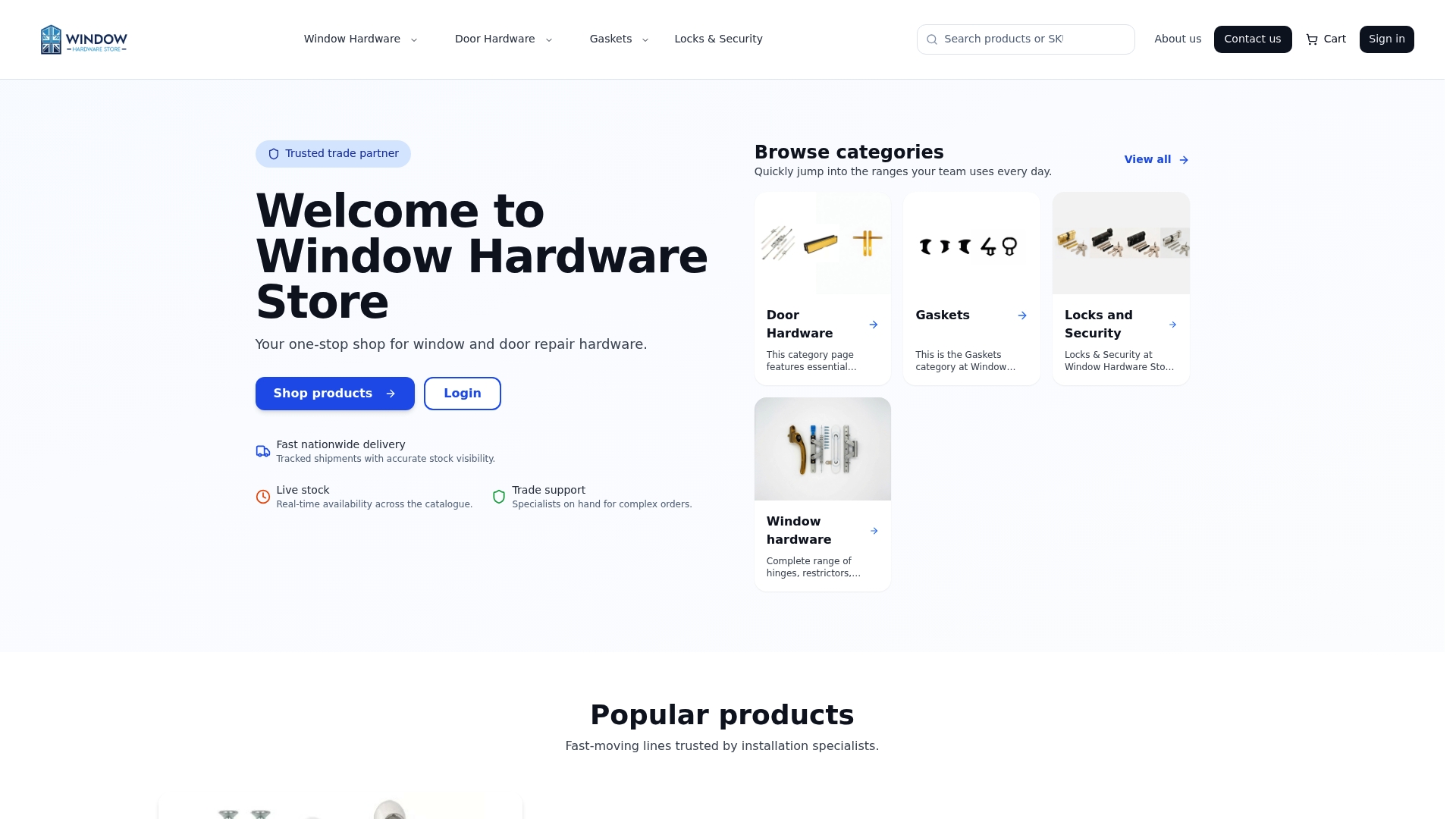
Opening an account is free and takes only a few minutes. Have your business details and proof of trading ready, and you'll typically be verified and ordering at trade prices within 24 to 48 hours. Whether you're stocking up on wedge gaskets, concealed window restrictors, or patio door handle sets, real-time stock visibility means you order once and get on with the job. Visit Window Hardware Store to start your application and get your first trade-priced order moving today.
Frequently asked questions
Are trade hardware accounts only for large contractors? No. Accounts are generally free to open for sole traders, limited companies and partnerships, with no minimum order size at most suppliers, including Window Hardware Store.
How much can I realistically save with a trade account? Savings commonly fall in the 10 to 30% range off retail pricing, with the higher end typically reserved for consistent, high-volume customers who've negotiated bespoke rates.
Will opening a trade account affect my business credit score? Used responsibly, it can help. Suppliers may report payment history to commercial credit bureaux, so on-time payment can build your credit profile, while missed payments or high utilisation can damage it.
How long does verification usually take? Most suppliers aim to verify and activate a new trade account within 24 to 48 hours of receiving your application and documents.
What documents do I need to apply? Expect to provide proof of trading, business bank details, and a VAT number if registered. Limited companies typically also need company registration details.
This article provides general information on trade hardware accounts and does not constitute financial advice. Confirm specific terms, credit limits and fees directly with your chosen supplier before applying.
Sources
- Trade accounts at builders merchants: how to open one and what you get | BuildersMerchantsDirect
- Trade card — The Self Build Guide
- A guide to trade accounts | Kriya