
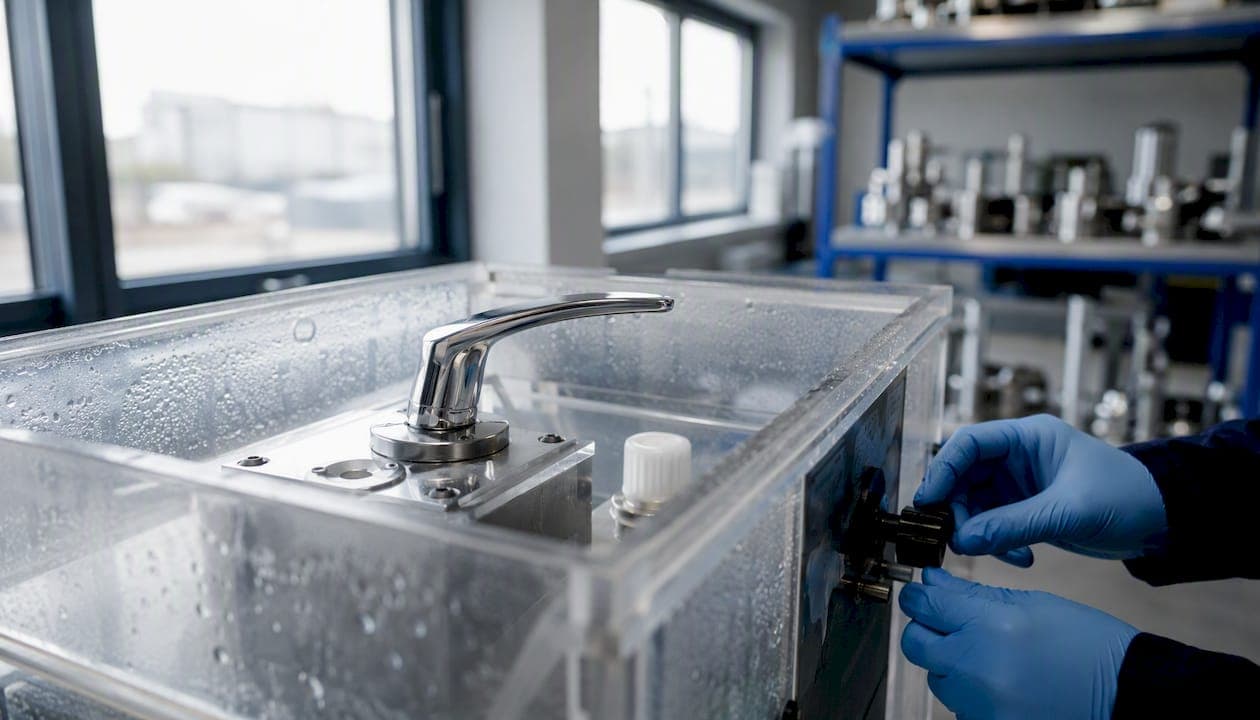
BS EN 1670:2007 classifies the corrosion resistance of building hardware across six grades (0–5) using neutral salt spray testing to EN ISO 9227, and every specification for doors, windows, shutters, or curtain walling should call up a grade by number. Three things to act on immediately:
- Call the grade explicitly. Write "BS EN 1670:2007, Grade [X]" in your specification line rather than a vague reference to "corrosion-resistant hardware."
- Treat NSS hours as a comparative benchmark, not a service-life prediction. A Grade 4 product has passed 240 hours of neutral salt spray; that does not translate directly to years of field performance.
- Obtain the official text from BSI or NBS. The BS EN 1670:2007 NBS/BSI entry incorporates the March 2008 corrigendum and is the correct reference for UK procurement.
Key takeaways
BS EN 1670:2007 is the definitive corrosion-resistance standard for building hardware in the UK, classifying products from Grade 0 (no requirement) to Grade 5 (480 hours NSS), and every specification should call up a grade by number alongside a certificate requirement.
| Point | Details |
|---|---|
| Always name the grade | Write "BS EN 1670:2007, Grade X" in spec text; a vague reference to "corrosion-resistant" is unenforceable. |
| NSS is comparative, not predictive | 480 hours of salt spray confirms production quality; it does not translate directly to years of field life. |
| Grade 4–5 for exposed and coastal sites | Grade 4 suits exposed external facades; the highest grades are appropriate for coastal or heavy industrial environments. |
| Fixings must comply too | Screws and fastenings supplied with hardware should carry the same EN 1670 grade where specified. |
| Retain certificates | Keep NSS test certificates with project O&M documentation for future maintenance and replacement decisions. |
Table of Contents
- What does BS EN 1670 actually cover?
- How the grades work: 0–5 and their NSS durations
- Understanding EN 1670 testing methods and what reports should tell you
- Which hardware items does EN 1670 apply to?
- How to specify the right grade and check compliance
- Related standards, corrigenda, and where to get authoritative copies
- Why NSS results need careful interpretation on demanding projects
- What specifiers should do right now
- A trade perspective on specifying EN 1670 in practice
- Sources
What does BS EN 1670 actually cover?
EN 1670:2007 sets corrosion-resistance requirements and test methods for building hardware, covering both coated and uncoated metallic components. Its scope takes in hardware for doors, windows, shutters, and curtain walling, including screws and fastenings sold as part of a hardware set when those fixings are specified to comply.
The standard was published in 2007 and remains current in the UK as BS EN 1670:2007, incorporating a corrigendum issued in March 2008. For procurement and contract citation, the NBS/BSI publication record is the authoritative British reference. National standards bodies across Europe maintain equivalent entries; the Dutch NEN entry, for example, confirms the standard's current status and provides the same publication metadata useful for cross-border projects.
How the grades work: 0–5 and their NSS durations
The six grades map directly to neutral salt spray exposure periods defined in EN ISO 9227. After the test, hardware must retain its function and meet appearance limits set by EN ISO 4628-2, which covers blistering, rusting, and related defects.
| Grade | Description | NSS exposure |
|---|---|---|
| 0 | No requirement | Not tested |
| 1 | Low corrosion resistance | Low exposure time |
| 2 | Moderate corrosion resistance | Moderate exposure time |
| 3 | Medium-high corrosion resistance | Intermediate exposure time |
| 4 | High corrosion resistance | High exposure time |
| 5 | Very high corrosion resistance | Very high exposure time |
Functional acceptance means the hardware must still operate correctly after exposure. Appearance acceptance limits tarnishing, blackening, and blistering to the thresholds set in EN ISO 4628-2; minor surface discolouration on non-visible faces is generally permissible, but blistering on functional surfaces is not.
Pro Tip: Grade 5 is the highest classification within EN 1670, but it is not an absolute ceiling of material technology. For marine or heavy industrial sites where chloride loading is severe, agree bespoke testing requirements with the manufacturer beyond the 480-hour NSS threshold — and document that agreement in the contract schedule.
Understanding EN 1670 testing methods and what reports should tell you
EN 1670 relies on two core references. Appearance assessment after exposure references the EN ISO 4628 series, particularly Part 2 for blistering and Part 3 for rusting.
A compliant test report should include:
- Sample identification (product reference, batch, coating system or plating description)
- Pre-conditioning details and sample quantity
- NSS duration and chamber conditions
- Pass/fail outcome for both functional performance and appearance criteria
- Any deviations from the standard test conditions
The critical point is what the report does not tell you. ISO guidance is clear that salt spray tests are comparative quality-control tools, not reliable predictors of long-term in-service durability. Real-world corrosion depends on temperature cycling, pollutant loading, UV exposure, and moisture frequency — none of which a constant NSS chamber replicates. Use the grade to compare products and verify production consistency; do not use it to estimate years of service life.
For chloride-contaminated environments, ISO 16701:2025 describes an accelerated atmospheric test combining intermittent salt exposure with humidity cycling, which better simulates coastal or industrial atmospheres. Its results, too, carry a caution against broad generalisation across all service conditions.
Which hardware items does EN 1670 apply to?
The standard covers the metallic hardware components most commonly specified on building envelopes:
- Lever handles and pull handles
- Hinges and pivot sets
- Cylinders, locks, and latches
- Window stays, restrictors, and keeps
- Curtain-wall fittings and associated brackets
- Screws and fastenings supplied with any of the above, when specified to comply
Non-metallic components such as nylon rollers, rubber gaskets, and treated timber inserts fall outside EN 1670's scope and need separate consideration in a specification. Bespoke alloys or specialist coatings not covered by EN ISO 9227 conditioning may also require supplementary test evidence agreed with the manufacturer. When writing a spec, list each hardware type and its required grade separately rather than applying a blanket grade to a mixed schedule. See our guidance on choosing window hardware for UK climate conditions for a practical breakdown by exposure zone.
How to specify the right grade and check compliance
Matching grade to exposure
- Internal, dry environments: Grade 1 or 2 is generally adequate.
- Sheltered external (e.g. covered walkways, recessed reveals): Grade 3.
- Exposed external (standard UK residential and commercial facades): Grade 4.
- Coastal, marine, or heavy industrial: Grade 4 minimum; Grade 5 where chloride loading is high.
Sample specification text
Paste either of these into your project spec:
Procurement checklist
- Confirm the product's EN 1670 grade is stated on the data sheet or certificate.
- Verify the NSS duration matches the grade (e.g. 240 h for Grade 4).
- Check the test was conducted to EN ISO 9227 and that both functional and appearance criteria were assessed.
- Confirm the coating or plating system is described on the certificate.
- Verify that accompanying screws and fixings carry the same grade where specified.
- Retain certificates with the project O&M documentation.
The Door and Hardware Federation advises assessing hardware holistically: corrosion resistance is one attribute, and security accreditations such as the TS 007 3 star cylinder rating should be considered alongside EN 1670 grades rather than in isolation.
Related standards, corrigenda, and where to get authoritative copies
Several companion documents sit alongside EN 1670 and should be on every specifier's reading list:
- EN ISO 9227 — the neutral salt spray test method referenced directly by EN 1670.
- EN ISO 4628 series — appearance assessment after corrosion testing (blistering, rusting, cracking).
- EN 1670 corrigendum, March 2008 — incorporated into the BS EN 1670:2007 BSI edition; check that any copy you reference includes this amendment.
- ISO 16701:2025 — supplementary accelerated atmospheric test for chloride-contaminated environments.
- DS/EN 1670/AC:2008 — the amendment document listed by national webstores including the ANSI webstore, confirming the corrigendum's scope.
Buy or view official copies through BSI, NBS, or your national standards body. National publishers such as AFNOR maintain equivalent catalogue entries for NF EN 1670 with purchase paths for non-UK projects. A "confirmed" national status means the national body has reviewed the standard and found no need for amendment at national level; it does not indicate a new edition.
Why NSS results need careful interpretation on demanding projects
Neutral salt spray testing is a production quality-control tool, and a very good one for that purpose. It gives you a consistent, repeatable basis for comparing products from different manufacturers and for verifying that a supplier's coating process is under control. What it does not give you is a direct read-across to field performance.
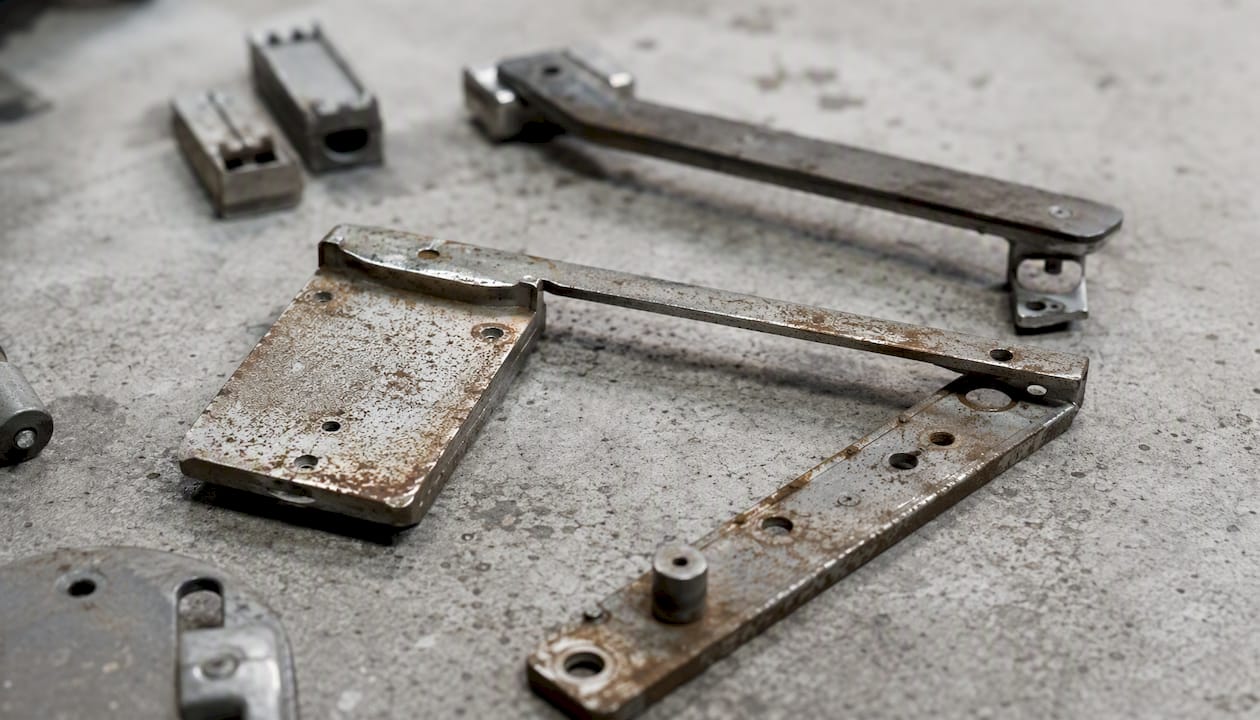
ISO guidance is explicit: real-world corrosion is driven by a combination of factors — chloride concentration, temperature swings, UV, pollution, and moisture frequency — that a constant salt fog chamber cannot replicate simultaneously. A product that passes 480 hours of NSS may still underperform in a severe marine microclimate if the coating system is poorly suited to UV degradation or thermal cycling.
For projects in genuinely harsh exposures, ISO 16701:2025 offers a more representative accelerated test by combining intermittent salt exposure with humidity cycling. Even then, results should not be extrapolated to all service conditions without engineering judgement.
Pro Tip: On coastal or industrial projects, ask manufacturers to supply both the EN 1670 NSS certificate and a full coating system description, including primer type, topcoat chemistry, and film thickness. The certificate confirms the grade; the coating description tells you whether the system is appropriate for your specific exposure.
For stainless steel options in high-exposure situations, stainless steel screens and fabrications from specialist manufacturers can complement a corrosion-resistant hardware specification where the substrate itself needs to perform beyond standard plated finishes.
What specifiers should do right now
BS EN 1670:2007 gives you a clear, grade-based framework for specifying and verifying corrosion resistance. The immediate actions are straightforward:
- Call the grade by number in every specification line referencing building hardware.
- Request NSS test certificates before or at delivery, and check that they cover both functional and appearance criteria.
- Verify fixings. Screws and fastenings supplied with hardware should carry the same EN 1670 grade where your spec requires it.
For coastal or exposed sites, Grade 4 is the practical minimum and Grade 5 is the right call where chloride loading is a known risk. Use the NBS/BSI record as your citation reference in contracts and technical schedules.
A trade perspective on specifying EN 1670 in practice
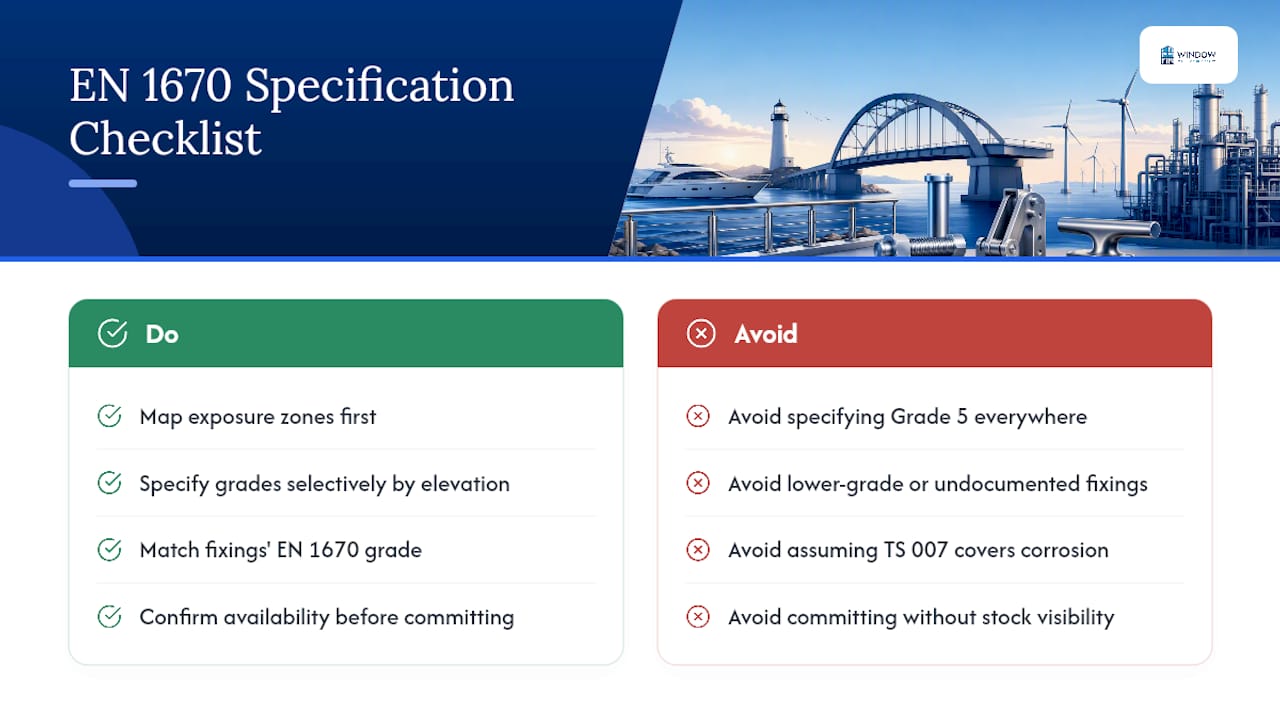
We speak to installers and specifiers every week who are confident about the grade they need but less certain about what to ask for on the paperwork. The most common gap is fixings: a lever handle or cylinder specified to Grade 4 is undermined immediately if the supplied screws are only Grade 2 or carry no EN 1670 declaration at all.
Our advice on large projects is to treat corrosion resistance and availability as a joint constraint. Grade 5 hardware in certain finishes can have longer lead times, and specifying it across an entire development when only the coastal elevations genuinely need it adds cost and programme risk. Map your exposure zones first, then apply the grade selectively. For security-critical items such as cylinders, remember that a TS 007 3 star cylinder rating addresses attack resistance; you still need to specify the EN 1670 grade separately for corrosion performance.
At Windowhardwarestore, we stock hardware with real-time stock visibility so you can confirm availability before committing to a specification. Our team is on hand for complex orders where you need to match grades across a mixed hardware schedule.
Sources
- ISO standard / commentary (salt spray testing guidance)
- Door and Hardware Federation (TS 007 guidance)
Always purchase from official publishers (BSI, ISO, national standards bodies) rather than third-party summaries when writing contracts or technical schedules. Third-party reproductions may omit corrigenda or carry outdated clause numbering.
Recommended
- How 3 Star Cylinders Are Tested: TS 007 Standard | Window Hardware Store | Window Hardware Store
- Choosing window hardware for UK climate conditions
- Why choose stainless window hardware: a practical guide
- Euro Cylinder Security Ratings: Understanding the Star System | Window Hardware Store | Window Hardware Store