

Stainless steel is usually the best choice for window hardware when you want long service life, predictable corrosion resistance, and minimal upkeep. For most UK exterior applications, specify A2 (grade 304) stainless; upgrade to A4 (grade 316) for coastal properties, marine environments, or sites with industrial pollution. Before buying, check the product's EN 1670 corrosion classification, and always pair stainless hardware with stainless fasteners to avoid galvanic corrosion.
Windowhardwarestore and FSB are reliable starting points for grade-specific product and specification guidance.
At a glance:
- A2 (304) suits most unpolluted UK exteriors — handles, hinges, restrictors, and locking mechanisms
- A4 (316) is the safer choice within two miles of the coast, near chlorinated pools, or in heavily polluted urban areas
- Check EN 1670 corrosion categories on product datasheets before specifying
- Always use stainless fasteners with stainless hardware — galvanised or zinc-plated screws create galvanic corrosion
- Windowhardwarestore and FSB both provide grade-specific guidance for trade and domestic buyers
Table of Contents
- Why stainless window hardware outperforms the alternatives
- Which stainless grade should you specify?
- When does stainless make sense for your property?
- What are the real downsides of stainless hardware?
- How to choose the right stainless hardware: a practical checklist
- Keeping stainless hardware in good condition
- Why installers and trade buyers default to stainless
- Key takeaways
- A trade perspective on specifying stainless
- Windowhardwarestore: stainless hardware for trade and home
- Useful sources and further reading
Why stainless window hardware outperforms the alternatives
The case for stainless steel comes down to one thing: it keeps performing long after plated or coated alternatives have started to fail. Here is what that means in practice.
Corrosion resistance. Stainless steel forms a self-repairing passive layer of chromium oxide on its surface. FSB's product guidance explains that this layer regenerates when damaged, which is why stainless hardware survives conditions that strip paint or corrode zinc plating within a few seasons. Surface contamination can cause temporary "flash rust," but it wipes away without damaging the metal underneath.
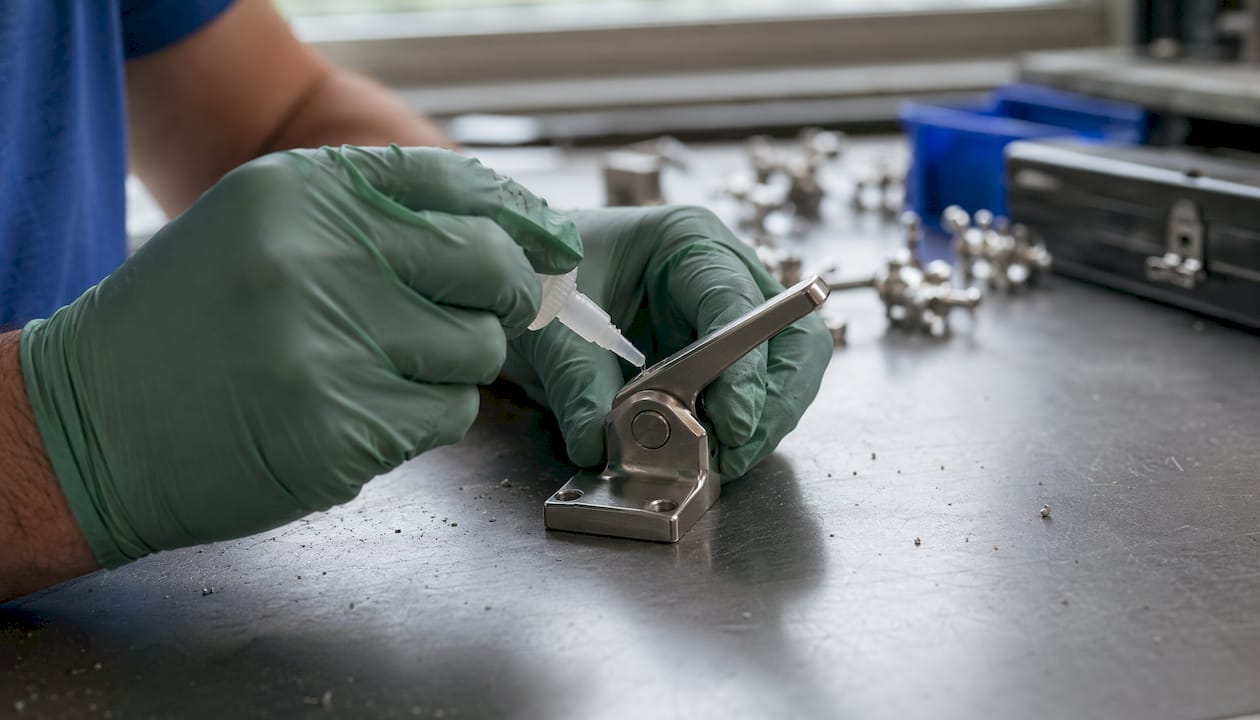
Durability and lifetime cost. Well-chosen stainless hardware typically lasts 20–30 years, while premium components in favourable environments can exceed 40 years. Plated alternatives rarely match that, and repeated replacement adds up quickly.
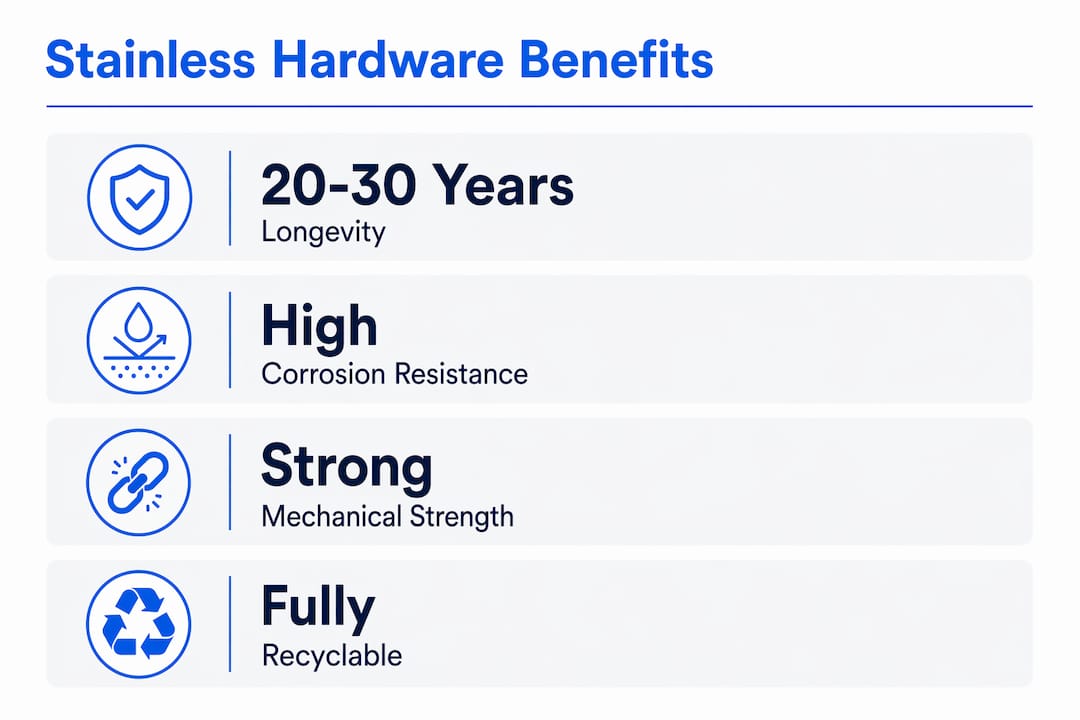
Security and mechanical strength. Stainless steel is significantly harder and more resistant to deformation than zinc alloy or aluminium. For locking handles, restrictors, and multi-point hinges, that strength matters. A handle that holds its shape under repeated force is a genuine security advantage — see our guide on window handle security features for more detail.
Hygiene and finish retention. Because the passive layer is the protection, there is no paint or plating to chip, flake, or harbour bacteria. That makes stainless the preferred choice in food-preparation areas, healthcare settings, and anywhere hygiene matters.
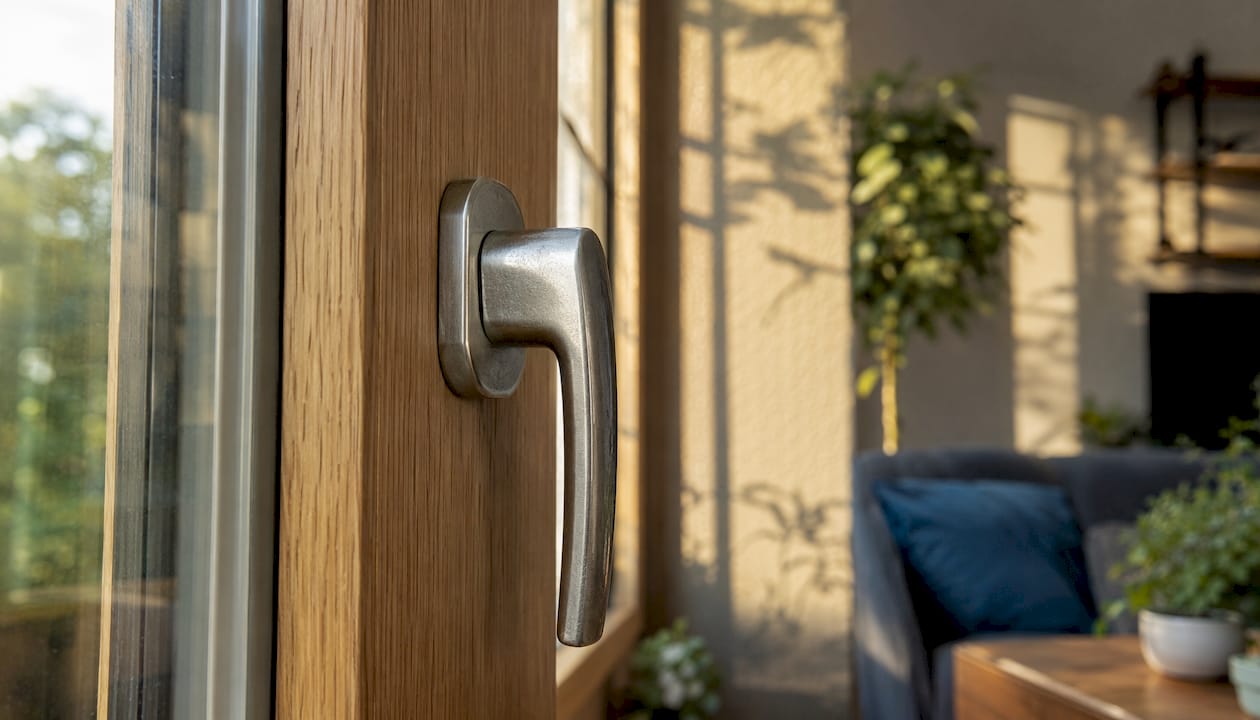
Aesthetics. Polished, satin, and brushed finishes are all available and age gracefully without the yellowing or pitting that affects coated alternatives. The look stays consistent across the product's life.
Environmental advantage. Stainless steel is fully recyclable at end of life, with a lower lifetime waste profile than hardware that needs replacing every five to ten years.
Some manufacturers offer long-term guarantees on 316 coastal ranges — a clear signal of confidence in the material's longevity under demanding conditions.
Pro Tip: When comparing costs, divide the purchase price by the expected service life rather than comparing upfront prices directly. A stainless handle at twice the price of a zinc alternative, lasting three times as long, is the better value.
Which stainless grade should you specify?
Not all stainless steel performs equally outdoors. The grade determines how much chromium, nickel, and molybdenum the alloy contains — and those elements directly control corrosion resistance.
Grade 201
Grade 201 contains less nickel than 304 and no molybdenum. It is noticeably less corrosion-resistant in exterior conditions and is best reserved for internal applications in low-humidity rooms. You will find it in budget-priced accessories, but it is not a reliable choice for any exposed UK exterior.
Grade 304 (A2)
Grade 304, sold under the European designation A2, is the workhorse of the stainless window hardware market. It contains 16–18% chromium and 8–13% nickel, giving it good resistance to normal atmospheric corrosion. Rapierstar confirms that A2 suits most unpolluted UK exterior environments. For the majority of domestic installations — inland towns, suburban homes, sheltered elevations — A2 is the right call.
Grade 316 (A4)
Grade 316 adds molybdenum (typically 2–3%) to the 304 composition, which significantly improves resistance to pitting and crevice corrosion in chloride-rich environments. Under the European A4 designation, it is the professional standard for coastal properties, poolside installations, and sites near industrial pollution. Some 316 coastal ranges carry 20-year manufacturer guarantees, which reflects the material's proven performance in salt-laden air.
Grade comparison at a glance
| Grade | Designation | Best use case | Corrosion resistance | Relative cost | Maintenance needs |
|---|---|---|---|---|---|
| 201 | — | Internal, low humidity only | Low | Lowest | Higher (prone to staining) |
| 304 | A2 | Most UK exterior domestic | Good | Moderate | Low |
| 316 | A4 | Coastal, marine, poolside, industrial | Excellent | Higher | Very low |
When to upgrade from A2 to A4:
- Property within approximately two miles of the coast or tidal estuary
- Visible salt spray or persistent condensation on external elevations
- Chlorinated pool or spa within the curtilage
- Industrial or heavily polluted urban setting
- High aesthetic expectations where any surface degradation is unacceptable
On product labelling: look for "A2" or "A4" stamped on fasteners, or "304" / "316" in the product datasheet. The word "stainless" alone tells you nothing useful about the grade — not all stainless is equal, and some budget products use 201 without making that obvious.
When does stainless make sense for your property?
Grade guidance is only half the decision. The other half is understanding where stainless is necessary, where it is ideal, and where a less expensive option might genuinely be sufficient.
Internal rooms and sheltered elevations
For windows that never face direct weather — internal glazed partitions, loft rooms with deep overhangs, or north-facing elevations in sheltered inland locations — A2 stainless is more than adequate. In genuinely dry, low-humidity interiors, a quality coated alternative may also perform acceptably, though stainless remains the lower-maintenance option over time.
Coastal and exposed sites
Salt spray accelerates corrosion on any metal that lacks adequate protection. Viwinco's research on casement and awning windows confirms that stainless hardware outperforms other metals in coastal conditions where salt, sand, and wind combine. For these sites, A4 (316) is not a premium upgrade — it is the minimum sensible specification.
Commercial and high-traffic installations
In commercial buildings, schools, care homes, and any setting with heavy daily use, stainless is effectively the industry standard. The mechanical strength holds up under repeated operation, and the finish survives the cleaning regimes that would strip coatings from lesser materials. For commercial-grade specification, our partner resource on stainless steel in commercial construction covers the relevant standards in detail.
Frame compatibility checklist
- uPVC frames: fully compatible with A2 and A4 stainless hardware; use stainless or A2/A4 screws into the reinforcement. Austenitic grades (304/316) cannot be hardened, so for drilling into steel reinforcement you may need bi-metallic or martensitic (410-series) self-tapping screws — Rapierstar's guidance covers this clearly.
- Timber frames (including Accoya®): stainless is the professional standard for chemically modified timbers; galvanised fixings can react with the acetylation treatment and cause staining.
- Aluminium frames: compatible, but check for galvanic compatibility between the aluminium extrusion and stainless fixings; use nylon or EPDM isolation washers where direct contact occurs.
Pro Tip: Before ordering, measure your spindle length and fixing centres precisely. A handle that fits the grade specification but not the frame geometry is wasted money. Our guide on universal window handle fit explains what to measure and why it matters.
What are the real downsides of stainless hardware?
Stainless steel is not the right answer in every situation. Here is an honest look at the trade-offs.
Higher upfront cost. A2 and A4 hardware costs more than zinc-alloy or plated alternatives at the point of purchase. For a budget refurbishment of a sheltered interior window, that premium may not be justified. The calculation changes for any exterior or coastal application, where the lifetime cost of stainless is almost always lower.
Scratching and surface marks. Polished finishes show fingerprints and fine scratches more readily than satin or brushed options. Brushed finishes are more forgiving in high-contact locations such as tilt-and-turn handles or restrictors. Scratches on stainless do not expose bare metal the way they do on plated hardware, but they are visible.
Galvanic corrosion when mixing metals. This is the most common installation mistake. Mixing dissimilar metals — for example, using galvanised screws to fix stainless hinges — creates an electrochemical reaction that accelerates corrosion at the joint. Always use stainless fasteners with stainless hardware, and use isolation washers where stainless contacts aluminium directly.
Availability and lead times. Bespoke finishes or less common grades can carry longer lead times than standard plated products. For time-sensitive projects, confirm stock before specifying.
Stainless is occasionally overkill. A sheltered interior window in a dry inland property does not need A4 (316) hardware. Specifying it there adds cost without adding meaningful performance. Save the upgrade for where the environment genuinely demands it.
How to choose the right stainless hardware: a practical checklist
Work through these steps before placing an order, and you will avoid the most common specification errors.
- Identify the environment. Is the installation internal, external, coastal, or near a pollution source? This determines whether you need A2 or A4.
- Check the EN 1670 corrosion classification on the product datasheet. Higher categories indicate better corrosion resistance; match the rating to your environment.
- Confirm the grade designation. Ask for "A2" or "A4" (or "304" / "316") in writing. "Stainless" alone is not a specification.
- Choose the finish for the location. Brushed or satin for high-contact areas; polished where aesthetics take priority and fingerprints can be managed.
- Measure spindle length and fixing centres before ordering. Refer to our locking window handle checklist for the exact dimensions to record.
- Specify stainless fasteners. Match the fastener grade to the hardware grade; never mix with galvanised or zinc-plated screws.
- Check the warranty. A2 hardware from reputable manufacturers typically carries a multi-year finish guarantee; A4 coastal ranges may offer 20 years.
- Ask about frame compatibility. For uPVC with steel reinforcement, confirm whether standard A2 screws will self-tap or whether bi-metallic fasteners are needed.
Quick decision shortcuts:
- Inland, sheltered, domestic exterior: A2 (304) is sufficient
- Coastal, poolside, industrial, or high-aesthetic: specify A4 (316)
- Any doubt about the environment: upgrade to A4 — the cost difference is modest; the performance difference is not
- Always ask for the EN 1670 rating and the manufacturer's guarantee in writing
Keeping stainless hardware in good condition
Stainless is low maintenance, not no maintenance. A simple routine keeps the passive layer intact and the finish looking good for years.
- Routine cleaning (inland locations): wipe down with a damp cloth and mild detergent every three to six months. Rinse thoroughly and dry. Avoid bleach-based cleaners and abrasive pads — both can damage the passive layer.
- Routine cleaning (coastal locations): increase frequency to monthly, or after any storm that deposits salt spray. A solution of warm water and a small amount of washing-up liquid removes salt deposits effectively.
- Removing flash rust: if surface rust spots appear, they are almost always environmental contamination rather than a material fault. FSB confirms the passive layer regenerates once contamination is removed. Use a non-abrasive stainless steel cleaner or a paste of bicarbonate of soda and water; rinse and dry thoroughly afterwards.
- Lubrication: apply a light silicone or PTFE lubricant to hinge pivot points and multi-point locking mechanisms once or twice a year. Avoid petroleum-based oils, which attract dirt and degrade rubber seals.
- Inspection: check fixing screws for tightness annually; inspect seals and gaskets for compression loss at the same time. Loose fixings allow movement that accelerates wear on both the hardware and the frame.
Maintenance frequency by environment
| Task | Inland | Urban | Coastal |
|---|---|---|---|
| Wipe-down clean | Every 6 months | Every 3–4 months | Monthly |
| Salt/deposit removal | As needed | As needed | After every storm |
| Lubrication | Annually | Annually | Every 6 months |
| Fixing inspection | Annually | Annually | Every 6 months |
| Seal/gasket check | Every 2 years | Annually | Annually |
Pro Tip: Keep a small bottle of stainless steel cleaner and a microfibre cloth in your maintenance kit. A five-minute wipe after a coastal storm costs nothing and prevents the surface contamination that causes flash rust.
Why installers and trade buyers default to stainless
Ask an experienced window installer why they specify stainless, and the answer is rarely about aesthetics. It is about predictability. Stainless hardware behaves consistently across a wide range of environments, which means fewer call-backs, fewer warranty claims, and fewer awkward conversations with clients about premature failure.
Many fabricators adopt what the trade calls a "belt and braces" approach: specifying stainless fasteners even when zinc-passivated screws might technically suffice, because the cost difference per unit is small and the risk of getting it wrong is not worth taking. That logic applies equally to handles, hinges, and restrictors.
FSB's product guidance puts it plainly: the passive chromium-oxide layer is self-repairing, which means stainless hardware does not depend on a coating remaining intact to stay protected. That is a fundamentally different performance model from plated or painted alternatives.
From a stocking and warranty perspective, manufacturers such as FSB and Coastal Group back their stainless ranges with long guarantees precisely because the material performs reliably enough to make those guarantees commercially viable. Retailers and trade suppliers benefit from that confidence too — fewer returns, clearer grade labelling, and customers who come back for the same product rather than looking for a replacement.
What trade buyers check before specifying:
- Grade designation (A2 or A4) confirmed on the datasheet, not just the packaging
- EN 1670 corrosion category matched to the installation environment
- Fastener compatibility, including whether bi-metallic screws are needed for steel-reinforced uPVC
- Manufacturer guarantee length and what it covers (finish, function, or both)
- Stock availability for the full fixing kit, not just the visible hardware
Windowhardwarestore stocks A2 and A4 hardware alongside matching stainless fasteners, with real-time stock visibility so trade buyers can confirm availability before committing to a project timeline.
Key takeaways
Stainless steel window hardware is the most reliable long-term choice for UK exteriors: specify A2 (304) for most domestic applications and A4 (316) wherever coastal exposure, pollution, or high aesthetic standards demand it.
| Point | Details |
|---|---|
| Grade selection | A2 (304) for most UK exteriors; A4 (316) for coastal, poolside, or industrial sites. |
| Longevity | Well-chosen stainless hardware typically lasts 20–30 years; premium components can exceed 40 years. |
| Fastener rule | Always use stainless fasteners with stainless hardware to prevent galvanic corrosion. |
| EN 1670 check | Confirm the corrosion classification on the product datasheet before specifying or buying. |
| Windowhardwarestore | Stocks A2 and A4 hardware with matching stainless fasteners and real-time availability for trade and domestic buyers. |
A trade perspective on specifying stainless
The conversation about stainless hardware often gets stuck on upfront cost, and that framing misses the point. The real question is not "is stainless worth the extra money?" but "what is the cost of getting it wrong?"
On a coastal refurbishment, the answer is clear. Salt air does not give plated hardware a grace period. Within a season or two, you are looking at corroded fixings, stiff mechanisms, and a client who wants to know why their new handles are already failing. Specifying A4 (316) from the outset costs a modest premium and removes that risk entirely. The guarantee backs it up; the material's track record backs it up further.
Where I think the industry sometimes gets it wrong is in over-specifying for genuinely sheltered interiors. A4 hardware in a dry inland bedroom is money spent on a problem that does not exist. The skill is in reading the environment accurately — not defaulting to the most expensive option, but not cutting corners where the conditions demand performance.
For installers, the practical discipline is this: confirm the frame substrate, match the fastener grade to the hardware, and get the EN 1670 rating in writing. Those three steps cover the vast majority of specification errors before they become site problems.
Windowhardwarestore: stainless hardware for trade and home
If you have worked through this guide and know which grade you need, the next step is straightforward. Windowhardwarestore carries a full range of A2 and A4 stainless window hardware, including locking handles, concealed restrictors, and matching stainless fasteners, all with real-time stock visibility so you can confirm availability before you commit.
Trade professionals get access to a dedicated support team for complex specifications, fast nationwide delivery, and technical guidance on grade selection and fastener compatibility. Homeowners get the same quality of product and the same honest advice, without needing a trade account to access it. Browse the full range at Windowhardwarestore or contact the trade support team directly if you need help matching a grade, finish, or fixing specification to your project.
Useful sources and further reading
These resources are worth bookmarking if you want to go deeper on grades, standards, or specific product ranges.
- Rapierstar — stainless grades for window screws: trade-oriented technical article covering A2, A4, and martensitic grades, with clear guidance on fastener selection for uPVC and timber frames. Recommended for installers.
- FSB — stainless steel product guidance: manufacturer-level explanation of the passive layer, flash rust behaviour, and cleaning recommendations. Useful for both trade and domestic buyers.
- Reddiseals — stainless steel in sash windows: covers coastal-range guarantees and the case for 316 in period properties. Consumer-facing but technically sound.
- Winlock — why stainless is worth the investment: accessible summary of durability, recyclability, and lifetime cost. Good starting point for homeowners.
- Lone Wolf Exteriors — choosing hardware for longevity: US-market source with useful longevity estimates (20–30 years for well-chosen hardware; 40+ years for premium stainless) and clear galvanic corrosion warnings.
- Viwinco — stainless on casements and awnings: US manufacturer data on coastal performance; useful for understanding why stainless is specified as standard on exposed window types.
- EN 1670 (corrosion classification standard): the relevant European standard for corrosion resistance of building hardware. Ask suppliers for the EN 1670 category on any product datasheet; it is the most reliable way to compare products across manufacturers.
- Windowhardwarestore — window handle maintenance guide: practical cleaning and lubrication steps for stainless and other hardware; trade and domestic audience.
- Windowhardwarestore — replacing window handles: useful if you are deciding between locking and non-locking stainless options during a replacement project.
Recommended
- Replacing Window Handles: Locking vs Non-Locking Options | Window Hardware Store | Window Hardware Store
- Universal Window Handles: Do They Actually Fit Most Windows | Window Hardware Store | Window Hardware Store
- Window Handle Maintenance: Cleaning Lubrication and Tightening | Window Hardware Store | Window Hardware Store
- Window Handle Security Features: What Makes a Handle Secure | Window Hardware Store | Window Hardware Store