

Window seals deteriorate because daily thermal cycling, UV radiation, moisture ingress and normal material ageing gradually break down the perimeter sealant and saturate the desiccant inside the spacer bar. The practical consequences for you are fogged panes you cannot wipe clean, cold spots near the glass, and rising energy bills as the insulating gas escapes.
Quick diagnostic you can do right now: press a dry cloth against the glass where the fog appears. If the mist wipes away, you are dealing with room-side condensation from humidity, not a failed seal. If it stays put no matter how hard you wipe, the moisture is trapped between the panes and the IGU seal has likely failed.
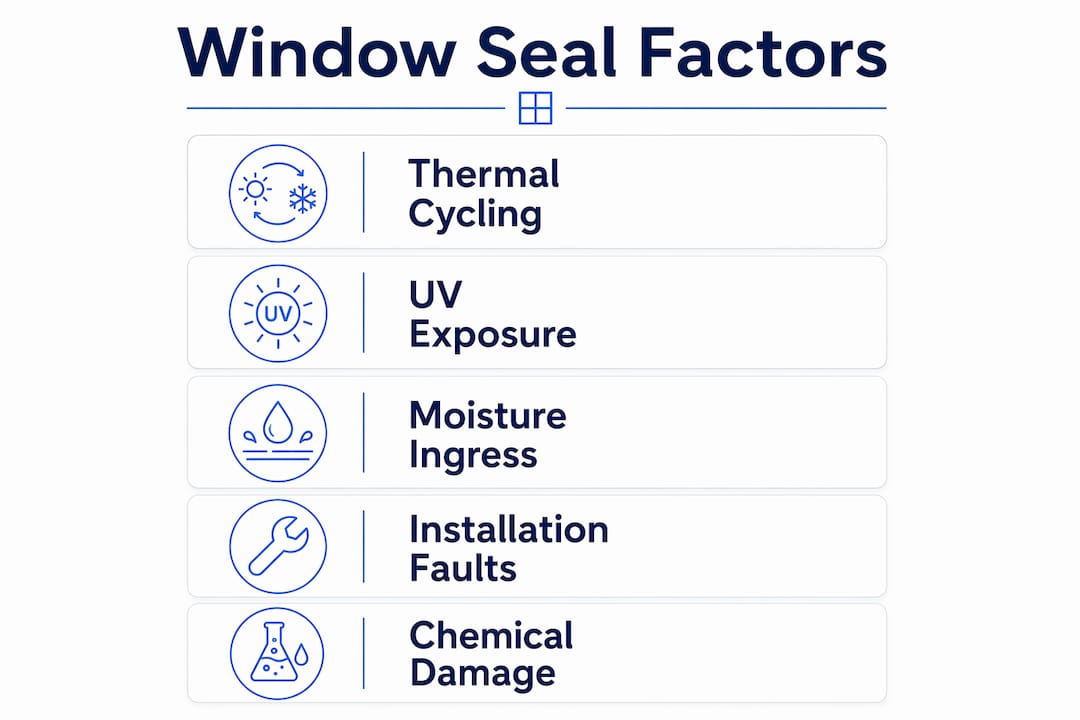
The main causes at a glance:
- Thermal cycling — the glass unit expands and contracts every single day, gradually fatiguing the edge seal
- UV photodegradation — sunlight breaks down polymer chains in butyl and polysulphide sealants, making them brittle
- Moisture and desiccant saturation — once the desiccant in the spacer bar is full, fogging becomes permanent
- Poor installation — blocked weep holes, incorrect shimming and over-compression accelerate failure
- Physical and chemical damage — impacts, pressure washers and solvent cleaners attack the seal compounds
- Material ageing — even well-made units have a finite lifespan, typically several years, depending on quality and conditions
Pro Tip: South- and west-facing windows are almost always the first to fail. If you have persistent fogging, start your inspection there before checking north-facing panes.
Table of Contents
- Why do window seals deteriorate? The mechanics behind each cause
- How to spot a failed seal: signs and simple tests
- Can a failed window seal be repaired, or does the unit need replacing?
- How long do window seals last, and what shortens their life?
- Practical steps to slow seal deterioration and extend window life
- A practical DIY checklist: what you can safely check and fix yourself
- Key takeaways
- The mistake most homeowners make with deteriorating seals
- Stock the right parts before you start any repair
- Useful sources and further reading
Why do window seals deteriorate? The mechanics behind each cause
Thermal cycling and solar pumping
Every day, the air trapped inside a double-glazed unit heats up and expands, then cools and contracts overnight. Glazing professionals call this solar pumping, and over thousands of cycles it gradually fatigues the perimeter seal. South- and west-facing windows experience the largest daily temperature swings, which is why they consistently fail earlier than north-facing panes on the same property. The seal does not snap suddenly; it creeps, micro-crack by micro-crack, until the hermetic barrier is breached.
UV photodegradation
Direct sunlight does more than fade your curtains. UV radiation breaks down the polymer chains in butyl and polysulphide sealants, causing them to harden, crack and lose adhesion. Once a sealant becomes brittle, even modest thermal movement is enough to open a gap. Windows on sunny elevations can show UV-related seal hardening noticeably earlier than shaded units on the same building.
Moisture ingress and desiccant saturation
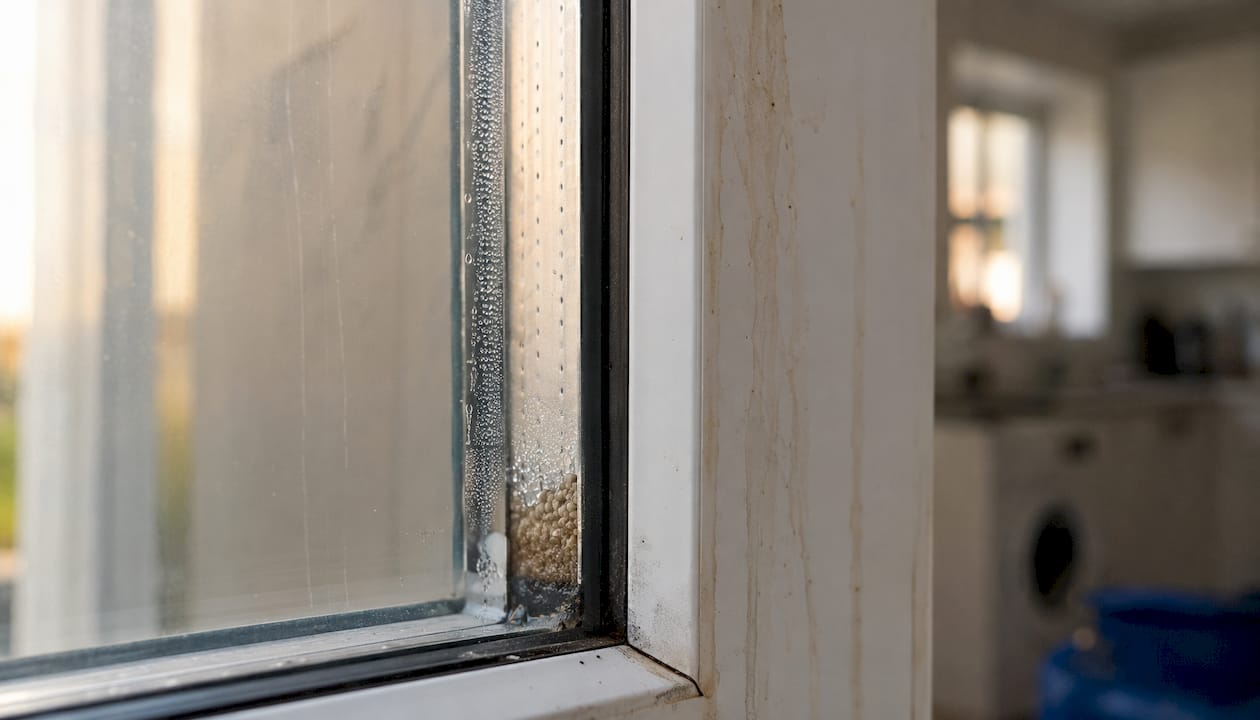
The spacer bar running around the inside edge of a sealed unit contains desiccant, a material that absorbs any moisture present during manufacture or that slowly migrates through the seal. For years it does its job quietly. When it reaches saturation, however, there is nothing left to absorb incoming moisture, and condensation becomes visible between the panes as a permanent fog or white mineral deposit. At that point, the desiccant cannot be regenerated in place; the unit itself needs replacing.
Poor installation and frame drainage faults
Missing flashings, blocked weep holes and incorrect shimming are among the most common causes of premature seal failure. When a window sits in standing water because the weep holes are clogged, the sealant at the bottom of the unit is under constant moisture attack. Over-compression during glazing concentrates stress at the corners, which are already the weakest points in the perimeter seal. A window installed out of square puts uneven load on the IGU, accelerating breakdown in ways that are almost impossible to reverse without reinstallation.
Physical and chemical damage
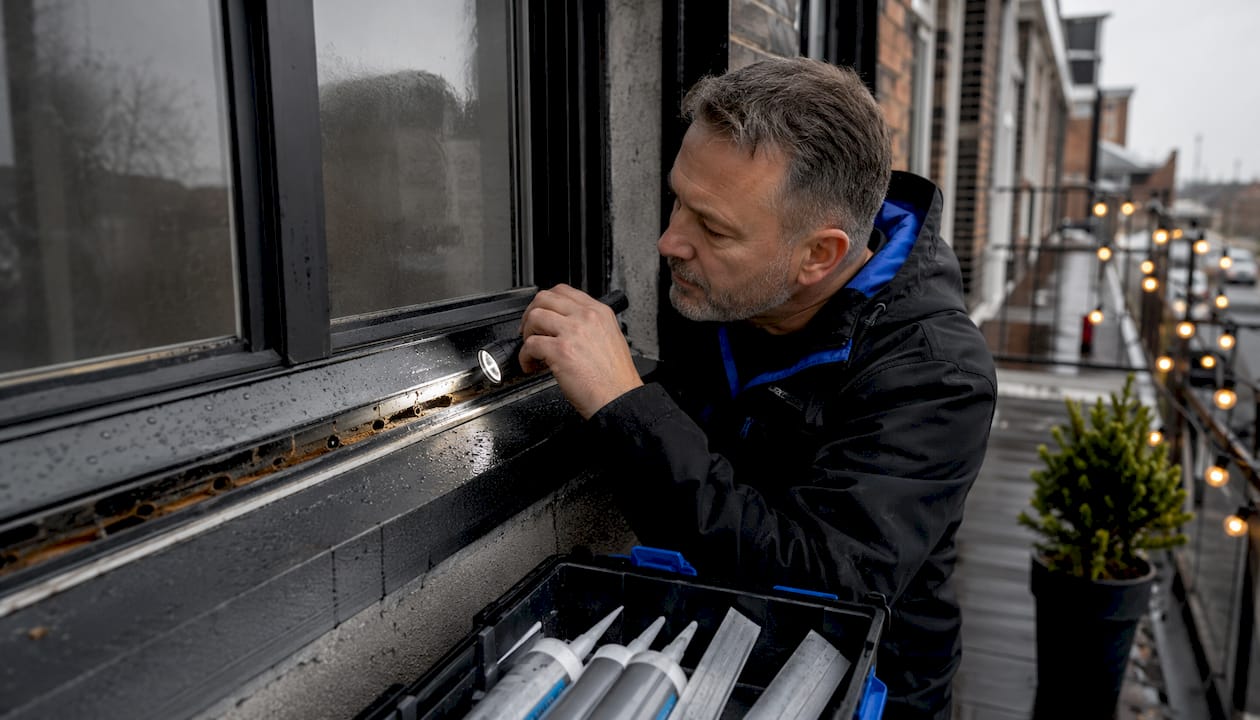
Pressure-washing aimed directly at the rebate, or applying solvent-based glass cleaners to the edge of the unit, chemically attacks and embrittles the sealant over time. The damage is cumulative and invisible until the seal fails. Impacts from garden tools, ladders or hailstones can crack or dislodge the edge seal in a single event. Low-grade units with manufacturing defects may show the same symptoms far earlier than their specification suggests.
Pro Tip: Never spray glass cleaner directly onto the window. Apply it to a cloth first, keeping solvents away from the frame edges and rebate area entirely.
How to spot a failed seal: signs and simple tests
Not every foggy window means the IGU has failed, so a methodical check saves you from unnecessary replacement costs.
Step-by-step diagnostic
- Wipe test — clean both interior and exterior glass surfaces thoroughly. If fog or haze remains, it is inside the unit.
- Check condensation timing — room-side condensation usually appears in the morning and clears as the room warms up. Cavity condensation between panes does not clear.
- Inspect the lower edge — fog often appears first at the bottom of the unit, where moisture pools inside the cavity.
- Feel for cold spots — run your hand close to the glass on a cold day. A noticeably cold zone suggests the insulating gas has escaped.
- Check weep holes and frame bottoms — look for pooled water or debris blocking the drainage slots at the base of the frame.
- Inspect spacer bars and edge seals — discolouration, rust-coloured staining or visible gaps around the spacer indicate advanced deterioration.
What each result tells you
- Fog wipes away from the interior surface — room-side condensation; improve ventilation before assuming seal failure
- Fog stays put after cleaning both sides — IGU breach; the unit needs professional assessment
- White mineral deposits inside the glass — the desiccant has been saturated for some time; replacement is the only lasting fix
- Draught near a closed window — check the draught seal and weatherstripping first, as this is often a separate issue from IGU failure
- Cold spot but no visible fog — early-stage gas loss; monitor closely and plan for replacement
Pro Tip: A cheap hygrometer placed on the windowsill can help you track indoor humidity. Readings consistently above 60% in winter often produce room-side condensation that mimics seal failure. Reduce humidity first, then recheck.
Can a failed window seal be repaired, or does the unit need replacing?
The honest answer: permanent restoration of original insulating performance almost always requires replacing the insulated glass unit. Here is why.
When a seal fails, two things happen simultaneously. The insulating gas (argon or krypton) escapes, and moisture enters. Defogging services that drill small holes and vent the cavity can reduce visible fogging temporarily, but they do not restore the gas fill and they do not return the window to its original thermal performance. The desiccant remains saturated, and the hermetic barrier stays breached.
When a temporary measure might be reasonable
- The window is relatively new and still under the manufacturer's guarantee
- Only one or two panes are affected and the frames are structurally sound
- You need a short-term cosmetic improvement while budgeting for full replacement
- The fogging is mild and intermittent, suggesting very early-stage ingress
When replacement is the responsible choice
- Permanent fog, mineral deposits or internal staining that never clears
- Multiple windows failing at the same time (often indicates a systemic installation fault or age-related batch failure)
- Cold spots that noticeably affect room comfort in winter
- Warped or water-damaged frames, which will compromise any new IGU fitted into them
Pro Tip: When replacing an IGU, ask your glazier about dual-seal units with a primary butyl seal and a secondary polysulphide or silicone seal. They offer meaningfully better longevity than single-seal alternatives.
Cosmetic options such as external perimeter recaulking can slow further moisture ingress at the frame edge, but they do not address a breached IGU. Think of them as buying time, not solving the problem.
How long do window seals last, and what shortens their life?
Well-made IGUs typically last 10–25 years, though the spread is wide because installation quality, material grade and exposure all pull the figure in different directions. In UK conditions, damp winters, coastal salt air and the temperature swings between a cold January night and a warm July afternoon all add cumulative stress that shortens service life compared with more stable climates.
| Factor | Typical lifespan range | Main risk modifier |
|---|---|---|
| High-quality IGU, sheltered site | 10–25 years | Minimal UV, good drainage |
| Standard IGU, average exposure | 15 years | Mixed orientation, moderate humidity |
| Budget IGU or poor installation | 10–15 years | Any adverse condition accelerates failure |
| South/west-facing, coastal or exposed | Can be under 10 years | Solar pumping and salt air compound UV damage |
Properties at higher risk of early failure:
- South- and west-facing elevations with unobstructed sun exposure
- Coastal locations where salt-laden air attacks sealant chemistry
- Poorly drained rebates where water pools at the base of the frame
- Older properties with timber frames that move seasonally, stressing the IGU
- Windows installed without proper flashings or with blocked weep holes
Practical steps to slow seal deterioration and extend window life
Good maintenance genuinely extends seal life. These steps are straightforward and most take only minutes.
Cleaning and chemical care
- Never spray solvent-based cleaners directly onto the glass edge or frame rebate; apply to a cloth first
- Avoid pressure-washing aimed at the window frame or rebate area
- Use mild soapy water for frame cleaning and rinse thoroughly
Drainage and moisture management
- Clear weep holes at the base of the frame every spring and autumn — a matchstick or thin wire is enough
- Check for pooled water at the frame bottom after heavy rain and clear any debris
- Inspect the external perimeter caulk annually; reapply where it has cracked or pulled away from the frame
Ventilation and humidity control
Controlling indoor humidity protects both your seals and your frames. Run extractor fans in kitchens and bathrooms, use trickle vents where fitted, and consider a concealed window restrictor to allow background ventilation safely. Aim to keep indoor relative humidity below 60% in winter.
Shading and UV protection
- Roof overhangs, external awnings and pergolas reduce direct solar heating on south-facing glass, cutting thermal cycling amplitude
- When replacing units, specify UV-stable sealants and dual-seal IGU construction
- External solar shading is one of the most cost-effective ways to extend seal life on exposed elevations
Pro Tip: When you replace a failed unit, take the opportunity to clear and repack the glazing packers correctly. Incorrect packer placement is one of the most common reasons a new IGU fails prematurely.
A practical DIY checklist: what you can safely check and fix yourself
Most homeowners can carry out these checks safely from ground level or from inside the property.
Step-by-step checks
- Wipe test — clean both glass surfaces and confirm whether fog is inside the unit or on the surface
- Hygrometer reading — check indoor humidity; above 60% in winter warrants ventilation improvements before assuming IGU failure
- Clear weep holes — use a thin implement to clear drainage slots at the frame base; check for pooled water
- Visual inspection of spacer bars — look through the glass at the spacer bar edge for rust staining, discolouration or visible gaps
- Check external perimeter caulk — run a finger along the external bead; cracking or separation is a sign it needs replacing
Small repairs a confident homeowner can tackle
- Replacing worn external perimeter caulk with a compatible silicone product (avoid solvent-based formulations near the glass edge)
- Clearing debris from drainage slots and weep holes
- Swapping a damaged or compressed perimeter gasket where it has lost its profile and no longer seats properly against the frame
Tools and parts you will need: silicone caulk (neutral-cure), a caulk gun, a plastic scraper, replacement gasket strip (match the profile to your existing seal), glazing tape for minor edge repairs, and a thin implement for clearing weep holes.
Safety warnings
- Never work at height on ladders without a second person present and proper footing
- Do not attempt to remove or reg laze a unit yourself; glass is heavy and fragile, and incorrect handling causes injury
- If a pane is cracked or broken, do not touch it; call a glazing professional immediately
When to call a professional
Permanent fogging that does not clear, cold spots affecting room comfort, warped or water-damaged frames, or more than two windows failing at the same time all warrant a professional assessment. Attempting DIY resealing on a breached IGU wastes money and delays the replacement that will actually fix the problem.
Key takeaways
Window seals fail primarily because thermal cycling, UV exposure and moisture saturation work together over years to breach the hermetic perimeter seal, and once the desiccant is saturated, only IGU replacement restores performance.
| Point | Details |
|---|---|
| Run the wipe test first | Fog that wipes away is room-side condensation; fog that stays is a breached IGU. |
| South/west-facing windows fail sooner | Solar pumping and UV exposure on exposed elevations shorten seal life significantly. |
| Typical lifespan is 10–25 years | Quality, installation and exposure all affect where in that range your windows land. |
| Defogging does not restore performance | Cosmetic fixes cannot replace lost insulating gas or regenerate saturated desiccant. |
| Windowhardwarestore stocks replacement parts | Gaskets, glazing tape and perimeter seals are available with nationwide delivery for DIY maintenance. |
The mistake most homeowners make with deteriorating seals
The most common error is delay. A homeowner notices a faint fog between the panes in January, decides it might clear up, and revisits the problem two winters later when the mineral staining has set in permanently and the frame below has started to show water damage. By that point, what was a straightforward IGU swap has become a more involved job.
The second mistake is reaching for the wrong fix. Cheap reseal services that inject sealant around the external perimeter of an already-breached unit do not address the saturated desiccant or the lost gas fill. They can slow further moisture ingress at the frame edge, but they will not restore thermal performance, and they can mask the problem long enough for frame damage to develop underneath.
The third, and perhaps least obvious, mistake is using the wrong cleaning products. Homeowners who regularly spray solvent-based cleaners directly onto the glass edge, or who pressure-wash the rebate area, are shortening their seal life with every clean. The damage is invisible and cumulative, which makes it easy to overlook until the seal fails years earlier than it should.
My suggested order of priorities: fix drainage and ventilation first, because those are the conditions that accelerate every other failure mechanism. Then address any windows showing permanent fogging or functional heat loss. Leave cosmetic surface condensation until last, because improving ventilation often resolves it without any glazing work at all.
Stock the right parts before you start any repair
When you are ready to tackle maintenance or a minor repair, having the right components to hand makes the job straightforward. Windowhardwarestore stocks a practical range of glazing consumables and window hardware, all with real-time stock visibility and fast nationwide delivery across the UK.

Relevant products for seal maintenance and minor repairs:
- Perimeter gaskets — replacement E020 and E015 gasket profiles for windows and doors, available in 10m, 25m and 50m lengths
- Wedge gaskets — TW023 wedge profile for frames requiring a different seal form factor
- Security glazing tape — 10–15mm tape for minor edge repairs and perimeter sealing tasks
- Full hardware range — door and window hardware, security locks and replacement components at Windowhardwarestore
Not sure which gasket profile matches your existing seal? Our support team can help you identify the right part from measurements or photos. Visit windowhardwarestore.com to browse stock, check availability, or get in touch with the team directly.
Useful sources and further reading
The following sources informed this article and are worth bookmarking for deeper reading or when preparing for a conversation with a glazing professional.
- Why older sealed units fail — Totalseal Repairs: a trade-focused explanation of solar pumping, desiccant saturation and UV degradation
- Window seal failure symptoms and fixes — Northridge Windows: practical symptom guide covering fog patterns, cold spots and when to replace
- What is a window seal? Signs of failure and when to replace — Masterseal: clear overview of IGU construction and failure mechanisms
- Foggy windows and condensation help — Shipshape: explains the limits of defogging services and realistic lifespan expectations
- Why window seals fail: causes and prevention — DMV Window Repairs: covers installation faults, drainage problems and prevention strategies
- Bubble gasket vs wedge gasket: which seal does your window need? — Windowhardwarestore: helps you identify the correct replacement gasket profile for your frame
For on-site diagnosis, particularly where multiple windows are failing or frames show signs of water damage, consult a qualified local glazing specialist. Online guides, including this one, are a starting point; a professional inspection gives you the specific detail your property needs.
Recommended
- Why Your Draught Seals Aren't Working: Troubleshooting Common Problems | Window Hardware Store | Window Hardware Store
- Window Handle Maintenance: Cleaning Lubrication and Tightening | Window Hardware Store | Window Hardware Store
- Bubble Gasket vs Wedge Gasket: Which Seal Does Your Window Need? | Window Hardware Store | Window Hardware Store
- Locking Window Handles: Buying Checklist | Window Hardware Store | Window Hardware Store