
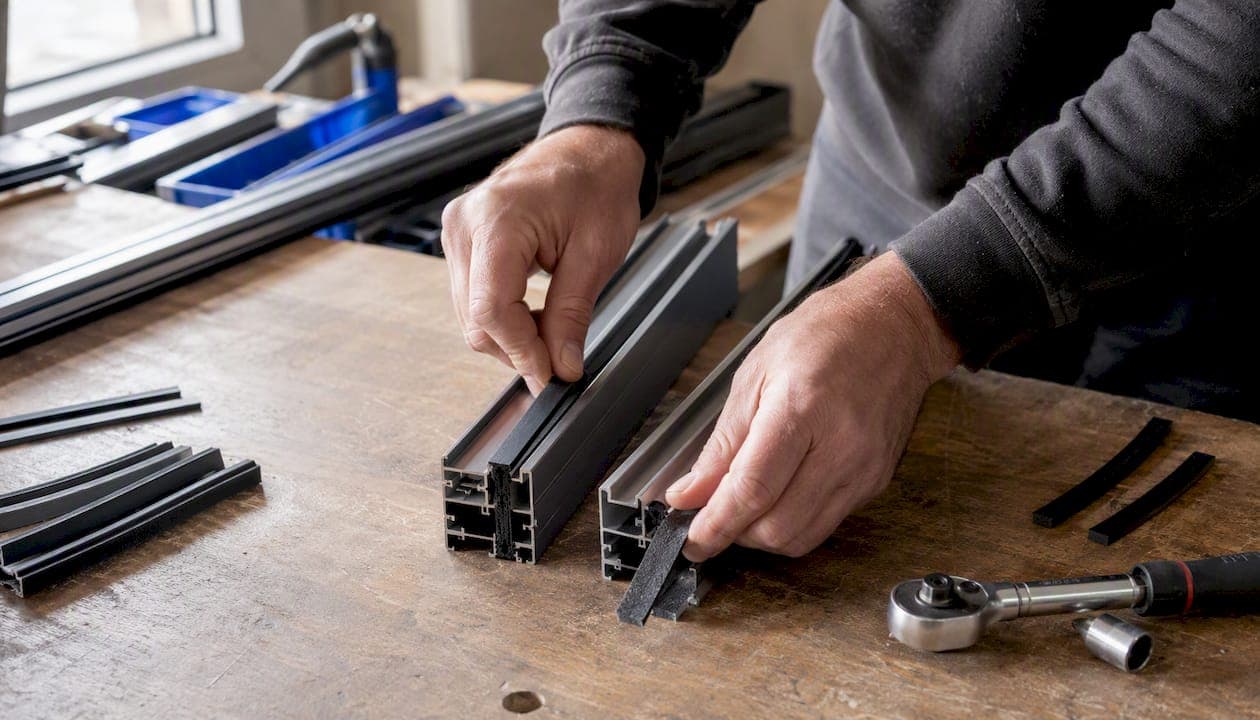
A thermal break frame is a metal window or door frame that contains an insulating barrier between its inner and outer metal profiles, interrupting the conductive heat path through the frame. In practical terms, this single design feature can roughly halve frame heat loss, reduce condensation on internal surfaces, and help metal-framed windows meet the U‑value requirements of Building Regulations Part L in the UK.
Here is what that means for your project:
- Lower frame U‑value: thermally broken aluminium frames can achieve frame U‑values in the range of 0.4–0.6 W/m²K, compared with non-broken frames that typically sit well above 2.0 W/m²K
- Reduced condensation risk: the insulating element raises the internal frame surface temperature, keeping it above the dew point under normal indoor humidity conditions
- Better occupant comfort: cold frames create radiant discomfort and draughts near glazed areas; a thermal break addresses both
- Energy savings: lower frame heat loss reduces heating demand, directly supporting compliance with BSI/EN test standards and Part L performance targets
- Retained slim sightlines: aluminium's structural strength means the break can be incorporated without significantly widening the visible frame
Key takeaways
A thermal break frame interrupts the conductive heat path through a metal frame using an insulating element with conductivity no greater than 0.5 W/m·K, reducing frame Uf from above 5 W/m²K to as low as 0.4–0.6 W/m²K in optimised systems.
| Point | Details |
|---|---|
| Definition | An insulating barrier between inner and outer metal profiles that interrupts conductive heat flow through the frame. |
| Performance range | Thermally broken aluminium frames achieve Uf values from around 2 W/m²K (standard) down to 0.4–0.6 W/m²K (deep-break, multi-chamber). |
| Fabrication quality matters | Incomplete debridging in poured systems leaves hidden metal paths; always request process documentation alongside test certificates. |
| System claim, not frame claim | Whole-window Uw depends on frame, glazing, spacer bars, and installation; verify with test evidence for the specific assembly. |
| Hardware coordination | Fixings and handles must be specified with the frame manufacturer to avoid point thermal bridges through the break. |
Table of Contents
- What does a thermal break frame actually look like inside?
- How does a thermal break actually reduce heat transfer?
- What types of thermal break are used in UK frames?
- How much difference does a thermal break make to performance?
- Thermally broken vs non-thermally broken: when does it matter most?
- Can thermally broken frames be fire rated?
- What should you ask when specifying or buying thermally broken frames?
- Thermal conductivity and U‑value data: what the numbers show
- A trade perspective on what actually predicts long-term performance
- Sources
What does a thermal break frame actually look like inside?
Slice through a thermally broken aluminium frame and you will see three distinct zones: an outer metal skin facing the weather, an inner metal skin facing the room, and an insulating element bonded or locked between them.
The main components are:
- Outer aluminium profile: the weather-facing extrusion, typically carrying the glazing rebate and weather seals
- Inner aluminium profile: the room-side extrusion, which carries internal hardware fixings and finish
- Insulating element: the thermal break itself, most commonly a polyamide (reinforced nylon) strip, poured polyurethane, or a thermal strut connector
- Mechanical lock: the joint between the insulating element and each aluminium profile, formed by rolling or crimping the aluminium flanges around the break material to create a structurally sound, load-bearing connection
- Gaskets and seals: EPDM or neoprene gaskets seated in the glazing rebate and at the frame perimeter; these contribute to both air tightness and secondary thermal resistance
The term thermally improved describes frames where the break is present but modest in depth. Pour-and-debridge refers specifically to the polyurethane manufacturing method. Thermal strut describes a connector-based approach. Standards guidance notes that thermal barrier material conductivity must be no more than 0.5 W/m·K, with practical break depths starting at around 5.3 mm and extending to 25 mm for deeper reinforced nylon sections.
How does a thermal break actually reduce heat transfer?
Thermal breaks work by interrupting the conductive path through the metal. Conduction is the dominant heat transfer mode through a frame: heat moves directly through the solid material from the warm side to the cold side, and aluminium is exceptionally good at it.
Aluminium has a thermal conductivity of approximately 160 W/m·K, while typical thermal break materials such as polyamide or polyurethane have conductivities well below 1 W/m·K. That contrast of more than 160:1 explains why even a narrow insulating strip produces a large reduction in frame heat loss.
Three metrics matter when you are specifying:
U‑value (Uf / Uw): the rate of heat transfer through the frame (Uf) or the whole window assembly (Uw), expressed in W/m²K. Lower is better. The frame U‑value feeds directly into the whole-window Uw calculation alongside the glazing centre-pane value and the edge-of-glass effect.
Linear thermal transmittance (psi, Ψ): the heat flow per metre of length at a junction or edge, such as where the frame meets the wall or where a transom meets a mullion. A thermally broken frame reduces psi at these junctions, which matters for whole-building heat loss calculations.
Condensation resistance factor (CRF): a dimensionless index that predicts how well a window assembly resists surface condensation under standardised indoor and outdoor conditions. Higher CRF means the internal surface stays warmer and drier.
A high-performance glazing unit paired with a non-thermally broken aluminium frame can still produce a poor whole-window Uw, because the frame acts as a thermal short-circuit around the edges of the glass. This is why frame conductivity cannot be treated as secondary to glazing specification.
What types of thermal break are used in UK frames?
The UK market uses four principal construction methods, each with different manufacturing processes, performance characteristics, and typical applications.
-
Polyamide (reinforced nylon) strips: the most widely used approach for residential and light commercial aluminium windows. A pre-formed strip of glass-fibre reinforced polyamide is mechanically locked into both aluminium profiles by rolling or crimping the aluminium flanges. Strip widths typically range from 14 mm to 34 mm; wider strips give lower Uf values. The method is reliable, well-understood, and produces consistent results when the rolling process is correctly controlled.
-
Poured-and-debridged polyurethane: liquid polyurethane is poured into a cavity formed between the two aluminium profiles, allowed to cure, and then the aluminium bridge at the base of the cavity is machined away. The result is a monolithic polymer core with excellent bonding to both profiles. Incomplete debridging can leave hidden metal paths that significantly compromise thermal performance, making fabrication process control critical.
-
Neoprene or PVC gasket breaks: a softer, compressible insulating gasket is used as the separating element. This approach is common in curtain wall and commercial glazing systems where the gasket also performs a sealing function. Thermal performance is generally lower than polyamide strip systems of equivalent depth.
-
Thermal strut connectors: a structural connector made from a low-conductivity material bridges the two metal profiles at discrete points. Specifiers should check the tested psi (linear transmittance) and the mechanical details for thermal strut systems, as performance varies considerably between products.
Multi-chamber profiles, where the aluminium extrusion itself contains internal air pockets, add secondary thermal resistance alongside the break. Durability across all four types is generally good; polyamide and polyurethane systems in particular show stable long-term performance when correctly manufactured and installed.
How much difference does a thermal break make to performance?
The performance gap between thermally broken and non-thermally broken metal frames is substantial. Published guidance from the NFRC notes that aluminium frame U‑factors can be reduced from roughly 2.0 to about 1.0 Btu/hr·ft²·°F when standard thermal breaks are used. In SI units, that translates to a frame Uf dropping from above 5 W/m²K for a non-broken aluminium frame to around 2–3 W/m²K for a standard thermally broken system, and lower still for deeper break designs.
At the higher-performance end, thermally broken aluminium frames can reach relatively low frame U‑values, making them comparable with timber or uPVC frames when combined with appropriate glazing.
The condensation picture is equally clear. A non-thermally broken aluminium frame in a UK winter can have an internal surface temperature close to the outdoor air temperature, well below the dew point of normal indoor air. A thermally broken frame raises that surface temperature significantly, which reduces the risk of condensation streaks, mould growth at the frame perimeter, and the associated maintenance problems.
For energy compliance, Building Regulations Part L sets whole-building fabric performance targets. A thermally broken frame contributes directly to meeting the notional building specification and to demonstrating compliance through SAP or SBEM calculations. Non-thermally broken metal frames will typically fail to meet the Uf thresholds referenced in current Part L guidance for new dwellings and commercial buildings.
The SCGMA technical bulletin on glazing system thermal breaks links CRF directly to correct mechanical locking and sealing during manufacture, reinforcing that performance is as much about fabrication quality as material choice.
Thermally broken vs non-thermally broken: when does it matter most?
The choice is not always straightforward. Here is a direct comparison to help you prioritise.
Thermally broken frames: advantages
- Substantially lower frame Uf, supporting Part L compliance
- Higher internal surface temperatures, reducing condensation risk
- Improved whole-window Uw when paired with double or triple glazing
- Reduced cold-edge radiant discomfort in occupied spaces
- Better acoustic performance in some systems due to the polymer layer
Thermally broken frames: considerations
- Higher unit cost than non-broken equivalents
- Structural performance must be verified for the specific break design under load
- Fire-rated applications require tested assemblies (see below)
Non-thermally broken frames: where they still appear
- Unheated agricultural, industrial, or storage buildings where condensation and heat loss are not primary concerns
- Replacement of existing non-broken frames in buildings not subject to Part L upgrade requirements
- Coastal or high-corrosion environments where some polymer break materials require additional assessment
When the thermal break is the primary lever: UK climate, large glazed areas, high internal humidity (kitchens, bathrooms, swimming pools), and new-build or major refurbishment projects subject to Part L all make a thermal break the first specification decision.
When glazing dominates: in high solar gain façades or south-facing commercial buildings, low-e glazing films and solar control coatings can be the more impactful intervention. The frame break still matters for condensation and winter heat loss, but the glazing specification drives summer performance.
Can thermally broken frames be fire rated?
Yes, thermally broken frames can form part of fire-rated assemblies, but the insulating polymer element introduces considerations that specifiers must address explicitly.
The key point is that fire rating is a system property, not a frame property. A tested and certified fire-rated assembly will specify the exact frame profile, glazing, intumescent seals, fixings, and installation method. Substituting a thermally broken frame into a previously tested non-broken assembly, or vice versa, invalidates the test evidence.
Checklist for specifiers and installers:
- Request the fire test report for the specific thermally broken assembly, not a generic certificate for the frame profile alone
- Confirm the polymer break material's behaviour at the rated temperature; some polyamide grades soften at temperatures below the fire rating threshold
- Check that intumescent seals are specified at all frame-to-wall junctions and at glazing rebates
- Verify that the thermal break does not interrupt the load path required for the fire-rated frame to maintain integrity under test conditions
- For high-rise applications, cross-reference with window restrictor regulations and any additional fire-safety requirements under the Building Safety Act 2022
Red flags: any claim of fire rating without a specific test report; plastic bridges remaining after debridging in poured systems; and modifications to a tested assembly made on site without re-testing.
What should you ask when specifying or buying thermally broken frames?
Whether you are tendering a commercial project or replacing windows in a single property, these questions will separate a well-specified frame from a vague "thermally broken" claim.
- What is the thermal conductivity of the break material, and does it meet the ≤0.5 W/m·K threshold?
- What is the break depth (separation between inner and outer profiles), and what Uf value does the manufacturer's test evidence support?
- Can you provide the linear thermal transmittance (psi) for the frame-to-wall junction and for transoms and sills?
- What is the whole-window Uw for the specific glazing unit and frame combination I am specifying?
- What is the CRF for the assembly, and under what indoor/outdoor conditions was it tested?
- Is the frame tested to BSI/EN standards, and can you provide the test certificate?
- For poured systems: what is the debridging process, and how is it verified in production?
- Are the hardware fixings and gasket grooves compatible with the thermal break design, and does fixing into the break material affect structural performance?
On delivery and site, look for:
- Visible metal continuity between inner and outer profiles (a sign of incomplete debridging or a missing strip)
- Gaps or misalignment in the polyamide strip at corners and joints
- Poor sealing at transoms, sills, and frame-to-wall junctions
Pro Tip: Request the manufacturer's fabrication process documentation alongside the test certificate. A certificate alone tells you what the frame achieved in a lab; the process document tells you whether your specific frames were made the same way. For poured-and-debridged systems, ask specifically how debridging is verified and whether there is a production quality record.
Coordinating gasket selection with the frame manufacturer matters more than many installers realise. The wrong gasket profile can leave gaps at the glazing rebate that undermine both thermal and acoustic performance, regardless of how good the break itself is.
Thermal conductivity and U‑value data: what the numbers show
The table below illustrates the conductivity contrast between aluminium and common thermal break materials, alongside indicative frame U‑value ranges. These figures are illustrative; actual Uf values depend on frame depth, profile geometry, number of internal chambers, and the specific glazing assembly.
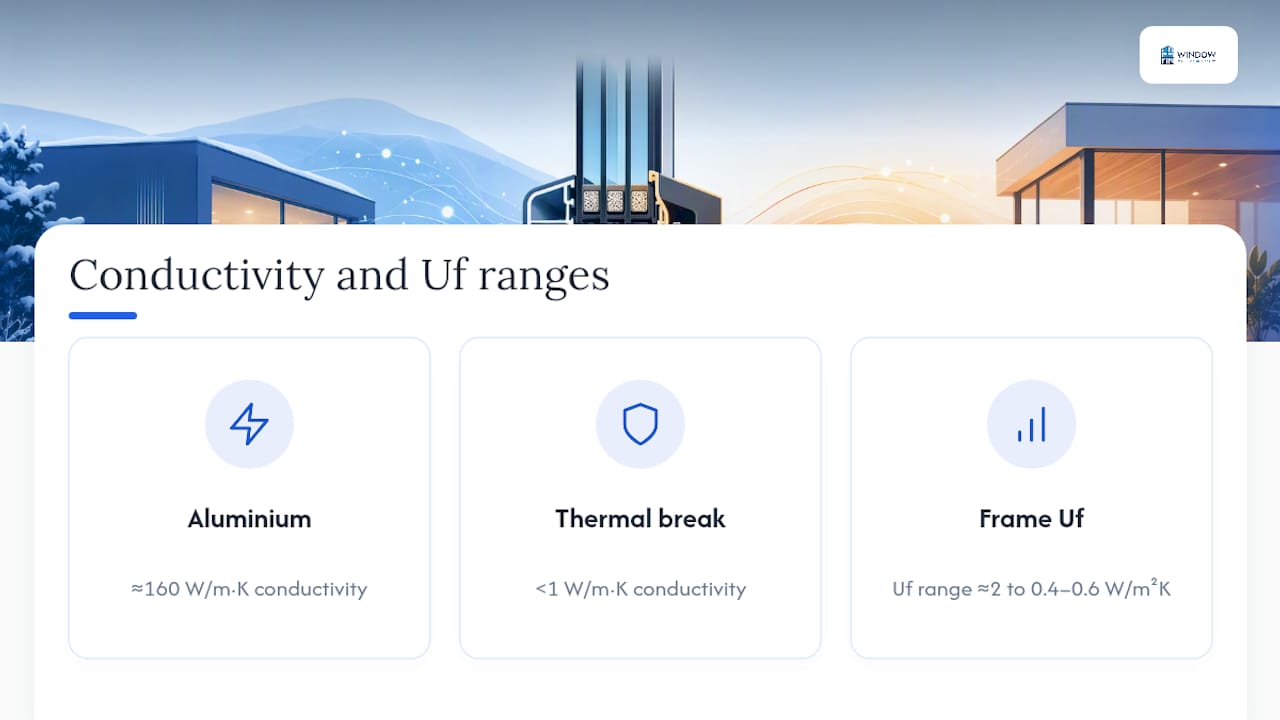
Aluminium's conductivity of approximately 160 W/m·K compared with under 1 W/m·K for thermal break materials explains the scale of the improvement. The deep-break, multi-chamber figure of 0.4–0.6 W/m²K reflects optimised systems; a standard 14 mm polyamide strip will sit toward the higher end of the thermally broken range.
When comparing manufacturer data sheets, always check whether the quoted Uf is for the frame alone or for the whole window Uw. A low Uf can still produce a mediocre Uw if the glazing unit is poor or the edge-of-glass spacer bar is highly conductive.
A trade perspective on what actually predicts long-term performance
The specification questions above are necessary, but in practice the most reliable predictor of long-term thermal performance is not the break material itself. It is whether the fabrication process was correctly followed and whether the installation detailing was completed properly.
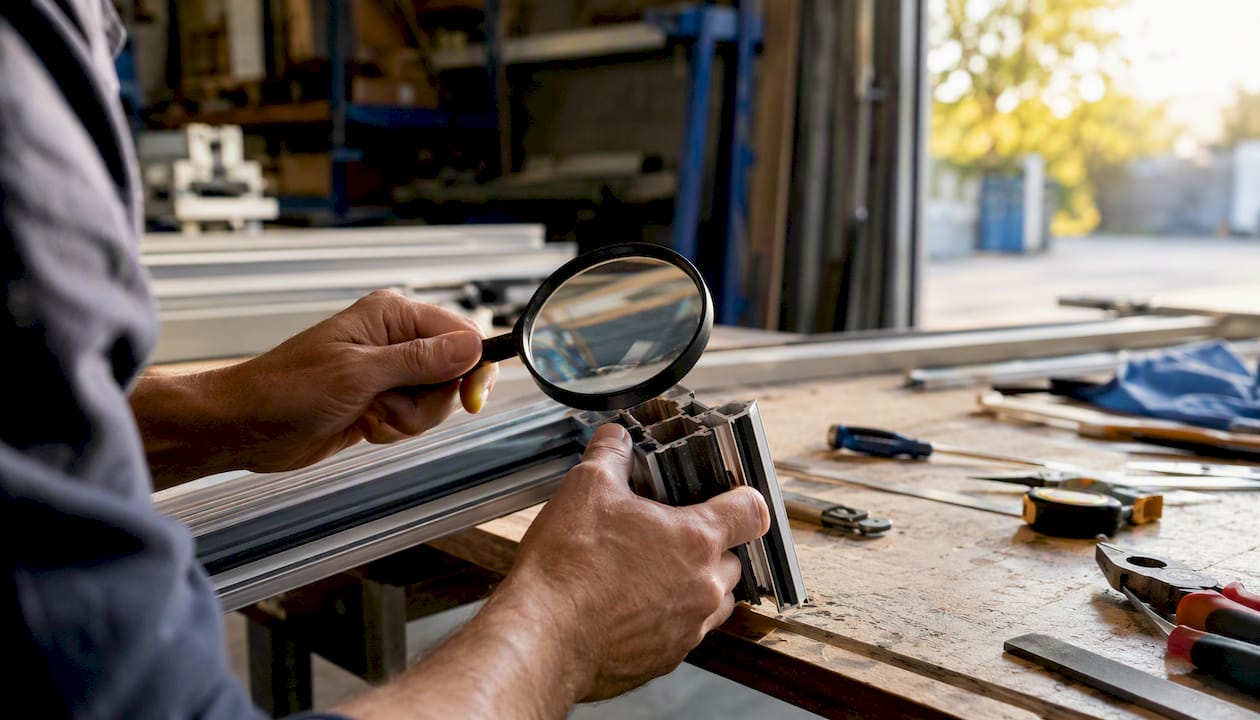
Poured-and-debridged systems are particularly susceptible to process shortcuts. A thin aluminium bridge left after incomplete debridging is almost invisible in a finished frame but creates a direct conductive path that can significantly raise the effective Uf. Glass Magazine's analysis of thermally broken framing makes this point clearly: fabrication steps are critical, and the finished frame gives little visual indication of whether the process was done correctly.
Hardware selection is the other area where we see problems in practice. Fixings that pass through the thermal break into the opposite aluminium profile create point thermal bridges. Handles, restrictors, and locking mechanisms need to be specified with the frame manufacturer, not chosen independently after the frame is ordered. For guidance on coordinating hardware with frame design, the window handles for double-glazed windows checklist is a practical starting point.
Sources
The following references are the most relevant for UK specifiers and installers working with thermally broken frames.
- How does thermal break technology improve windows?
- Framing - Thermally Broken Frames | Better Building Docs
- SCGMA technical bulletin glazing system thermal breaks
- Thermal break strip on windows
- Thermal break
- How to keep people cool: thermally broken framing
For compatible gaskets, hardware, and sealing components for thermally broken window and door frames, Windowhardwarestore stocks a full range with real-time availability and fast UK delivery. Trade and homeowner orders welcome.

Recommended
- Locking Window Handles: What They Do and When You Need Them | Window Hardware Store | Window Hardware Store
- Casement Window Stays: Keeping Your Windows Open Safely | Window Hardware Store | Window Hardware Store
- Window Restrictor Regulations: Safety Requirements Explained | Window Hardware Store | Window Hardware Store
- Window Handles with Locks: When You Need Them and Why | Window Hardware Store | Window Hardware Store