

Concealed hinges are mechanical assemblies made up of three parts: a cup pressed into a recess in the door, an arm that links the door to the frame, and a mounting plate fixed to the cabinet or door frame. When the door closes, all three components fold out of sight, leaving a completely uninterrupted face. Use concealed hinges when you want a flush, clean finish or need the flexibility of post-installation adjustment. The 35mm cup is the global standard for European cabinet hinges, and three-way adjustment is built into most modern designs, making them the default choice for custom cabinetry and increasingly popular for architectural doors across UK projects.
Key takeaways
Concealed hinges are the professional standard for custom cabinetry and minimalist architectural doors because they combine a flush finish with three-way post-installation adjustment and, in many cases, tamper-resistant internal hardware.
| Point | Details |
|---|---|
| Match overlay to construction | Confirm full, half, or inset overlay against cabinet drawings before ordering — wrong overlay is the most common specification error. |
| Specify soft-close explicitly | Soft-close is a model option, not a default; always state it when ordering or it will not be included. |
| Confirm fire rating for fire doors | Fire-rated hinges must be part of a tested assembly; never substitute a standard hinge on a fire door. |
| Finalise spec during shop drawings | Changing overlay type or mounting plate after carcasses are built is costly; lock the specification early. |
| Use three-way adjustment for alignment | Side, height, and depth screws let you correct gaps and reveals after hanging without removing the door. |
| Windowhardwarestore for trade and home | Real-time stock, trade pricing, and technical support for concealed hinge selection and compatibility checks across the UK. |
Table of Contents
- What are concealed hinges? Types and how they differ
- How do concealed hinges work?
- What are the benefits and drawbacks of concealed hinges?
- How do you choose the right concealed hinge?
- How to install and adjust concealed hinges
- Special applications: fire doors, heavy doors, and slim profiles
- Why buying from a specialist supplier makes a difference
- A trade perspective on getting concealed hinges right
- Stock, support, and next-day delivery from Windowhardwarestore
- Sources
What are concealed hinges? Types and how they differ
Concealed hinges split into two broad families: cabinet hinges (often called European or cup hinges) and architectural door hinges. Understanding which family you are dealing with determines almost everything else about specification and installation.
Cabinet (European cup) hinges
These are the hinges you find on virtually every modern kitchen, bedroom, and bathroom cabinet. The 35mm cup standard is universal across manufacturers, which means cups, arms, and mounting plates from different brands are often interchangeable. The three overlay categories define which hinge you need:
- Full overlay: the door sits fully over the cabinet side panel. Used on frameless (carcass) cabinets, which are the most common configuration in modern UK kitchens.
- Half overlay: two doors share a single cabinet panel, each covering half of it. Common in face-frame cabinets or where a central divider is shared.
- Inset: the door sits flush inside the cabinet opening. Requires a different crank angle and is typical of traditional or Shaker-style furniture.
Getting the overlay wrong is one of the most common specification mistakes, so confirm the cabinet construction type before ordering.
Architectural and door concealed hinges
For interior and exterior doors, concealed hinges work differently. Rather than a cup-and-arm mechanism, these use a multi-link pivot system embedded in both the door edge and the frame. When the door closes, the linkage arms collapse inward, producing a completely flush face with no visible hardware. Opening angles on some designs reach up to 180°, which suits wide-access or accessibility applications.
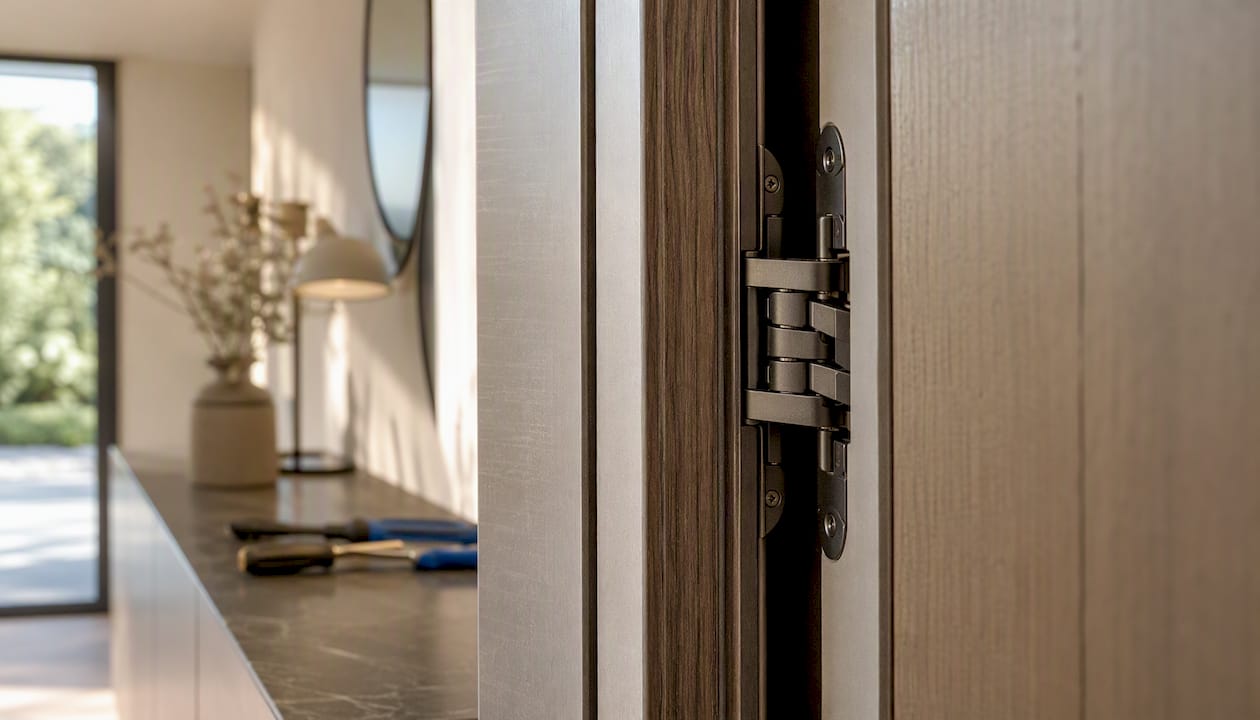
The SFS W-Tec range is a well-known industry example for interior architectural doors in the UK, engineered as a multi-lever, multi-axis solution for minimalist design where the door is intended to blend into the wall.
Special variants worth knowing
- Soft-close: a damper mechanism that slows the door in the final degrees of closing. Available across most cabinet hinge ranges but not included on every model by default — specify it explicitly when ordering.
- Push-to-open: removes the need for a handle; the door springs open with a gentle push. Often paired with handleless kitchen designs.
- Wide-angle: opens to 165° or 170°, useful for corner cabinets or where full access to the interior is needed.
- Fire and heavy-duty architectural: higher weight ratings, tested assemblies, and specific fire ratings for use on fire doors. SFS W-Tec and similar ranges cover this category.
How do concealed hinges work?
The core components are the cup, the arm, and the mounting plate. Each plays a distinct role.
The cup is a circular recess bored into the back face of the door, typically 35mm in diameter and around 13mm deep. The hinge body snaps or screws into this recess. The arm is the lever-like link between the cup and the mounting plate. It folds as the door opens and closes, controlling the swing arc. The mounting plate (also called the baseplate or frame) screws to the inside of the cabinet side panel or door frame and accepts the arm via a clip-on or screw-fix connection.
For architectural door hinges, the mechanism is a multi-link pivot rather than a simple arm. The linkage arms are embedded in mortices cut into the door edge and frame, and they collapse inward when the door closes — which is why the face remains completely flush.
Three-way adjustment explained
Three-way adjustment is the practical reason concealed hinges dominate custom cabinetry. Once the hinge is installed, three screws let you move the door independently in each axis:
- Side (lateral): moves the door left or right to equalise the gap between adjacent doors.
- Height (vertical): raises or lowers the door to align the top and bottom reveals.
- Depth (in/out): moves the door closer to or further from the cabinet face, correcting a proud or recessed door front.
Small adjustments of 1–2mm in each axis are usually enough to correct minor construction tolerances without removing the door. This is the core reason concealed hinges are the professional standard for custom cabinetry.
What are the benefits and drawbacks of concealed hinges?
Concealed hinges offer a genuinely strong set of advantages, but they are not the right choice for every situation. Here is an honest assessment.
Benefits
- Clean aesthetics: no visible hardware when the door is closed, which suits minimalist and contemporary interiors.
- Tamper resistance: because the hardware is internal, it cannot be accessed from outside, making concealed hinges a practical choice for cabinets and enclosures where security matters.
- Three-way adjustability: post-installation correction of gaps and reveals without removing the door.
- Easy door removal: most clip-on mounting plates allow the door to be lifted off without tools, which is useful during fitting or decorating.
- Wide opening angles: standard models open to 110°; wide-angle variants reach 165°–170°.
Drawbacks
- Higher cost than simple butt hinges, particularly for architectural-grade units.
- More precise installation: cup boring must be accurate in diameter, depth, and position.
- Specific tooling required: a 35mm Forstner bit or dedicated hinge-boring machine for the cup recess.
- Limited retrofit options: adding concealed hinges to an existing door or cabinet may require significant modification.
- Soft-close is not automatic — it must be specified as a model option.
Price guidance for the UK market
Basic cabinet concealed hinges are among the most affordable hardware items available, with entry-level models costing only a few pounds each. Architectural concealed hinges for heavy or fire-rated doors sit at the other end of the scale, where unit costs are substantially higher and the specification process is more involved. Budget accordingly when moving from cabinetry to door applications.
How do you choose the right concealed hinge?
Work through this checklist before placing an order. Missing one item is usually what causes a return or a site delay.
Selection checklist
- Cabinet construction: frameless or face-frame? This determines the overlay category.
- Overlay type: full, half, or inset — confirm against the cabinet drawings.
- Door weight and thickness: check the manufacturer's rated capacity; heavier doors need reinforced arms or additional hinges.
- Opening angle: standard 110° suits most applications; wide-angle or 180° variants suit corner units or accessibility requirements.
- Soft-close: specify explicitly if required — it is a model choice, not a standard inclusion.
- Fire rating: required for fire doors; confirm the hinge is part of a tested and certified assembly.
- Finish and corrosion resistance: nickel, stainless, or zinc-plated options suit different environments; marine or high-humidity spaces need appropriate protection.
Door and cabinet type matched to hinge family
| Door or cabinet type | Recommended hinge family |
|---|---|
| Frameless kitchen cabinet, full overlay | European cup hinge, full overlay |
| Face-frame cabinet, shared panel | European cup hinge, half overlay |
| Traditional or Shaker inset cabinet | European cup hinge, inset crank |
| Corner cabinet needing full access | Wide-angle cup hinge (165°–170°) |
| Handleless kitchen, no visible hardware | Push-to-open cup hinge |
| Interior architectural door, flush finish | Multi-link concealed door hinge (e.g. SFS W-Tec) |
| Fire door | Fire-rated concealed hinge, tested assembly |
For interior door swing and clearance, confirm the opening direction before specifying the hinge, as this affects which side the mounting plate sits on and whether a wide-angle variant is needed.
Common specification mistakes to avoid
- Ordering full-overlay hinges for an inset cabinet (or vice versa).
- Specifying the wrong cup depth for the door thickness, which prevents the hinge from sitting flush.
- Assuming soft-close is included when it is a separate model option.
- Failing to confirm fire rating for doors in a fire-compartment wall.
- Overlooking mounting plate compatibility when mixing hinge arms from different product lines.
Pro Tip: Check manufacturer technical portals for door-finder tools that match hinge families to specific door and frame configurations — this is particularly useful for architectural applications where weight, thickness, and fire rating all interact.
How to install and adjust concealed hinges
Installation follows a clear sequence. Getting each step right avoids the most common on-site problems.
Installation steps
- Confirm the hinge family and overlay type against the cabinet or door drawings before cutting anything.
- Mark the cup positions on the door face using a template or jig. Standard positioning is typically 100mm from the top and bottom edges of the door, with additional hinges at equal intervals for taller doors.
- Bore the cup recess using a 35mm Forstner bit set to the correct depth (usually 13mm). A dedicated hinge-boring machine gives the most consistent results on production runs. For guidance on mortising technique, the principles in butt hinge mortising apply equally to preparing accurate recesses.
- Fix the mounting plates to the cabinet side panel or door frame at the corresponding positions, using the manufacturer's specified screw pattern.
- Clip the hinge arm onto the mounting plate and check the door sits square in the opening before tightening fully.
- Test the swing through the full opening arc and check for binding or uneven gaps.
Making the three-way adjustment
Once the door is hung, use a cross-head screwdriver to make fine corrections:
- Side screw: turn clockwise to move the door towards the hinge side; anticlockwise to move it away. Use this to equalise the gap between adjacent doors.
- Height screw: loosening allows the door to slide up or down on the mounting plate slot; re-tighten once the reveal is even.
- Depth screw: moves the door in or out relative to the cabinet face. A door that sits proud of the cabinet front needs the depth screw adjusted inward.
For composite doors, the same three-axis principle applies — see composite door hinge adjustment for door-specific guidance.
Pro Tip: Finalise the hinge specification during the shop drawing phase for custom millwork or joinery projects. Changing overlay type or mounting plate after the carcasses are built is costly and time-consuming.
Fire door compliance
Fire doors require hinges that are part of a tested and certified assembly. Always follow the manufacturer's installation instructions and confirm compliance with UK standards before fitting. For detailed compliance requirements, fire door hinge guidance covers the key checks installers need to make.
Special applications: fire doors, heavy doors, and slim profiles
Not every project uses a standard 18mm cabinet door or a lightweight interior door. Here is how specification changes for demanding applications.
Fire doors
- Concealed hinges for fire doors must be part of a tested door assembly — the hinge, door, and frame are tested together, not independently.
- Confirm the fire rating (typically FD30 or FD60 in the UK) and that the hinge manufacturer provides documentation for the specific assembly.
- Weight ratings are higher for fire doors, which are heavier than standard interior doors; check the manufacturer's load specification carefully.
- Never substitute a standard concealed hinge for a fire-rated one, even if the physical dimensions appear identical.
Heavy and architectural doors
- Architectural concealed hinges use multi-axis designs with higher load ratings, often supporting doors well above the capacity of standard cabinet hinges.
- Mounting arrangements differ: some architectural hinges require deeper mortices or additional reinforcement plates in the door edge.
- The SFS W-Tec range is an example of a multi-lever, multi-axis architectural hinge engineered for minimalist interior doors in the UK, handling both weight and thin profiles.
- For a starting point on supplier enquiries, specify: door weight (kg), door thickness (mm), opening angle required, and whether a fire rating applies.
Slim and ultra-thin profiles
- Some concealed hinge families are engineered for doors as thin as 16mm, using a shallower cup depth and a reduced arm profile.
- Confirm the minimum door thickness in the manufacturer's data sheet before ordering — fitting a standard 13mm cup into a 16mm door leaves only 3mm of material behind the cup, which is insufficient.
- Slim-profile hinges typically have a lower weight rating than standard models, so check both dimensions together.
Why buying from a specialist supplier makes a difference
Sourcing concealed hinges from a specialist trade supplier rather than a general DIY retailer gives you access to things that genuinely affect project outcomes: real-time stock visibility, technical support for hinge selection, and trade pricing without minimum order requirements.
When a project involves fire doors, heavy architectural doors, or an unusual overlay configuration, a supplier's technical team can confirm cup depth, mounting plate compatibility, and fire rating documentation before you order. That check takes minutes and avoids the kind of specification error that costs a day on site.
Windowhardwarestore stocks concealed hinge ranges for both trade and household applications, with next-day UK delivery options and a support team available for complex specifications. If you are working with SFS W-Tec products or need to confirm compatibility between hinge arms and mounting plates, the team can advise on the right combination. For uPVC and composite door hinge options, the same stock and support applies across the full range.
Contact a specialist before ordering if: the door is fire-rated, the weight exceeds standard cabinet hinge ratings, the profile is unusually thin, or you are mixing hinge arms and mounting plates from different product lines.
A trade perspective on getting concealed hinges right
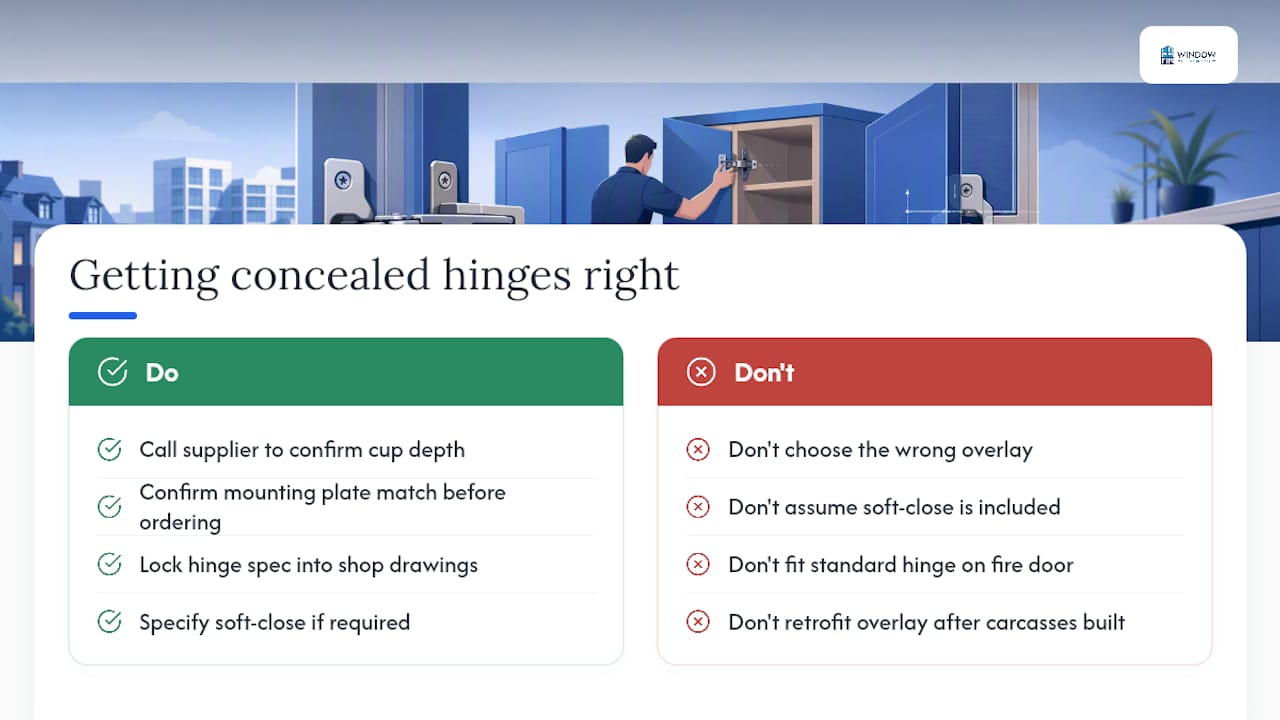
The specification errors I see most often are not about the hinge itself — they are about the decisions made before anyone picks up a Forstner bit. Choosing the wrong overlay, assuming soft-close is included, or fitting a standard hinge on a fire door: these are the mistakes that generate callbacks and cost time. The hinge is the easy part once the specification is correct.
What I would encourage any installer or homeowner to do is treat the supplier conversation as part of the process, not an afterthought. A quick call or message to confirm cup depth, mounting plate match, and fire rating before ordering takes very little time and removes the main sources of on-site delay. If you are working from shop drawings, lock the hinge specification into those drawings before the carcasses are built. Retrofitting a different overlay type after the fact is the kind of job nobody wants.
Concealed hinges are genuinely good hardware when they are specified correctly. The three-way adjustment alone makes them worth the extra cost over a simple butt hinge for any project where precision gaps and reveals matter. Get the overlay right, specify soft-close if you need it, and confirm fire ratings where they apply. Everything else follows from those three decisions.
Stock, support, and next-day delivery from Windowhardwarestore
Trade professionals and homeowners across the UK can source concealed hinges directly from Windowhardwarestore, with real-time stock visibility and trade pricing available to all customers — no account or minimum order required.

Whether you need standard European cup hinges for a kitchen fit-out, wide-angle variants for a corner cabinet, or architectural-grade hinges for a heavier door, the team can confirm compatibility, check mounting plate matches, and advise on fire-rated options before you order. Next-day UK delivery is available on stocked lines, so a specification query today does not have to delay a job tomorrow.
This article is published by Windowhardwarestore. If your project involves complex specifications — fire doors, unusual door thicknesses, or mixed hinge families — contact the team directly for technical support before placing your order.
Sources
- Concealed cabinet hinges: what to spec, what to skip, and why it matters
- Concealed hinges. Types, features and application. - SFS
- Concealed hinges: everything to know about hidden door hinges
- What are concealed hinges and how do they work?
- How do hidden door hinges work? | AKADA
- What are concealed hinges? - Essentra Components
Recommended
- How Many Butt Hinges Per Door? Guidelines for UK Doors | Window Hardware Store | Window Hardware Store
- Fire Door Butt Hinges: Compliance Requirements | Window Hardware Store | Window Hardware Store
- Composite Door Adjustment Hinges Adjusting | Window Hardware Store | Window Hardware Store
- How to Mortise for Butt Hinges: Carpentry Tips | Window Hardware Store | Window Hardware Store