
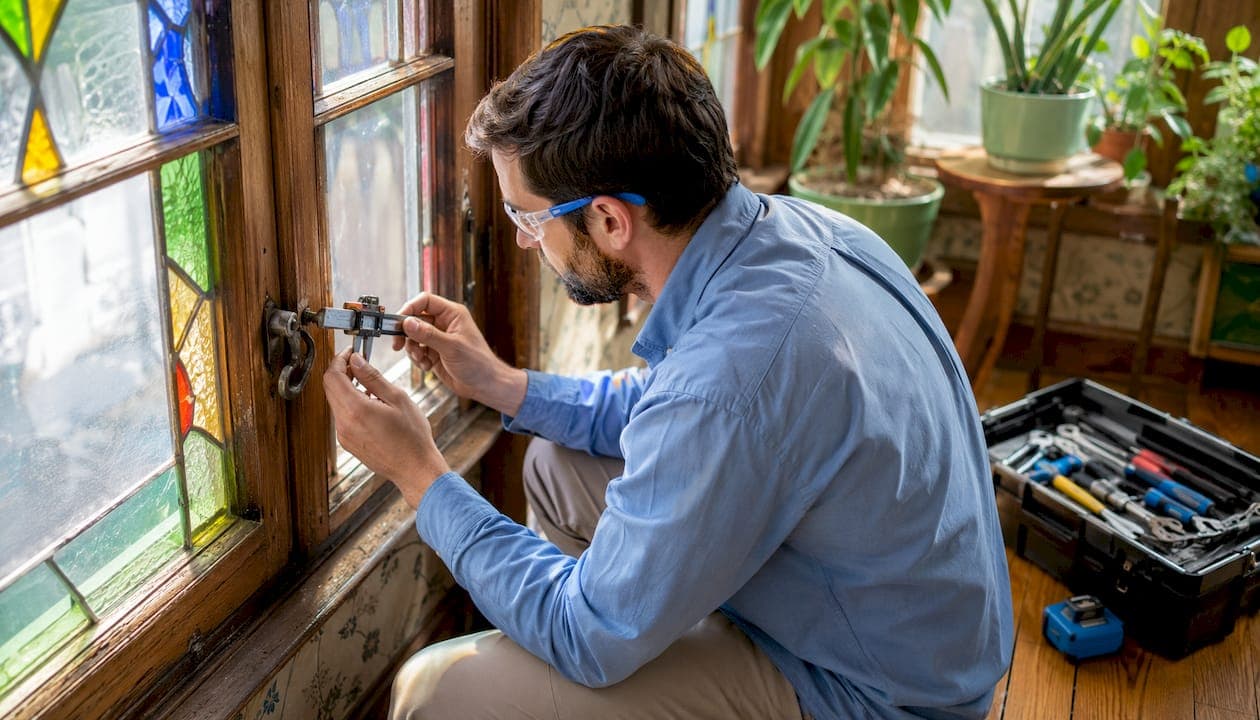
Finding a match for a discontinued window part is faster than most people expect, provided you work in the right order. The quickest route: locate any cast or etched part number on the hardware, photograph the part in place, record four critical measurements to trade tolerances, then check specialist trade suppliers before moving on to salvage, universal retrofits, or remanufacture. This sequence alone resolves the majority of cases.
Before you start, copy this checklist:
- Where to look: sash edge, hinge pocket, operator body, spacer bars between panes, foil stickers inside the frame
- Four measurements to take: screw centres, arm length, spindle length, profile thickness (all to the nearest 1 mm)
- Three priority search sources: manufacturer parts portal, specialist trade supplier, salvage or reclamation yard
- When to remanufacture: only after the first three sources have drawn a blank
Two rules that prevent wasted orders: keep the old part until the new one is confirmed to fit, and always test a single sample before ordering multiples. Record handing as viewed from inside the building — left-hand and right-hand conventions are reversed on the outside, and that single error causes more returns than any other mistake.
Table of Contents
- 1. How to identify the part and where markings are found
- 2. Exactly what to measure and how to record it
- 3. Where to search for discontinued parts in the UK
- 4. Retrofits, universal parts and adaptor kits: when do they work?
- 5. Commissioning remanufacture or 3D printing
- 6. What to send a supplier and questions to ask before you order
- 7. DIY or call a professional? Clear decision points
- 8. How Windowhardwarestore helps trade customers find matches
- Key takeaways
- A trade perspective on sourcing obsolete parts
- Windowhardwarestore: real stock, real support for trade and homeowners
1. How to identify the part and where markings are found
The fastest way to narrow a search is to find the part number before you do anything else. Manufacturer labels containing model and serial numbers are commonly found on the sash edge or jamb liner, so start there. Run your fingers along the sash edge and check the hinge pocket with a torch; cast numbers on hinges and operators are often recessed and easy to miss in poor light.
Common marking formats and what they tell you:
- Cast or stamped numbers on hinges, handles and operators: these are usually OEM part numbers, not the window brand's own reference. Searching by the cast number directly often finds a match faster than searching by brand name, because many legacy windows used components from third-party manufacturers.
- Etched glass codes: glass etch codes commonly show a brand logo plus a two-digit year, which narrows the product series considerably.
- Spacer bar stamps: the spacer bars between panes often carry a manufacture date and plant code. Use a torch held at an angle to read faint impressions — this detail can confirm the production era when the sash label is missing.
- Foil stickers inside the frame: these degrade over time but frequently survive inside the frame cavity. A phone camera with a flash can capture text that is invisible to the naked eye.
Handing: always record left or right as seen from inside the building, standing at the window looking out. Note it on your photos immediately.
Pro Tip: Photograph the entire window in context, then close-ups of the part in situ, then any numbers or marks before you remove anything. A clear set of photos for part identification submitted to a specialist supplier can produce a match within 24–48 hours.
2. Exactly what to measure and how to record it
Guesswork at this stage costs money. Use digital calipers for hole diameters and spindle measurements; a machinist's rule or steel tape for arm lengths and screw centres. Record everything to the nearest 1 mm (or 1/16 inch for imperial-spec frames). A photo labelled to match each measurement is worth more than a written description alone.
Critical measurements for common hardware types:
- Screw centres: the distance between fixing holes, centre to centre. This is the single most important dimension for handles and matching screw centres on uPVC frames.
- Arm length: measured along the centreline from pivot to tip.
- Backset: distance from the face of the frame to the spindle or fixing point.
- Spindle length and diameter: critical for handles; a spindle 1 mm too short will not engage the mechanism.
- Profile thickness: the depth of the frame section the hardware mounts to.
- Hole diameters: use calipers; a 7 mm hole and an 8 mm hole look identical to the eye.
Measurement template — copy and fill in:
| Item | Measurement name | Value | Unit | Tolerance | Photo ref |
|---|---|---|---|---|---|
| Handle | Screw centres | mm | ±1 mm | Photo 3 | |
| Handle | Spindle length | mm | ±0.5 mm | Photo 4 | |
| Hinge | Arm length | mm | ±1 mm | Photo 5 | |
| Operator | Backset | mm | ±1 mm | Photo 6 | |
| Frame | Profile thickness | mm | ±0.5 mm | Photo 7 | |
| Fixing holes | Hole diameter | mm | ±0.5 mm | Photo 8 |
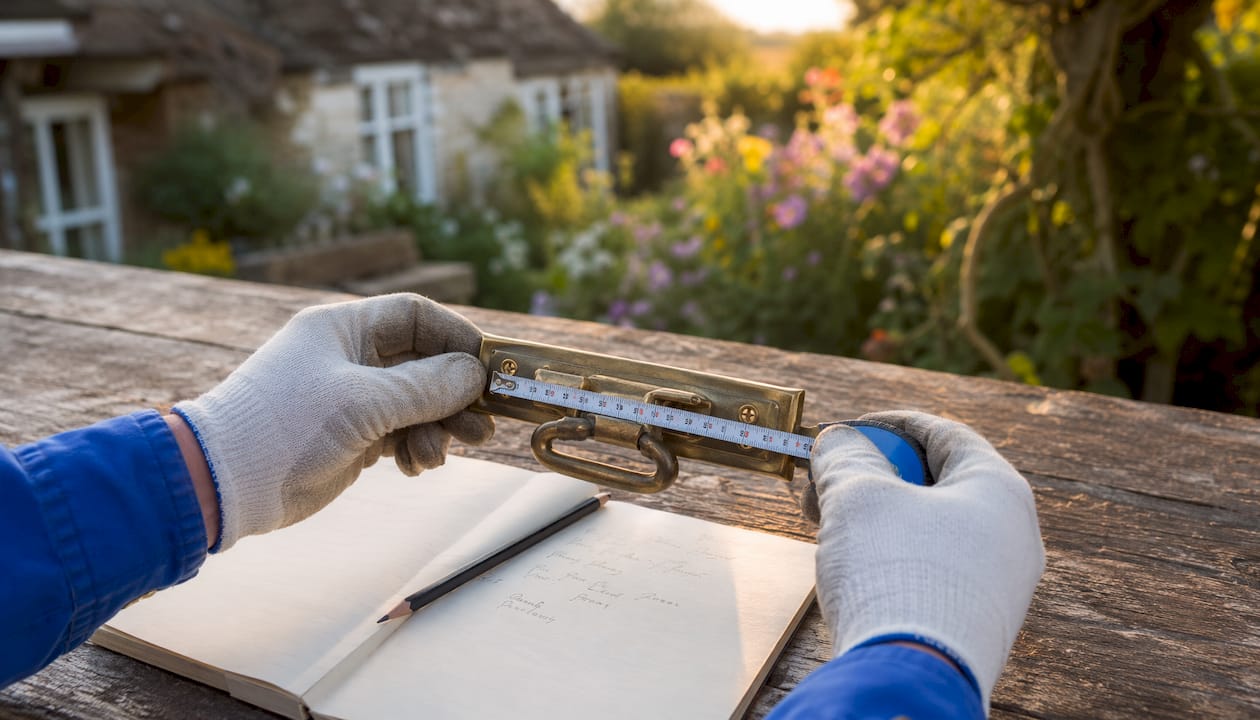
Pro Tip: Digital calipers cost under £15 and pay for themselves on the first job. For retrofit parts, close tolerance on screw centres and spindle and hole diameters is important to guarantee engagement. See the measurement guide for a worked example.
3. Where to search for discontinued parts in the UK
Work through these sources in order. Each step up the list is faster and cheaper; each step down is slower but more likely to find genuinely rare items.
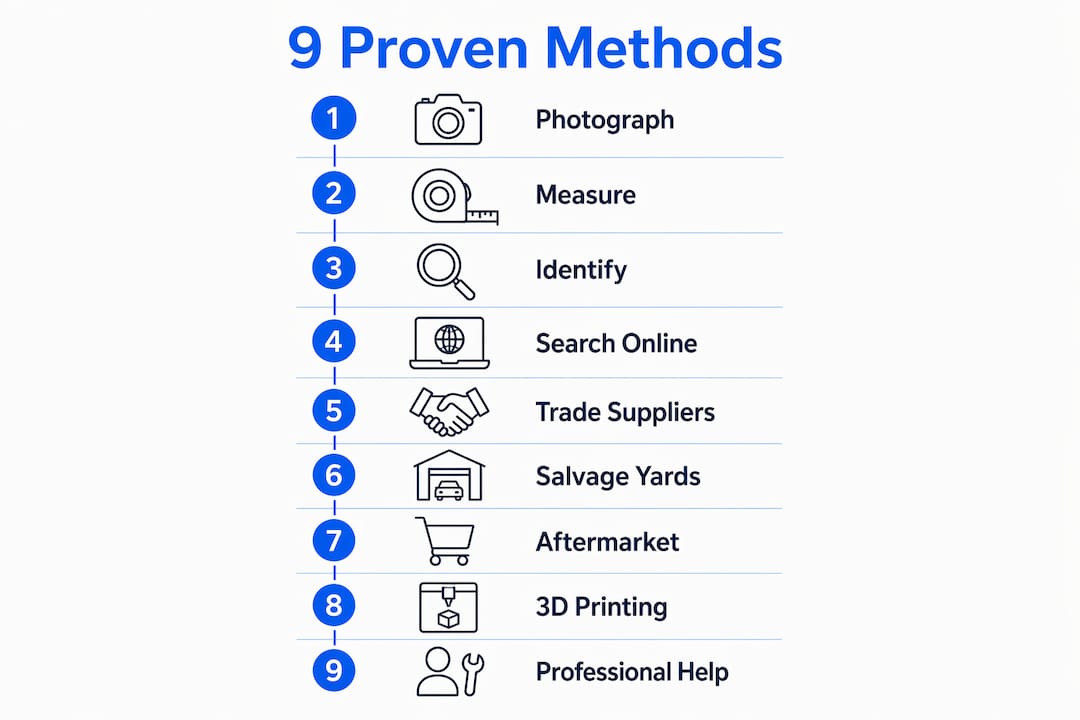
1. Manufacturer parts portals Many brands keep diagrams and parts for models from the mid-1990s onwards available through their official portals, even when those parts appear obsolete on the public site. Use the etched glass code or frame sticker to identify the model series, then search the portal directly. Live chat on manufacturer sites can surface superseded replacement references that do not appear in standard search results.
2. Specialist trade suppliers and trade counters Specialist vendors maintain deep obsolete-parts catalogues and photo-matching services covering operators, sash locks, balances and rollers. Submit your photos and measurements; a good trade supplier will cross-reference their catalogue and identify superseded alternatives the same day. This is the most reliable route for hardware from the 1990s and 2000s.
3. Salvage and reclamation yards Genuine used parts from salvage yards are worth considering when you need an exact original, particularly for heritage or listed properties where modern retrofits are not acceptable. Expect to spend time searching, and inspect parts carefully for wear before fitting. Auction platforms and online marketplaces carry individual items too, though quality varies.
4. Aftermarket and universal replacement vendors, forums and identification communities If the first three sources fail, specialist businesses will hand-match from samples you post in — useful when photos alone are not sufficient. Technical forums and identification communities can also name a part from a clear image, often within a day or two.
Rough cost and timeline guide:
| Source | Typical lead time | Relative cost |
|---|---|---|
| Manufacturer portal | a few days | Low to medium |
| Specialist trade supplier | quick turnaround | Medium |
| Salvage yard | variable time | Low (used) |
| Aftermarket / universal | within about a week | Low to medium |
| Remanufacture / 3D print | several weeks | High |
4. Retrofits, universal parts and adaptor kits: when do they work?
Universal and retrofit parts are a practical solution for the majority of standard uPVC and aluminium window hardware. They are not always the right answer for heritage frames or safety-critical mechanisms, but for everyday handles, hinges and operators they work well when the compatibility checks are done properly.
Common retrofit categories:
- Universal handles: adjustable spindle lengths and multiple screw-centre options cover most standard uPVC frames. Check the compatibility guide for universal handles before ordering.
- Adjustable operators and friction stays: many modern stays are adjustable in length and can replace a range of older fixed-arm operators.
- Adaptor plates: bridge mismatched fixing patterns when screw centres differ by a small margin.
- Modern multipoint gearboxes: a current-production gearbox can replace an obsolete one if the hook positions and backset match. Measure the existing hook spacing carefully before ordering.
Compatibility checklist before you buy:
- Screw centres match within ±1 mm
- Spindle diameter and length are correct
- Fixing depth does not exceed the frame profile
- Operation geometry (the arc the handle or stay travels through) is compatible
- Weatherseal interfaces are not compromised by the new part
After fitting, test the full operating cycle: open, close, lock and unlock. Check that the sash closes flush and that all locking points engage. A part that passes the static fit test but binds under load needs adjustment before the job is signed off.
Pro Tip: When the window is on a listed building or has original period hardware, a matching used original from salvage is usually preferable to a retrofit. Restoring and refurbishing old hardware with a clean, light lubrication and minor adjustment can extend service life significantly before replacement becomes necessary.
5. Commissioning remanufacture or 3D printing
Remanufacture is the last resort, not the first call. It makes sense when the part has a rare or proprietary shape, when no used original can be found, and when the window is worth the investment.
When to commission a remake:
- The part is no longer available from any supplier or salvage source
- The window is heritage, listed, or part of a matched set where visual consistency matters
- The mechanism is safety-critical (a restrictor or locking component) and a non-original retrofit is not acceptable
Material guidance:
- Injection-moulded nylon or PA (polyamide): suitable for handles, cover plates and non-structural components. UV-stable grades are available for exposed hardware.
- Glass-filled polymers: better wear resistance for moving parts such as cam followers and operator arms.
- Aluminium castings: appropriate for structural brackets and hinge components where load-bearing capacity matters.
- CNC-machined or lost-wax cast metal: for precision parts where tolerances under 0.5 mm are required.
Realistic cost bands vary widely: 3D-printed prototypes typically cost tens of pounds depending on size and complexity. Small injection-moulded runs require tooling investment plus unit cost. CNC or cast metal remakes start at moderate prices. Lead times can range from a couple of weeks to over a month for production.
Pro Tip: Always request a machined or printed prototype before committing to a production run. Specify secondary operations — light machining of bearing surfaces, plating for corrosion resistance, or heat treatment for metal parts — in the brief. A part that fits perfectly but wears out in six months is not a solution.
6. What to send a supplier and questions to ask before you order
A well-prepared enquiry gets a faster, more accurate response and reduces the chance of a costly return. Suppliers dealing with obsolete parts need more information than a standard order, so give them everything upfront.
Ordering checklist:
- Clear photographs: the part in situ, removed from the frame, and close-ups of any cast numbers, stamps or labels
- All measurements from the template above, with photo references
- Handing noted (left or right, viewed from inside)
- A short video of the operation cycle if the mechanism is complex
- The window brand and approximate age if known
- Any part numbers, etch codes or foil label text you have found
Questions to ask the supplier:
- Is this an exact match, a superseded replacement, or a compatible alternative?
- What is the lead time, and is the part in stock or ordered on demand?
- What is the returns policy for obsolete or special-order items?
- Do you recommend a test fit before I order for multiple windows?
- Are there any known fitting modifications required?
Order one sample first when replacing hardware across several windows. Fit it, test it through a full cycle, and confirm it works before placing the full order. If it does not fit, a clear record of your measurements and the supplier's confirmation of compatibility will support a return claim.
7. DIY or call a professional? Clear decision points
Replacing window hardware is a straightforward DIY task for discrete failures: a single handle, a worn hinge, or a failed locking point. Most homeowners and tradespeople can complete these repairs without specialist tools, provided the measurements are right and the part is compatible.
Call a trade supplier or installer when:
- The mechanism involves multiple failing subsystems (gearbox, hinges and seals all failing together)
- The repair requires frame modification or routing
- The window has structural or rot issues that affect the frame
- The hardware is safety-critical, such as a window restrictor on an upper-floor window, and compliance with Building Regulations matters
- The job involves matching finishes across multiple windows for a client
For tradespeople working on older housing stock, keeping a small stock of the most common uPVC parts in the van saves repeat visits. The trade guide to essential uPVC parts covers the most useful items to carry.
Pro Tip: Ask your supplier whether they offer a photo-identification service and whether they will hold stock against a test order. A supplier who will reserve matched parts while you confirm the sample fit is worth their weight in avoided callbacks.
Homeowners weighing repair against full replacement should also consider the broader picture. When hardware is the only failure, replacement is almost always the more cost-effective route. For context on how window condition affects home energy loss, the thermal performance argument for keeping well-sealed frames in good repair is strong.
8. How Windowhardwarestore helps trade customers find matches
Windowhardwarestore is built around exactly this problem: sourcing the right part when the obvious routes have drawn a blank. The store's trade services are practical rather than theoretical.
What the trade service includes:
- Photo-identification support: send clear images and measurements via the live chat or email enquiry, and the team will cross-reference the catalogue, identify superseded alternatives, and confirm stock.
- Cross-reference lookups: the team works with OEM cast numbers and frame codes, not just brand names, which means they can often find a match that a standard web search misses.
- Real-time stock visibility: the store shows live availability, so you know before you order whether the part ships today or is on lead time.
- Next-day despatch: where stock is confirmed, orders placed before the cut-off ship the same day for next-day delivery across the UK.
To submit an enquiry, send the photos, measurements and any part numbers you have found. The team will respond with a part identification, any superseded alternatives, current price and stock status. For tradespeople managing multiple sites, a trade account gives access to order history, faster reordering and priority support on complex enquiries.
The Windowhardwarestore product range covers handles, hinges, gaskets, multipoint gearboxes, restrictors and more, all with the same real-time availability and trade-focused support.
Key takeaways
Matching a discontinued window part reliably comes down to four steps: photograph and record markings, measure to trade tolerances, search specialist suppliers before anything else, and treat remanufacture as a last resort rather than a first option.
| Point | Details |
|---|---|
| Photograph before removal | Capture the part in situ, close-ups of cast numbers, and the full window before touching anything. |
| Measure to 1 mm tolerance | Record screw centres, spindle length, arm length and profile thickness; use digital calipers for holes. |
| Search in order | Manufacturer portal first, then specialist trade supplier, then salvage — remanufacture only after these. |
| Test one sample first | Always fit and test a single part before ordering multiples across several windows. |
| Windowhardwarestore trade support | Submit photos and measurements via live chat for photo-ID, cross-reference lookups and real-time stock. |
A trade perspective on sourcing obsolete parts
The conventional advice on matching discontinued window parts tends to stop at "check the manufacturer's website." That is rarely where the answer lives.
The more useful insight is this: most legacy window hardware was not made by the window brand at all. It was made by a third-party OEM and badged or supplied to the window manufacturer. The cast number on the hinge or operator body is the OEM's reference, and searching by that number rather than the window brand name is consistently the faster route to a match. Tradespeople who know this skip straight to the cast number and save hours.
The second thing most guides understate is the value of a good photo pack. A set of clear images — part in situ, removed, close-up of any numbers, and a coin or ruler for scale — submitted to a specialist supplier will identify the majority of parts within a working day. That is not an exaggeration. The combination of a cast number search and a photo submission to a knowledgeable supplier resolves most cases before remanufacture is ever on the table.
Remanufacture and 3D printing are genuinely useful options, but they are slower and more expensive than most people expect. Treat them as the solution for parts that are truly unobtainable, not as a shortcut around the sourcing process.
Windowhardwarestore: real stock, real support for trade and homeowners
When you have the photos and measurements ready, Windowhardwarestore is the practical next step. The store carries an extensive range of window and door hardware with real-time stock visibility, so you are not ordering blind. The trade support team handles photo-identification enquiries directly, cross-references OEM cast numbers, and confirms whether an exact match or a superseded alternative is available before you commit to an order.
For tradespeople, a trade account with Windowhardwarestore gives you order history, priority support on complex sourcing jobs, and next-day despatch on stocked items across the UK. For homeowners tackling a single repair, the same stock and the same expert advice are available without a trade account. Whether you need a multipoint gearbox for an older uPVC door or a gasket to restore a draught-free seal, the range is there with the guidance to match.
Visit Windowhardwarestore to submit your photos and measurements, check live stock, or open a trade account today.
Useful sources and next steps
Recommended UK and trade sources:
- Manufacturer parts portals: Andersen and Pella both maintain online parts catalogues with diagrams for older models; UK manufacturers' portals work similarly.
- Specialist trade suppliers: photo-matching services from trade suppliers are the highest-leverage tool for obsolete hardware.
- Salvage and reclamation yards: useful for heritage and listed properties; inspect parts for wear before fitting.
- Identification forums: online communities dedicated to window hardware can name parts from clear images, often quickly.
Your next-steps checklist:
- Photograph all markings and the part in situ before removal.
- Record measurements to the template above.
- Search the manufacturer's parts portal using the model code or etch reference.
- Submit photos and measurements to a specialist trade supplier such as Windowhardwarestore.
- If no match is found, consider salvage for originals or commission a remanufacture for proprietary shapes.
For complex cases involving multiple windows, heritage frames, or safety-critical hardware, engaging a trade supplier early avoids the cost of multiple failed orders. The locking versus non-locking handle guide is a useful reference when the replacement involves a functional change as well as a like-for-like swap.
Recommended
- Replacement Window Handles: How to Match Your Existing Handle | Window Hardware Store | Window Hardware Store
- Replacing Window Handles: Locking vs Non-Locking Options | Window Hardware Store | Window Hardware Store
- Trade Guide: Essential uPVC Window Parts to Keep in Your Van | Window Hardware Store | Window Hardware Store
- Double Glazing Window Handles Replacements: Matching Screw Centres | Window Hardware Store | Window Hardware Store