
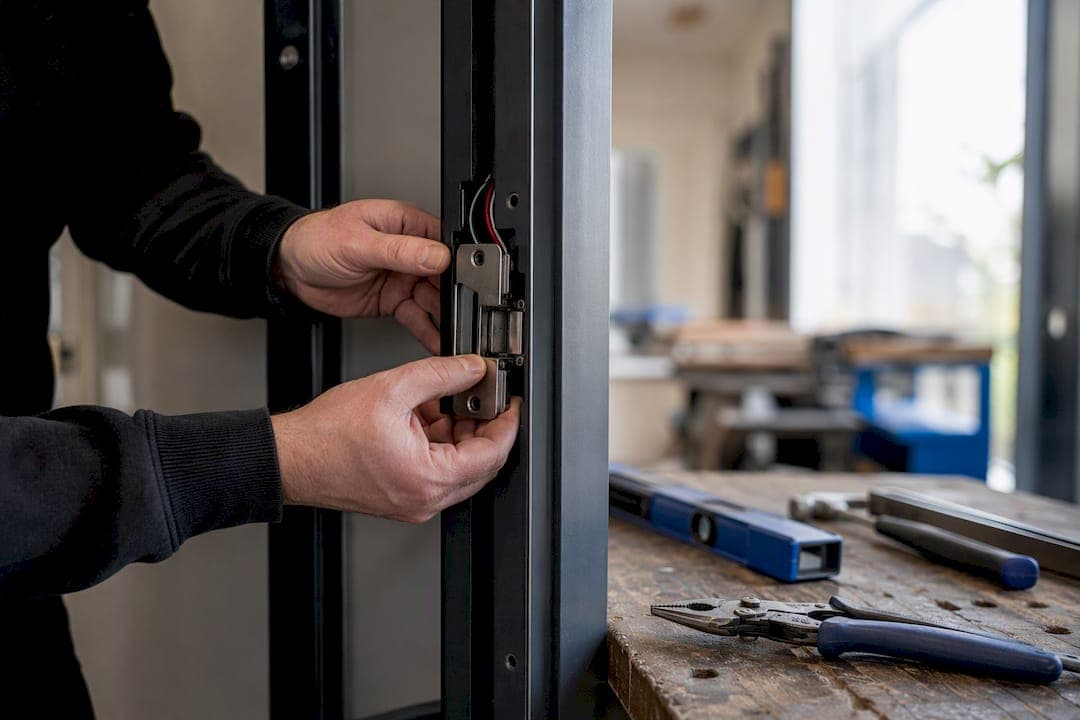
Choose a fail-secure, lock-type-matched electric strike for external doors that must hold security when power fails, and a fail-safe or hold-open strike for escape routes and reception counters that need free exit at all times. That single decision, paired with correct lock compatibility, decides most of what you order.
- Check holding force and duty rating against door use. Look for ANSI/BHMA A156.31 testing where high-traffic performance matters, and UL 10C listing on any fire door.
- Match the strike to the lock type first: cylindrical, mortise, deadbolt, or exit device strikes are not interchangeable.
- On site, confirm cut versus no-cut frame requirements, latch projection, and recapture before you order, not after.
Key Takeaways
Matching lock-type compatibility, failure mode, and frame cut-out to the door's actual use case prevents the vast majority of electric strike installation failures.
| Point | Details |
|---|---|
| Match lock type first | Cylindrical, mortise, deadbolt, and exit device strikes are not interchangeable. |
| Choose failure mode by application | Fail-secure for security doors, fail-safe or hold-open for escape routes and reception counters. |
| Deadbolts need recapture strikes | Standard release keepers cannot re-secure a deadbolt without a spring latch. |
| Check standards before ordering | Confirm ANSI/BHMA A156.31 and UL 10C listing where fire doors are involved. |
| Buy from a trade-stocked source | Windowhardwarestore offers strike families, faceplate kits, and trade support for cut-out templates and configuration checks. |
Table of Contents
- Types of electric strike locks: the main categories
- Electric strike lock types by locking device
- What do fail-secure, fail-safe, and hold-open actually mean?
- Checking mounting and frame compatibility
- AC vs DC power and duty ratings explained
- Which standards and specs actually matter?
- How to specify an electric strike correctly
- Where to buy compatible electric strikes and get trade support
- Sources
Types of electric strike locks: the main categories
Electric strikes fall into two overlapping systems, and mixing them up is where most wrong orders come from. The first is lock-type compatibility: cylindrical, mortise, deadbolt, and rim/panic/vertical-rod strikes are built around different latch geometries and are not interchangeable. The second is failure mode: fail-secure, fail-safe, and hold-open, which governs what the strike does the moment power is cut.
Electric strikes remain the most widely specified electric locking device across low, medium, and high security applications, and they cover cylindrical, mortise, deadbolt, and exit device hardware with monitoring options built in on most modern ranges, according to SDC's technical guidance. That breadth is exactly why the category confuses first-time specifiers: a strike that looks similar on a shelf might be entirely wrong for the lockset behind it.
ADI Global's guidance on strike selection groups the market into three practical families: centreline strikes for cylindrical locks, all-in-one adjustable strikes that suit many mortise applications, and rim strikes for panic and vertical-rod exit devices. Specialised variants exist too, including open-back strikes for double doors and heavy-duty or fire-rated models for higher-risk openings.
Use these two axes together, not separately. A fail-secure strike on the wrong lock type will not fit; a correctly matched strike in the wrong failure mode will not behave safely.
| Application | Typical lock type | Recommended failure mode |
|---|---|---|
| Office entrance door | Cylindrical or mortise | Fail-secure |
| Fire door with electric access control | Mortise or exit device | Fail-secure (fire-rated) |
| High-security plant room | Deadbolt or mortise | Fail-secure |
| Reception counter / low-security office | Cylindrical | Fail-safe |
| Fire escape route with hold-open requirement | Exit device | Hold-open |
| Retrofit on aluminium narrow-stile door | Rim or surface-mount | Fail-secure or fail-safe |
Electric strike lock types by locking device
Cylindrical (centreline) strikes
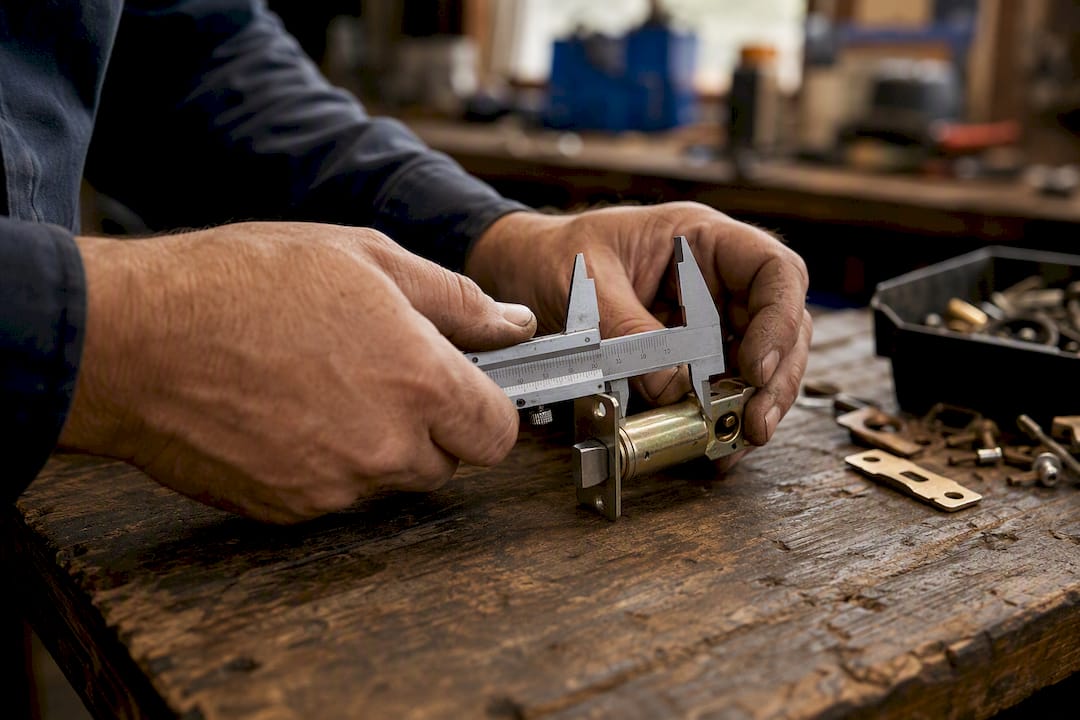
Cylindrical strikes are built around a spring-loaded latch that retracts on turning the handle, and the strike's keeper simply releases that latch on command. They typically use a centreline keeper shape sized to match common cylindrical latch throws, and most field kits accept a latch projection somewhere in the 12.7 to 15.9 mm range, the figures Adams Rite's 7400 series datasheet lists for its own range. Confirm your actual latch projection against the manufacturer's accepted range before ordering, because a mismatch here is the single most common return.
Mortise strikes
Mortise locks often combine a latch and a deadbolt in one case, so mortise-compatible strikes tend to be adjustable, all-in-one designs that accommodate both elements moving independently. ADI's guidance on strike families notes these all-in-one units suit the widest range of mortise applications, which is why trade stock tends to favour them over fixed-keeper alternatives.
Deadbolt strikes
Deadbolts have no spring latch, so a standard release keeper does nothing useful. According to the Wikipedia summary of electric strike operation, deadbolts require a "hold" or recapture keeper design that physically retains the bolt in the frame and then re-engages it once the door closes again. Get this wrong and the bolt simply will not re-secure after the first cycle.
Rim, panic, and vertical-rod strikes
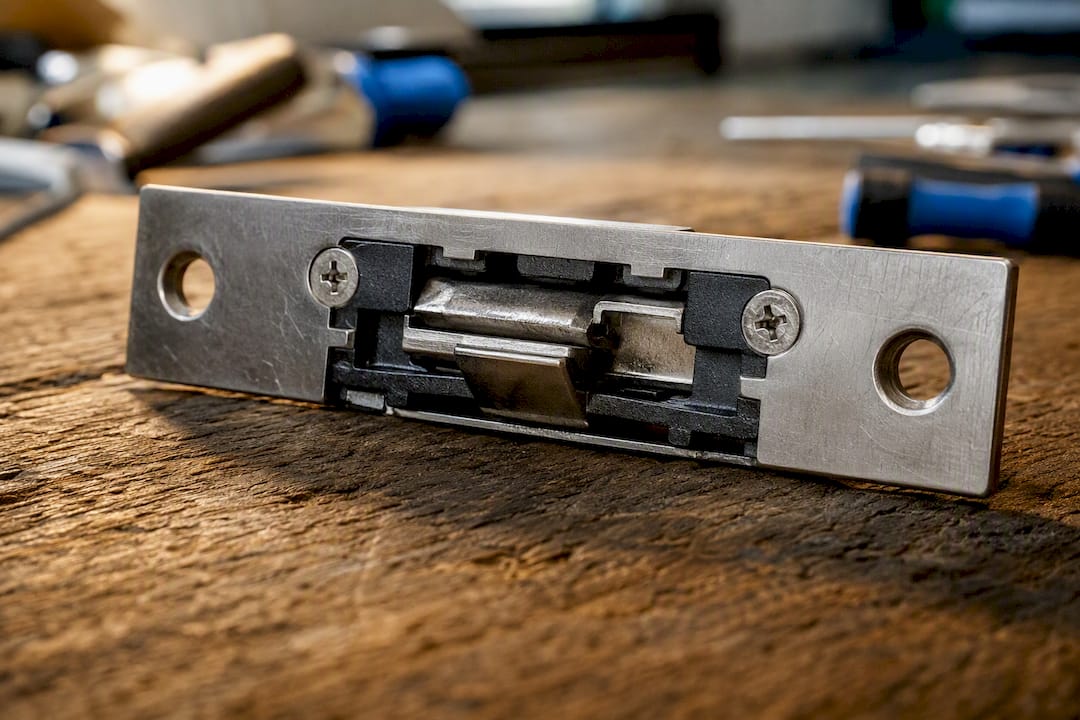
Exit devices and panic hardware usually pair with surface-mounted rim strikes rather than a cut-in keeper, which suits retrofit jobs where cutting the frame is impractical. On double-leaf doors, Von Duprin's training guidance distinguishes open-back strikes, which work without a door coordinator, from closed-back strikes, which usually need one to guarantee the active leaf closes first.
When specifying any of these, ask for:
- A latch status monitor if the access control system needs door-secure feedback.
- An adjustable keeper on mortise applications rather than a fixed-depth unit.
- Multi-voltage solenoid options, which reduce the number of SKUs a trade van needs to carry.
Pro Tip: Carry both open-back and closed-back rim strikes on double-door jobs. You often cannot tell which one you need until you have the door coordinator, or lack of one, in front of you.
What do fail-secure, fail-safe, and hold-open actually mean?
Fail-secure (also called fail-locked) strikes stay locked when power is lost, so the door remains secure unless someone has a mechanical key. Fail-safe (fail-open) strikes unlock the instant power drops, prioritising free egress over security. Hold-open strikes go a step further, physically keeping the latch retracted so the door swings free without needing repeated triggering.
Fire doors and escape routes almost always need fail-safe or hold-open behaviour so people can get out during a power failure or fire alarm event, while external security doors, plant rooms, and cash offices need fail-secure so a mains outage does not hand an intruder an open door. Von Duprin's guidance is explicit that fire-door assemblies typically require fail-secure strikes rather than fail-safe, which sounds counterintuitive until you remember the fire door's job is compartmentation, not free-swing egress in every scenario.
| Application | Recommended mode | Backup power note |
|---|---|---|
| External security door | Fail-secure | Battery backup recommended |
| Fire door (compartment) | Fail-secure, fire-rated | UL 10C listing required |
| Escape route door | Fail-safe or hold-open | Confirm with fire strategy |
| Reception counter | Fail-safe | Optional |
Deadbolt applications complicate this further because of the recapture behaviour mentioned earlier, so always confirm the strike is rated for the exact lock type before assuming a standard fail-secure unit will do the job.
Checking mounting and frame compatibility
Get these measurements before you order, not after the strike arrives and does not fit:
- Latchbolt projection against the accepted range on the datasheet. Adams Rite's 7400 series accepts roughly 12.7 to 15.9 mm; other ranges vary by manufacturer.
- Backset and faceplate length, matched to the existing keeper or mortice cutout.
- Frame depth and jamb material, since hollow metal, aluminium, timber, and UPVC frames all demand different fixing approaches.
- Keeper opening dimensions, particularly on retrofit jobs where the old mechanical keeper leaves an irregular cutout.
Cut-out type depends on what you are replacing. Full-cut strikes need a proper mortice into the frame, partial-cut units suit a shallower recess, and surface or no-cut rim strikes bolt straight onto the face of the frame, which is why they dominate retrofit and aluminium narrow-stile applications where cutting into a hollow profile risks weakening the section. Electric strikes generally win here over electrified locksets anyway, because wiring stays in the jamb rather than running through the door leaf itself, a point SDC's brochure makes clearly.
Pro Tip: Keep a small stock of trim and cover plates in the van. A faceplate that is 2mm too wide for an old mortice looks like a wasted trip, but a cover plate fixes it in five minutes.
AC vs DC power and duty ratings explained
DC strikes run quieter than AC units, because AC solenoids buzz at mains frequency and produce a noticeably higher inrush current on energising. DC also gives cleaner control over hold-open functions and integrates more predictably with modern access control panels, which is why most new specifications default to DC unless there's a legacy AC system already on site.
Duty rating matters just as much as voltage. Continuous duty strikes are built to stay energised indefinitely (useful for hold-open applications), while intermittent duty units are only rated for short bursts and will overheat or fail early if left powered for long periods. Read the manufacturer's duty cycle figures carefully; a strike rated for intermittent use on a door that gets buzzed open constantly all day will not survive its warranty period.
For wiring, plan for:
- Correct voltage matched to the strike (commonly 12 to 24 VDC on trade ranges).
- Appropriate fusing and a dedicated lock power supply.
- Battery backup on fail-secure installations, so security is maintained through short outages.
- Latch status monitoring contacts where the access control system needs door-secure confirmation.
Which standards and specs actually matter?
Ask for ANSI/BHMA A156.31 test data where high-cycle performance needs proving, and insist on UL 10C listing for any strike destined for a fire door, since SDC's documentation ties that standard directly to fire-rated strike categories. EN or UKCA markings apply where relevant to the installation's jurisdiction.
Beyond certification, check holding force in lbs or kg, whether latch or keeper contacts are monitored, the stated endurance cycle count, and the environmental rating for external use. Von Duprin's own guidance is blunt on this point: never assume a mechanically robust strike is fire-rated just because it feels solid. If the fire door needs a listing, the strike must carry that listing explicitly.
How to specify an electric strike correctly
Work through this order every time, and you will rarely need a second site visit:
- Confirm the application: external security door, fire door, escape route, or reception counter.
- Identify lock type: cylindrical, mortise, deadbolt, or exit device.
- Set the failure mode: fail-secure, fail-safe, or hold-open, cross-checked against fire strategy.
- State holding force required, in lbs or kg, based on door use and risk level.
- Specify faceplate configuration and finish to match existing hardware.
- Decide monitoring needs: latch status, door position, or both.
- Confirm voltage and duty: DC preferred for quiet running, continuous duty for hold-open.
- Note fire rating where the door is part of a compartment strategy.
Always request cut-out templates and wiring diagrams from the manufacturer before the order ships, confirm recapture behaviour explicitly on any deadbolt application, and ask for status contact options in writing rather than assuming they're standard.
Two sample spec lines worth keeping on file:
- "Fail-secure, centreline electric strike, 12 to 24 VDC, latch status contact, ANSI/BHMA A156.31 tested."
- "Fail-safe rim strike for panic exit device, open-back configuration, no-cut surface mount, fire-rated to UL 10C."
Common pitfalls installers actually run into
Most call-backs trace to two things: a mis-measured latch projection or a faceplate that does not match the old mortice. I have seen busy reception doors specified with a fail-secure strike when what the client actually needed was hold-open, because nobody asked how the door gets used at 9am on a Monday. Deadbolt recapture failures crop up more than they should, usually because someone assumed a standard strike would work.
Noisy AC strikes get swapped for DC units more often than any other retrofit job I have come across. For trade packs, stock multi-application strikes with interchangeable faceplates. It cuts van inventory without sacrificing site flexibility.
— Samuel
Where to buy compatible electric strikes and get trade support
Sourcing the right strike gets a lot easier when stock, faceplate kits, and technical support sit in one place. Windowhardwarestore stocks strike families across the lock-type and failure-mode categories covered above, with real-time stock visibility and trade pricing open to every customer, so you are not waiting on a quote just to confirm availability.
Trade support at Windowhardwarestore covers the details that actually cause delays on site: cut-out templates for full-cut and partial-cut installations, voltage and configuration checks before your order ships, and guidance on monitored contacts or fail-state selection when a spec is ambiguous. If you're pairing a strike with existing lockset hardware, the range of replacement locks for UPVC doors is worth a look for compatibility notes, and the deadbolt security features guide explains recapture requirements in more depth. To check stock, request sample parts for an on-site trial, or get technical support on a complex order, visit Windowhardwarestore and speak to the trade team before you commit to a spec.
Sources
- Electric strikes
- Electric Strikes 101: Secure Door Lock Solutions
- Choosing the Right Strike | ADI Global
Recommended
- Deadbolt vs Night Latch: Which Lock Is More Secure? | Window Hardware Store | Window Hardware Store
- Deadbolt Lock Grades Explained: Understanding Security Ratings | Window Hardware Store | Window Hardware Store
- Best uPVC Door Locks for Maximum Security: Trade Picks | Window Hardware Store | Window Hardware Store
- Shootbolt vs Espagnolette: Which Locking System Is Better? | Window Hardware Store | Window Hardware Store