
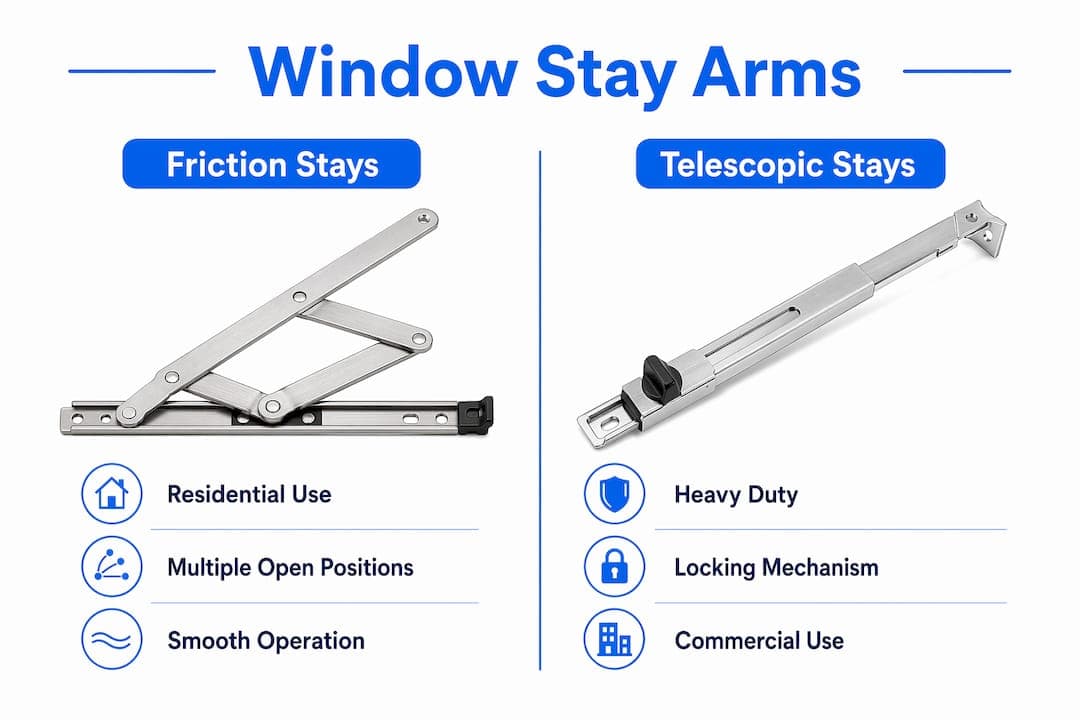
A window stay arm is defined as the hardware component that holds a casement or fanlight window open at a fixed angle, preventing it from swinging shut or blowing open in the wind. The role of window stay arm hardware goes well beyond simple convenience. It distributes wind loads across the frame, protects hinges from stress, and provides a controlled opening for ventilation and child safety. In many regions, window stays are a regulatory requirement for habitable rooms, making them a compliance item as much as a functional one. Whether you are an installer, contractor, or DIY homeowner, understanding how these components work will save you time and prevent costly damage.
What is the role of window stay arm hardware?
A window stay arm holds a window sash at one or more open positions without placing strain on the hinges. Without it, a casement window relies entirely on its hinges to resist wind pressure. That is a job hinges were never designed to do alone. Faulty stays cause window sagging and poor weather-sealing, which leads to draughts, water ingress, and eventually frame damage.
The stay arm also controls the opening angle. This matters for ventilation, where too wide an opening in exposed locations can let in rain, and for child safety, where a restricted opening prevents falls. The window stay arm purpose, in short, is to give you control over a window that would otherwise be at the mercy of wind and gravity.
How does a window stay arm work mechanically?
Window stays are precision slider-crank mechanisms that convert wind loads into forces distributed safely across the frame. The mechanism has four main parts: a track fixed to the window sill or frame, a sliding shoe that travels along that track, a pivoting arm connecting the shoe to the sash bracket, and the sash bracket itself. When you push the window open, the shoe slides along the track and the arm rotates, guiding the sash through its arc.
The holding force comes from friction. In a friction stay, the sliding shoe grips the track through a friction pad or spring wedge. The tighter the friction setting, the more force is needed to move the shoe, and the more firmly the window holds its position. Stay arm geometry influences the sash opening angle and the holding force at each position. A longer arm allows a wider opening; a shorter arm gives more control at narrow angles.
High-tensile steel stays resist bending under load, which is why material quality matters for exposed or large windows. Aluminium alloy arms suit lighter residential sashes where corrosion resistance is the priority.
Pro Tip: If your window drops or fails to hold position, check the friction pad or spring wedge inside the stay housing before assuming the hinge or frame is at fault. Most cases of window dropping trace back to a worn friction pad, not structural damage.
Key components at a glance:
-
Track: Fixed to the frame; guides the sliding shoe along a straight path
-
Sliding shoe: Travels along the track; contains the friction pad or wedge
-
Stay arm: Pivoting link between shoe and sash; determines opening arc
-
Sash bracket: Fixed to the sash; receives the arm pivot pin
-
Friction pad or spring wedge: Provides the holding force at any open position
What are the common types of window stay arms?
Standard friction stays suit quiet residential ventilation, while heavy-duty telescopic stays with locking detents are the correct choice for commercial buildings, high-wind locations, or smoke ventilation systems. Choosing the wrong type can cause mechanical failure or regulatory non-compliance. The window stay buying guide at Windowhardwarestore covers lengths, finishes, and styles in detail if you need help matching a stay to a specific window.
| Type | Best for | Key advantage | Limitation |
|---|---|---|---|
| Standard friction stay | Residential casements | Smooth, quiet operation | Not suited to high-wind exposure |
| Telescopic heavy-duty stay | Commercial or exposed locations | High load capacity, locking detents | Bulkier; higher cost |
| Locking stay | Security-conscious installations | Prevents unauthorised opening | Requires key or tool to adjust |
| Non-locking stay | General domestic use | Easy one-hand operation | No security function |
| Fixed stay | Single-position ventilation | Simple and low maintenance | No angle adjustment |
| Adjustable stay | Rooms needing variable airflow | Multiple open positions | More moving parts to maintain |
Modern friction stays in aluminium windows use sliding arms and channels to provide smooth operation, load support, and stable positioning at various angles. They also allow wider openings than traditional hinges, which improves ventilation in rooms where airflow matters most.
For residential use, a standard friction stay in a corrosion-resistant finish covers most needs. For a commercial shopfront, a roof light, or a window in a coastal location, a telescopic stay with locking detents is the safer and more compliant choice. The guide on casement window stays explains how to compare friction and telescopic options for different window types.
Why is the window stay arm important for safety and ventilation?
Window stays prevent sudden slamming, which is the single most common cause of cracked glass in casement windows. A window that swings freely in a gust puts enormous stress on the glass, the frame, and the hinges simultaneously. Worn friction pads or corrosion in the stay cause windows to drop or slam suddenly, leading to glass damage and increased safety risks.
Child safety is a direct function of the stay arm. Window stays hold windows at desired angles and provide child-safety restrictions by limiting how far a window can open. In upstairs rooms, this is not optional. Building regulations in the UK recommend that windows above ground floor level should not open more than 100mm without a restrictor unless a fall-prevention device is fitted. A correctly specified stay arm, or a dedicated concealed window restrictor, satisfies this requirement.
Ventilation control is the third benefit. Adjustable stays offer multiple open positions while fixed stays hold one position. In practice, adjustable stays let you fine-tune airflow without leaving the window fully open and exposed to rain or intruders. This is particularly useful in bathrooms, kitchens, and bedrooms where background ventilation is needed throughout the day.
The importance of window stays extends to weather-sealing. A stay that holds the sash firmly closed when the window is shut also keeps the frame compressed against its gasket. When the stay wears out and the sash rattles, the seal breaks down and draughts follow.
How to maintain and replace window stay arms effectively?
Catching wear early is far cheaper than dealing with the secondary damage it causes. Ignoring worn stays risks cracked glass, bent frames, and safety hazards. A stay arm that slips, drops, or grinds when you move it is telling you it needs attention now, not at the next scheduled maintenance visit.
Signs that a stay arm needs replacement:
-
The window drops or will not hold position at any angle
-
The sliding shoe sticks or grinds along the track
-
Visible corrosion on the arm, shoe, or track
-
The pivot pin is bent or the arm wobbles laterally
-
The friction pad is visibly worn or missing
Replacing a window stay takes 15–30 minutes and is one of the most cost-effective repairs in window maintenance. The process involves removing the sash bracket screws, sliding the shoe off the track, and fitting the new stay in reverse order. Most friction stays are handed (left or right), so check the orientation before ordering.
Matching the replacement correctly matters. Measure the track length, note the finish (white, gold, chrome, or satin), and check whether the existing stay is a friction or locking type. Window handles and stay arms work as a pair, so replacing the handle at the same time prevents a second call-out within months. Worn handles reduce security and can accelerate stay arm failure by putting uneven load on the mechanism.
Pro Tip: Apply a small amount of dry PTFE lubricant to the track and sliding shoe when fitting a new stay. Avoid oil-based lubricants, which attract dust and cause the friction pad to slip prematurely.
For detailed guidance on keeping handles and stays in good condition between replacements, the window handle maintenance guide at Windowhardwarestore covers cleaning, lubrication, and tightening in practical steps.
Window hardware failures often lead to costly window replacement, but stay arms are designed to be replaceable components. Treating them as a serviceable part, rather than a permanent fixture, keeps the whole window system performing correctly for years longer.
Key takeaways
The window stay arm is the single component that controls opening angle, distributes wind load, and protects the entire window system from slamming, sagging, and seal failure.
| Point | Details |
|---|---|
| Core function | Stay arms hold windows at fixed angles and distribute wind loads away from hinges. |
| Mechanical principle | A slider-crank mechanism with a friction pad provides holding force at multiple positions. |
| Type selection | Match stay type to exposure: friction stays for residential, telescopic locking stays for commercial or high-wind sites. |
| Safety compliance | Stays limit opening distance for child safety; UK guidance recommends no more than 100mm without a restrictor above ground floor. |
| Maintenance timing | Replace stays at the first sign of slipping or corrosion; the job takes 15–30 minutes and prevents far costlier damage. |
What I have learned from years of window stay arm work
Samuel here. After years of working with window hardware across residential and commercial sites, the pattern I see most often is this: stay arms get ignored until something breaks. A window drops, glass cracks, or a child leans against a sash that should have been restricted. At that point, the repair bill is three or four times what a timely stay replacement would have cost.
The other mistake I see regularly is mismatched hardware. Someone replaces a worn friction stay with whatever is cheapest and available, without checking the arm length, the track width, or the finish. The new stay fits loosely, the friction is wrong for the sash weight, and the window is back to dropping within a year. Getting the specification right the first time is not complicated. It just requires measuring carefully and understanding whether you need a friction, locking, or telescopic stay for the conditions.
My honest advice: treat the stay arm as a wear item, the same way you treat a door hinge or a window seal. Inspect it annually. If it slips, replace it. And when you do replace it, change the handle at the same time. The two components wear together, and replacing one without the other is a false economy.
— Samuel
Quality window stay arms from Windowhardwarestore
Windowhardwarestore stocks a full range of windows stay arms for residential and commercial applications, including standard friction stays, heavy-duty telescopic stays, and locking varieties in multiple finishes.

Whether you are a contractor sourcing components for a large project or a homeowner replacing a single worn stay, Windowhardwarestore offers real-time stock visibility and fast nationwide delivery. The team is on hand to help with complex orders and specification queries. Browse the full window hardware range to find friction stays, telescopic stays, handles, and restrictors, all in one place. Ordering the right part first time saves a second visit and keeps your windows performing safely.
FAQ
What does a window stay arm actually do?
A window stay arm holds a casement or fanlight window open at a fixed angle, prevents slamming in wind, and distributes load away from the hinges. It also limits the opening distance for child safety and ventilation control.
How do I know when to replace my window stay arm?
Replace the stay arm when the window drops, fails to hold position, or when you see corrosion, a bent pivot, or a worn friction pad. Replacement takes 15–30 minutes and prevents cracked glass and frame damage.
What is the difference between a friction stay and a telescopic stay?
A friction stay uses a pad or spring wedge to hold the window at multiple positions and suits standard residential casements. A telescopic stay extends in length and uses locking detents, making it the correct choice for heavy sashes, commercial windows, or high-wind locations.
Do window stay arms affect child safety compliance?
Yes. Stay arms limit how far a window opens, which is a key child-safety measure. UK guidance recommends windows above ground floor level should not open more than 100mm without a restrictor or fall-prevention device.
Can I replace a window stay arm myself?
Most stay arm replacements are straightforward DIY jobs taking 15–30 minutes. Measure the track length, confirm the hand (left or right), match the finish, and fit the new stay by reversing the removal steps. Replace the window handle at the same time for best results.