
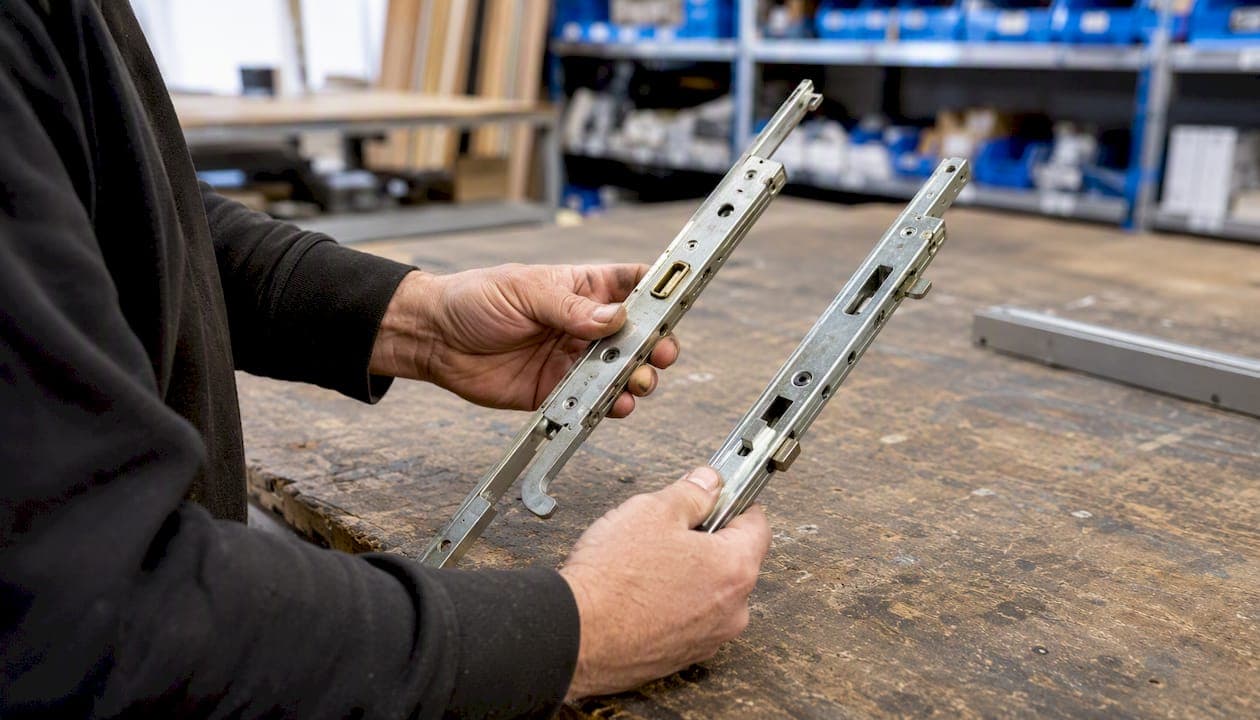
A lift lever requires the handle to be lifted upward to engage the multipoint gearbox before pressing down to release the latch. A split spindle uses a divided spindle arrangement where the inside lever operates the latch independently from the outside furniture, which is typically a passive pad. Choose a lift lever for lever-lever sets on uPVC and composite doors where both sides operate the lock. Choose a split spindle where the outside furniture must remain passive unless a key is used, such as lever-pad configurations on front doors.
- Lift lever: most common on newer multipoint locks where both handles are active and the user lifts to engage the gearbox before pressing down.
- Split spindle: the right choice when the outside pad should not operate the latch directly, giving controlled external access through a key cylinder instead.
Measurements to record before ordering are covered in the retrofit checklist further down.
Key takeaways
A split spindle gearbox is the correct choice whenever the outside furniture is a passive pad, and a lift lever gearbox suits lever-lever sets where both handles are active.
| Point | Details |
|---|---|
| Identification rule | Check whether the outside furniture moves the latch; a passive pad means split spindle. |
| Measurements to record | Spindle projection, spindle thickness, backset, PZ/centre distance, and faceplate width before ordering. |
| Main retrofit pitfall | Ordering a lift lever gearbox for a lever-pad set is the most common and avoidable mismatch. |
| Gearbox variants | Many manufacturers offer the same gearbox body in both lift lever and split spindle options; always confirm the variant on the spec page. |
| Windowhardwarestore | Stocks both gearbox types with real-time availability, trade pricing, and next-day UK delivery. |
Table of Contents
- What lift lever and split spindle actually mean
- How each mechanism works with a multipoint gearbox
- How to identify lift lever vs split spindle on site
- Handle and furniture configurations that work with each type
- Pros and cons: lift lever vs split spindle compared
- Installation and retrofit: step-by-step checklist
- Common faults and quick fixes
- Decision checklist: what to specify when ordering
- A trade perspective on getting this right
- Windowhardwarestore: gearbox and spindle stock for trade and homeowners
- Sources
What lift lever and split spindle actually mean
A lift lever is a handle mechanism where lifting the lever upward engages the multipoint gearbox, compressing or lifting the internal follower to retract hooks and bolts, then pressing down releases the latch. Both inside and outside handles are active in a lift lever set-up. You will typically see this on lever-lever furniture, where both handles perform the same lifting action. The term "single spindle" is sometimes used interchangeably because one continuous spindle passes through the gearbox follower, connecting both handles.
A split spindle uses two separate spindle sections rather than one continuous bar. The outside furniture, usually a pad or an inactive handle, does not operate the latch — the inside lever operates the latch while the outside pad remains passive unless a key is turned in the cylinder. This is the standard arrangement for lever-pad sets on front doors.
Related terms to know:
- Lever-lever: both sides have an active lever; almost always paired with a lift lever or single spindle gearbox.
- Lever-pad: inside lever is active, outside is a fixed pad; requires a split spindle gearbox.
- Single spindle: another name for the continuous spindle used in lift lever configurations.
How each mechanism works with a multipoint gearbox
The gearbox is the heart of a multipoint door lock. Understanding what moves inside it tells you immediately why the spindle type matters.
With a lift lever, lifting the handle rotates the follower upward inside the gearbox. That rotation drives the locking cams, hooks, and bolts into the retracted position, freeing the door to open. Pressing the handle down then retracts the latch. Because both handles share a single spindle passing through the follower, either side can operate the mechanism.
With a split spindle, the gearbox follower has a divided receiver. The inside spindle section engages the follower directly, so the inside lever operates the latch and hooks as normal. The outside spindle section is separated, meaning the outside pad turns freely without moving the follower at all. A key in the cylinder is what drives the outside operation when needed.
Key mechanical differences at a glance:
- Lift lever: handle lifts → follower rotates → hooks/cams retract → latch releases.
- Split spindle (inside): lever presses down → follower engages → latch retracts.
- Split spindle (outside pad): pad is passive → no follower movement → door stays locked until key is used.
Manufacturers such as Winkhaus offer the same gearbox body in both lift lever and split spindle variants, with the follower machined differently for each. The choice between them is driven by the handle furniture specified and the security requirement for the outside face of the door.
How to identify lift lever vs split spindle on site
The fastest identification rule: look at the outside furniture and try to move it. If the outside handle or pad does not move the latch at all, you almost certainly have a split spindle gearbox.
Visual cues to check:
- Outside pad present: a fixed pad with no lever action on the outside is a strong indicator of a split spindle set-up.
- Spindle cut-out in the faceplate: some faceplates have a visible divided slot or two separate spindle holes rather than one continuous opening.
- Handle movement: on a lift lever set-up, lifting either handle engages the gearbox. On a split spindle, only the inside lever does.
- Sticker or stamp on the gearbox: many manufacturers print "SS" (split spindle) or "LL" (lift lever) on the gearbox body or faceplate. Check the edge of the door with the door open.
Measurements to record before ordering:
- Spindle projection: how far the spindle protrudes from the handle backplate, measured in millimetres.
- Spindle thickness: the diameter or square section of the spindle (commonly 8mm square for uPVC door furniture).
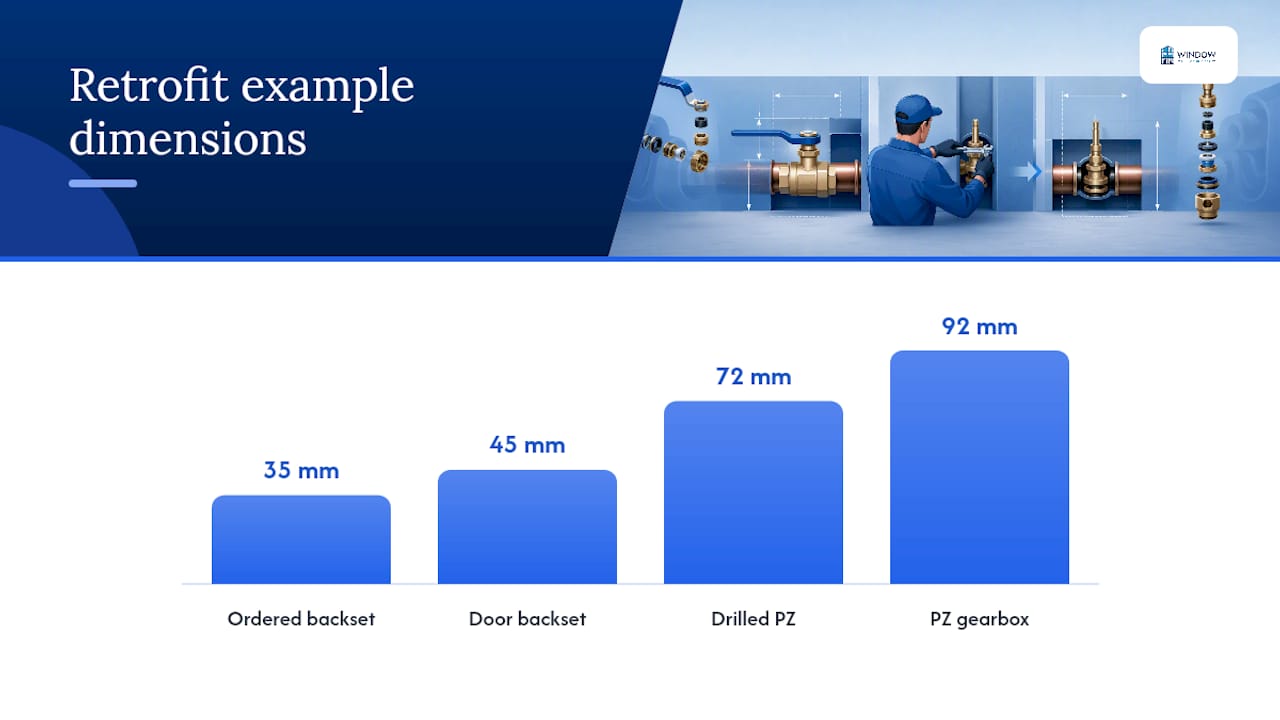
- Backset: distance from the edge of the door to the centre of the spindle hole, typically 35mm or 45mm.
- PZ/centre distance: the distance between the spindle centre and the cylinder centre, commonly 92mm on standard uPVC doors.
- Faceplate width and length: measure the exposed metal strip on the door edge; 16mm and 20mm widths are the most common.
Pro Tip: Photograph the gearbox faceplate and the handle backplate before removing anything. Locksmith training resources consistently flag photographic evidence as the single most effective way to avoid misorders and unnecessary returns.
Handle and furniture configurations that work with each type
Choosing the wrong handle set for the gearbox type is one of the most common ordering mistakes. The pairing must be deliberate.
Lift lever gearboxes suit lever-lever configurations, where both inside and outside handles are active levers. This is the standard set-up for most uPVC and composite doors where the occupant wants to operate the lock from either side without a key. Patio doors frequently use inline lever-lever handles with a lift lever gearbox, since both sides of a patio door are typically accessible to the occupant. For lever handle selection by door type, the door construction and frame material will also influence which handle profile fits correctly.
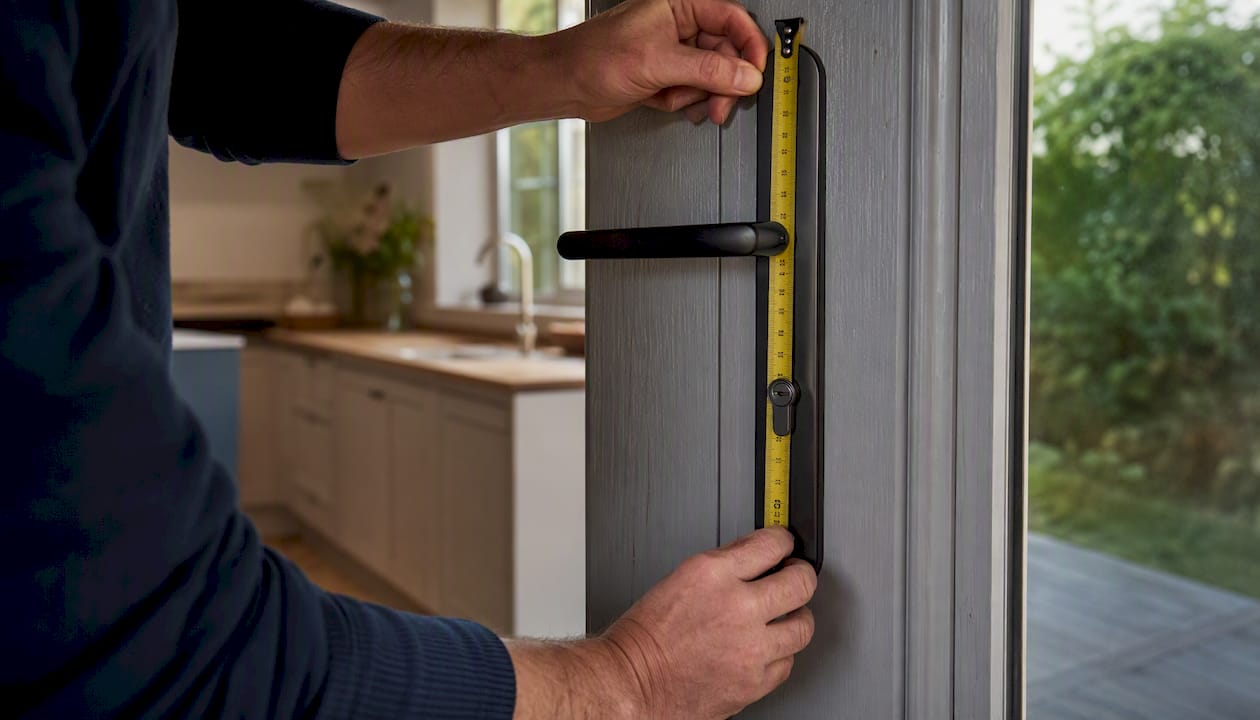
Split spindle gearboxes are the correct choice for lever-pad sets, where the outside furniture is a fixed pad with no active lever. This configuration is common on front doors where security requires the outside to be key-operated only. Composite doors with a thumb-turn inside and a pad outside also use split spindle gearboxes. For composite door installations, handle compatibility and security considerations are worth reviewing before specifying parts.
A split spindle set-up also suits certain keyed outside furniture arrangements, such as a lever with a key lock on the outside paired with a free-turning inside lever. In those cases, the outside lever only operates when the key is turned, while the inside lever remains free at all times.
Pros and cons: lift lever vs split spindle compared
Lift lever wins on simplicity and ease of use. Split spindle wins where controlled external access is the priority.
| Feature | Lift lever | Split spindle |
|---|---|---|
| Suitable handle configurations | Lever-lever (both sides active) | Lever-pad, keyed outside furniture |
| Mechanical action | Lift handle to engage gearbox; both sides operate latch | Inside lever operates latch; outside pad is passive |
| Ease of retrofit/installation | Straightforward; single spindle passes through follower | Requires correct split spindle gearbox; follower must match divided spindle |
| Compatibility with multipoint gearboxes | Very wide; most standard uPVC gearboxes support lift lever | Narrower; gearbox must be specified as split spindle variant |
| Visual ID | Both handles move; single spindle visible | Outside pad does not move latch; divided spindle or "SS" stamp |
| Typical relative cost/availability | Widely available; generally lower cost | Slightly less common; may need to specify at order stage |
For door handle security features relevant to each configuration, the split spindle arrangement offers a meaningful security advantage on the outside face of the door.
- For general replacement jobs on uPVC and composite doors: lift lever is the more common choice and the easier retrofit.
- For front doors with lever-pad furniture or where external access must be key-controlled: specify split spindle and confirm the gearbox variant before ordering.
Installation and retrofit: step-by-step checklist
Measure before you order. That single rule prevents the majority of call-backs on gearbox and handle replacements.
Step-by-step measurement and removal checklist:
- Open the door fully and locate the gearbox faceplate on the door edge.
- Note any stamps or stickers on the faceplate ("SS", "LL", backset size, faceplate width).
- Photograph the faceplate, the handle backplate, and the spindle before removing anything.
- Remove the handle screws and carefully withdraw the handle from both sides.
- Measure spindle projection (how far it protrudes from the backplate), spindle thickness, backset, PZ/centre distance, and faceplate dimensions.
- Record all measurements in millimetres and cross-reference against the manufacturer spec page before placing the order.
Critical dimensions for typical multipoint gearboxes:
| Measurement | What to record | Common values |
|---|---|---|
| Spindle projection | Distance spindle protrudes from backplate | a range depending on door thickness |
| Spindle thickness | Square section diameter | typically standard for uPVC doors |
| Backset | Door edge to spindle centre | common sizes vary |
| PZ/centre distance | Spindle centre to cylinder centre | standard and some older door sizes |
| Faceplate width | Exposed metal strip on door edge | typical widths |
Manufacturer product pages typically list faceplate width and backset alongside the operation type, so checking the spec page against your recorded measurements is a reliable final verification step.
Common retrofit pitfalls:
- Wrong spindle length: a spindle that is too short will not engage the follower; too long and it fouls the opposite handle backplate.
- Incorrect backset: ordering a 35mm backset gearbox for a 45mm backset door means the latch will not align with the keep.
- Confusing lever-pad with passive pad: a lever-pad set always needs a split spindle gearbox. Fitting a lift lever gearbox with lever-pad furniture means the outside pad will still not operate the latch, but the gearbox follower will be wrong for the inside lever action.
- Not checking PZ/centre distance: a 92mm PZ gearbox will not fit a door drilled for 72mm without re-drilling.
For broader retrofit guidance, avoiding common DIY door replacement pitfalls covers measurement errors that apply equally to trade and homeowner jobs.
Common faults and quick fixes
The most frequent faults are spindle play, a stiff or seized follower, and misaligned keeps. Most trace back to wear, a mismeasured replacement, or a gearbox that was never the right type for the furniture.
Spindle play or handle wobble: the spindle has worn or the follower is loose inside the gearbox. Check whether the spindle is the correct thickness; an 8mm spindle in a worn follower will rattle. Replace the spindle first. If play persists, the follower is worn and the gearbox needs replacing.
Handle lifts but latch does not retract: on a lift lever set-up, this usually means the follower has seized or the spindle is too short to engage it fully. Remove the handle, check spindle engagement depth, and lubricate the follower with a dry PTFE spray. If the follower is corroded solid, replace the gearbox.
Outside pad operates the latch unexpectedly: this points to a lift lever gearbox being fitted where a split spindle was needed, or a split spindle gearbox where the divided section has failed and the two halves are binding together. Confirm the gearbox type against the furniture specification and replace accordingly.
Door does not latch on closing: the keep is misaligned or the backset is wrong. Adjust the keep position by 1–2mm increments. If the latch bolt does not reach the keep at all, the backset is likely incorrect for the door.
Stiff handle action after retrofit: the spindle is too long and is pressing against the opposite backplate. Trim the spindle to the correct projection or order the correct length.
Escalate to full gearbox replacement when the follower is seized, the gearbox body is cracked, or the hooks or bolts no longer travel their full stroke after adjustment.
Decision checklist: what to specify when ordering
Before placing any order for a gearbox or handle set, confirm every item on this list.
What to specify:
- Mechanism type: lift lever or split spindle (confirm against the outside furniture).
- Spindle projection in millimetres.
- Spindle diameter or section (8mm square is standard for most uPVC doors).
- Backset: 35mm or 45mm.
- PZ/centre distance: 92mm or 72mm.
- Faceplate width: 16mm or 20mm.
- Whether a split spindle is required for a lever-pad furniture set.
Questions to ask your supplier:
- Is this gearbox in stock for same-day or next-day despatch?
- Are replacement spindles available separately, or only as part of a handle set?
- What is the returns policy for mismeasured parts?
What to keep in stock for typical jobs: a selection of 35mm and 45mm backset gearboxes in both lift lever and split spindle variants, plus a range of 8mm spindles in 30mm, 40mm, and 50mm projections covers the majority of uPVC and composite door call-outs without a second trip.
A trade perspective on getting this right
The mistakes we see most often at Windowhardwarestore are not about not knowing the difference between a lift lever and a split spindle. They are about ordering before measuring. An installer arrives on site, removes the old handle, and orders a replacement based on what the door looks like rather than what the gearbox faceplate actually says. The wrong backset or the wrong spindle type arrives, and the job is delayed.
The small checks that prevent this are straightforward: photograph the faceplate before removal, record the backset and PZ distance, and confirm the operation type from the gearbox stamp or the outside furniture behaviour. Our team handles complex retrofit queries daily and can cross-reference part numbers against measurements when the gearbox markings are unclear. Real-time stock visibility means you can confirm availability before travelling to site, and next-day delivery keeps jobs on schedule.
Windowhardwarestore: gearbox and spindle stock for trade and homeowners
When you know whether you need a lift lever or split spindle gearbox and you have your measurements recorded, the next step is straightforward: order the right part without delay.
Windowhardwarestore stocks multipoint gearboxes and handle sets in both lift lever and split spindle configurations, with real-time stock visibility so you can confirm availability before you commit. Trade pricing is open to all customers with no minimum order, and next-day UK delivery keeps your jobs on schedule. For patio door replacements, the Winlock patio door handle set is a reliable lift-lever compatible option. For anything more complex, our trade support team can help match part numbers to your recorded measurements. Browse the full range or contact us directly at Windowhardwarestore.
Sources
Recommended
- Offset Handle Spindle Lengths: Finding the Right Size | Window Hardware Store | Window Hardware Store
- Espag Handle Spindle Lengths: Finding the Right Size | Window Hardware Store | Window Hardware Store
- Replacement Double Glazed Window Handles: Spindle Length Explained | Window Hardware Store | Window Hardware Store
- Inline Handle Spindle Sizes: 7mm vs 8mm | Window Hardware Store | Window Hardware Store